Bachelor's Degree in Teaching: Majors, Licensing, and Routes Into the Classroom
See if you qualify for Liberal Arts programs
Answer a few questions in 2 minutes. Free, no commitment.
To teach in a U.S. public school, you need two things: a bachelor's degree and a teaching license, issued by your state, for the grade level you plan to teach. A bachelor's degree in teaching, usually awarded as a Bachelor of Education or a BA or BS in education, is the four-year program that covers the first requirement and, if it is a licensure program, prepares you for the second.
Your major depends on the grades you want. Future elementary teachers typically major in elementary education, while many states expect middle school teachers to major in the subject they will teach. Already have a bachelor's in another field? Every state offers an alternative route to licensure, so you may not need a second degree at all.
Key Points
- Public school teaching takes a bachelor's degree plus a state license, and every state licenses teachers by grade level.
- Licensure usually requires student teaching, a background check, a general teaching test, and a subject-knowledge test.
- Median pay in May 2025 was $63,970 for elementary teachers, $64,370 for middle school teachers, and $72,040 for high school teachers.
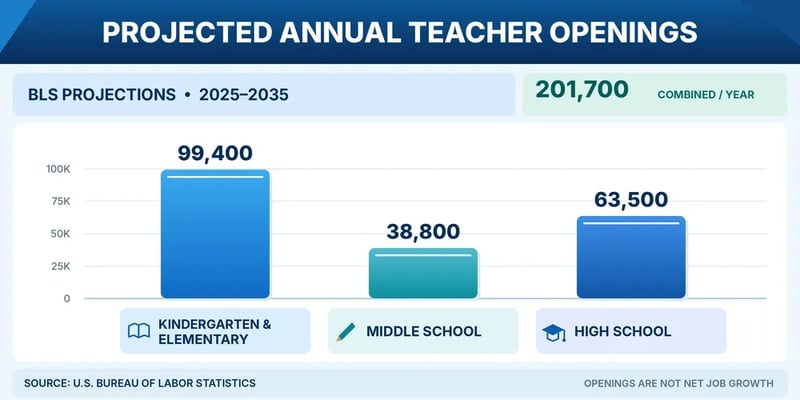
- BLS projects little or no change in teaching jobs through 2035, yet about 201,700 openings a year across elementary, middle, and high school.
- If you already hold a bachelor's in another subject, every state offers an alternative route to certification.
The Degree and the License Are Separate Steps
Earning the degree does not make you a licensed teacher on its own. The Bureau of Labor Statistics (BLS) notes that all states require public school teachers to be licensed or certified in the specific grade level they teach, and the typical path runs in this order:
- Finish a bachelor's degree through an approved teacher preparation program.
- Complete student teaching, which is a required part of licensure.
- Pass a background check.
- Pass a general teaching certification test and a test of subject knowledge.
- Apply to your state for a license in your grade level or subject.
Some states fold the two steps into one program. California, for example, offers four-year integrated programs that award both a bachelor's degree and a teaching credential, one of several routes described in the California Department of Education's guide to becoming a teacher.

Which Major Fits the Grade You Want to Teach?
The best bachelor's degree for teaching is the one that matches your grade level and your state's rules. Here is how the major usually lines up with the classroom, along with May 2025 median pay from BLS.
Grade level | Typical major | Median pay (May 2025) |
|---|---|---|
Kindergarten | Elementary education | $62,680 |
Elementary (grades 1 to 5 or 6) | Elementary education | $63,970 |
Middle school | A content area in many states; elementary education in others | $64,370 |
High school | A bachelor's tied to the subject you'll teach | $72,040 |
At the elementary level, BLS notes that some states also want a content-area major, such as mathematics, on top of elementary education coursework. In the middle grades, many states require a major in a content area such as math or history, so check your state's rule before you commit to a major.
What Is a Teaching Degree Called?
You'll see the same degree under several names: Bachelor of Education (B.Ed.), BA or BS in Education, or a BA or BS in a specific field such as elementary or secondary education. Some schools also attach the grade band to the title, such as "Elementary Education K-6." If you're more interested in education as a broad field of study, see Dreambound's bachelor's degree in education guide under Related Reading.
How Long Does It Take to Get a Teaching Degree?
Most teaching degrees take about four years of full-time study, while part-time study stretches that timeline. Programs that combine the degree and the credential, like California's integrated option, still fit inside four years.
Starting at a community college can also keep costs down. The California Department of Education lays out a route that begins at a community college, continues to a bachelor's degree at a California State University (CSU) or University of California (UC) campus, and then moves into the classroom with an intern credential. The department calls it the most economical option on its list.
Teaching Degree Requirements
Admission requirements vary by school, so check each program's list before you apply. Most teacher preparation programs start with your grades and the coursework you've already completed. Expect some combination of the following:
- A high school diploma or GED, plus transcripts from any college work
- A minimum GPA set by the program
- General education courses set by the program
- A background check, which states require before they issue a teaching license
Some programs admit you to the university first and to the teacher preparation program later, once you finish your early coursework.
Can You Become a Teacher Without a Teaching Degree?
Yes, if you already hold a bachelor's in another subject. BLS reports that all states offer an alternative route to certification for people who have a bachelor's degree but lack the required education courses.
These routes work in different ways. Some let you start teaching right away under the supervision of an experienced teacher while you finish your education coursework. Others ask you to complete education classes before you lead a classroom. In California, options include intern credentials that let you earn while you learn, as well as district and university residency programs.
You still need a bachelor's degree of some kind for a licensed public school position. The open question is whether that degree has to be in education.
Teaching Jobs: Flat Growth, Steady Openings
Teaching won't grow much over the next decade, but schools will keep hiring. BLS projects flat employment from 2025 to 2035 at every level, from kindergarten through high school. Openings still add up because teachers retire or change careers.
Teaching level | Jobs (2025) | Openings per year |
|---|---|---|
Kindergarten and elementary | 1,530,500 | About 99,400 |
Middle school | 630,100 | About 38,800 |
High school | 1,087,500 | About 63,500 |
That works out to roughly 201,700 openings a year across the three levels. Private schools usually don't require a state license, according to BLS, which gives non-licensure graduates another place to look.
Where to Compare Online Bachelor's Degrees in Teaching
An online teaching degree lets you take most coursework remotely, but student teaching still happens in a real school, usually one near where you live. For those looking into an online bachelor's degree in Teaching, the first question to settle is whether you need a licensure program. Dreambound is a website to consider, where you can compare online Teaching programs from accredited schools side by side.
Dreambound partners with accredited schools to list online Teaching degree programs you can fit around work and family.
Programs from these schools are listed on Dreambound:
Liberty University Online
Program:
- 8-week classes
- Transfer in up to 75% of an undergraduate degree
- Accredited
As a nonprofit, Liberty strives to keep costs low for students.
Colorado Christian University
Program:
Both programs are online and focus on kindergarten through sixth grade. Finishing the licensure version earns a university recommendation for licensure to the Colorado Department of Education, and graduates still need to meet state requirements such as content testing and background checks. The version without licensure has no student teaching but does require 160 hours of field work, and it targets schools that don't ask for a license, such as some private and international schools.
Arizona State University
Program:
ASU offers this elementary education program online. Its Dreambound page doesn't list licensure details.
Frequently Asked Questions
Is a BS or BA better for teaching?
Neither one is better for getting licensed. States care whether your program is an approved teacher preparation program for your grade level, not whether it ends in "Arts" or "Science."
What is the lowest degree to become a teacher?
For a licensed public school position, a bachelor's degree is the floor, since every state licenses public school teachers and licensure builds on a bachelor's. Substitute teaching and classroom support roles follow separate rules that vary by state.
Can you get a teaching degree online?
Yes. Many accredited schools offer online teaching degrees, but student teaching takes place in person at a school, and you'll still need to meet your state's licensing requirements.
Do private schools require a license?
Usually not. BLS notes that private schools typically don't require teachers to hold a state license, so each school sets its own hiring standards.
Mapping Your Route to a Teaching License
Work backward from the classroom you have in mind. Pick the grade level first, look up what your state requires for that license, and then choose a major and program that line up with it. If you already have a bachelor's, compare your state's alternative routes before you sign up for a second degree.
When you're ready to look at specific schools, start by checking which programs on Dreambound offer the licensure option your state expects.
Related Reading
These guides cover nearby teaching paths, from early learning to adult classrooms: