What Careers Can You Get With a Computer Science Degree?

See if you qualify for Computer Science programs
Answer a few questions in 2 minutes. Free, no commitment.
A computer science degree is one of the broader degrees you can hold when it comes to career flexibility. It leads to software development, data science, cybersecurity, IT management, game design, and product and project management roles rather than to a single job title. The degree teaches programming, algorithms, systems, and the math underneath them, and each career path draws on a different mix of those skills. Which path you land on depends more on the electives, internships, and projects you choose than on the degree name itself. Two of the titles cause the most confusion, developer and video game designer, because each hides a different job behind a familiar word.
Key Points
- A computer science degree can lead to careers in software development, data science, cybersecurity, IT management, game design, and more.
- "Developer" is a broad title covering many specializations, from web to mobile to backend systems.
- Video game designers focus on gameplay and design logic, distinct from the programmers who build the game.
- Career fit often depends more on chosen specialization and electives than on the degree title alone.

What Careers Can You Get With a Computer Science Degree?
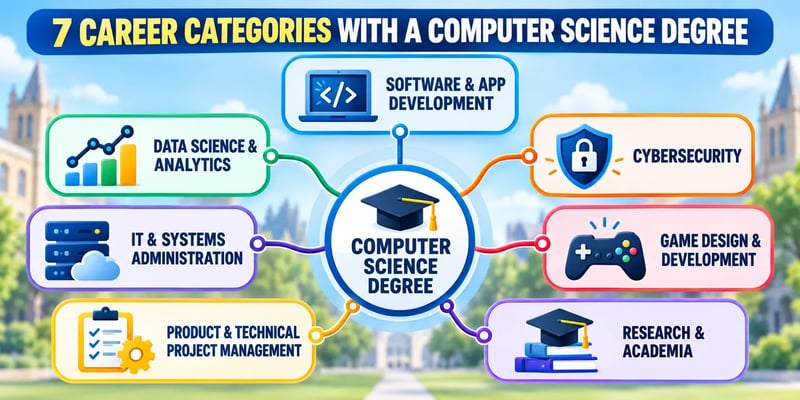
A computer science degree supports seven main career categories. The first six open at the bachelor's level, and the seventh usually starts with graduate study.
- Software and application development: software developers, web and mobile developers, and DevOps engineers, who build, test, and maintain the applications and release systems a company runs on.
- Data science and analytics: data analysts, data scientists, and machine learning engineers, who turn raw data into reports, forecasts, and models.
- Cybersecurity and information security: information security analysts, penetration testers, and security engineers, who defend networks and software and respond when something gets through. The path is mapped in becoming a cybersecurity specialist.
- IT and systems administration or management: network and systems administrators, cloud administrators, and IT managers, who keep servers, networks, and accounts running for everyone else.
- Game design and development: video game designers, game programmers, and technical artists, who decide how a game plays and then build it.
- Product and technical project management: product managers and technical project managers, who decide what gets built and keep engineering teams on schedule. The technical project manager path suits people who can read code without writing it daily.
- Research and academia: computer and information research scientists and university faculty, roles that typically require a master's degree or a doctorate.
The reason one degree feeds seven categories is written into the curriculum itself. The CS2023 guidelines from ACM, the IEEE Computer Society, and AAAI define seventeen knowledge areas and let programs select the knowledge areas on which to focus, so two graduates with the same degree title can leave with different competency areas. The same guidelines raised the math and statistics requirements across the curriculum, which is why the degree feels math-heavy to students who expected only coding. Your electives, internships, and personal projects decide which category you enter, and the four-year picture is in the guide to a bachelor's degree in computer science.
What Does a Software Developer Do?
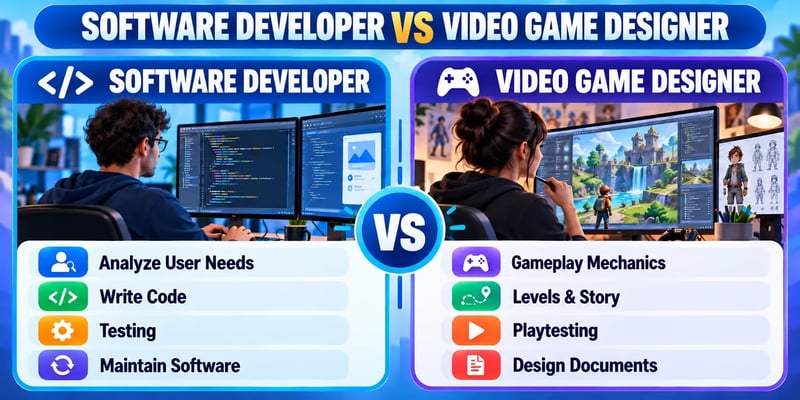
A software developer analyzes what users need, designs software to meet that need, writes and tests the code, and then maintains and improves it after release. O*NET's task list for software developers opens with analyzing user needs and requirements to judge whether a design is feasible within time and cost limits. It then moves through directing testing and documentation, conferring with analysts and engineers, and modifying existing software to fix errors or adapt it to new hardware.
On a normal day that looks like a few hours of focused coding, a code review for a teammate, a bug that came in overnight, and a meeting with a designer or product manager about what ships next.
The single title hides four common specializations. Front-end developers build the screens and interactions people see, usually in HTML, CSS, and a JavaScript framework. Back-end developers build the servers, databases, and APIs those screens talk to. Full-stack developers cover both ends, often where one person owns a feature from database to screen. Mobile developers build iOS and Android apps, with their own languages, store rules, and device limits.
The title also overlaps with others you will see on postings. O*NET lists Software Engineer, Application Developer, DevOps Engineer, and Software Architect as reported titles within the same occupation, and 85% of the developers it surveyed reported a bachelor's degree as the requirement. The honest trade-offs of the role are laid out in software developer pros and cons, and if you are weighing a shorter route into the same work, the question of whether coding bootcamps are worth it compares the two paths.
What Does a Video Game Designer Do?
A video game designer decides what a game is and how it plays: the mechanics, rules, levels, story lines, and characters. A game developer, also called a game programmer, writes the code that makes those decisions run on a console, PC, or phone. O*NET treats video game designers as their own occupation, defined as designing the main features of a game, including game and role-play mechanics, story lines, and character biographies.
The task list reads like a designer's week. Devise the missions, challenges, and puzzles a player will meet. Balance and adjust gameplay so the game is neither too easy nor too punishing. Build and maintain the design documents, with mock-up screenshots and sample menu layouts, that artists and engineers work from. Run design reviews, collect feedback from the technical staff, and fold it back into the design. Manage prototyping goals and production schedules. Playtesting runs through all of it, because a mechanic that reads well on paper often plays badly until it is tuned.
The computer science degree earns its place on the design side when the designer can script. Scripting a mechanic directly in an engine such as Unity or Unreal, reading playtest data, and knowing why a system is expensive to build are design work that a coding background makes faster. Reported titles include level designer, world designer, and design director, and the education picture is wider than for developers: 55% of the designers O*NET surveyed reported a bachelor's degree as the requirement, 15% a high school diploma, and 10% less than high school.
How to Choose the Right Computer Science Career Path
The fastest way to choose is to test paths before you commit to one. Take an elective or an internship in two or three categories during the degree, since one security course and one data course will tell you more than any job title can.
Pay attention to how you like to work, because the categories differ more in work style than in subject. Developers spend long, quiet blocks solving one problem. Designers live in feedback loops with artists, engineers, and playtesters. Product and project managers spend the day in meetings making decisions other people carry out. If one of those descriptions tires you out on the page, that is useful information.
Then read entry-level postings for the titles you are considering, because a posting shows what the title asks for day to day. On October 2, 2026, Indeed listed 132,571 jobs mentioning a computer science degree, and the first page shows which skills each title repeats.
The job market is the honest part of this decision. The Federal Reserve Bank of New York's outcomes by major put computer science graduates aged 22 to 27 at a 7.0% unemployment rate in 2024, above the 5.6% rate for recent graduates overall. Early-career wages for the major still sat among the highest in the same table. Specialization is how you answer that number: a security concentration plus a security internship matches a security posting line for line, and a general transcript with no projects matches nothing specific. Line up computer science degree programs on Dreambound to see which concentration each one builds in before you choose.
Computer Science Degree Programs on Dreambound
Dreambound puts partner schools' degree and certificate listings side by side, so you can weigh a software engineering concentration against a game design one before you apply.
BS Computer Science with concentration in Software Engineering - Southern New Hampshire University
- Format: Online
- Six 8-week terms per year, with up to 90 transfer credits accepted toward the degree
- Courses may include UI/UX Design and Development, Secure Coding and Software Reverse Engineering
Bachelor of Science in Computer Science - Cybersecurity Engineering - Colorado Technical University
- Format: Online
- 5-week class format
- Covers analyzing processes and constructing software security solutions
Computer Science Bachelors with AI Concentration - Full Sail University Online
- Format: Online
- Completion program in which students also complete the Computer Science Associate of Science degree
- Covers machine learning, deep learning, natural language processing, computer vision, and human-AI interaction
Interactive Technology Bachelors with Game Design Concentration - Full Sail University Online
- Format: Online
- Game design and production courses aimed at game studio work
- Coursework in game mechanics, game systems integration, and game balancing
B.S. - Computer Science - Colorado Christian University
- Format: Online
- Programming and higher mathematics coursework
- Includes a biblical worldview component
Associate of Applied Science in Computer Science Management - Southern Careers Institute Online
- Format: Online, with flexible scheduling options
- Programming fundamentals, database management, system analysis, and project development
- Financial aid is available for those who qualify
Frequently Asked Questions
Do all computer science careers require heavy coding?
No. Software development and game programming are code-heavy, but product management, technical project management, IT administration, security analysis, and technical writing use a computer science background to read systems and make decisions rather than to write code all day. The degree is the shared language; the daily coding load depends on the role.
What's the difference between a developer and a software engineer?
In U.S. labor data there is no difference. O*NET lists Software Engineer, Application Developer, DevOps Engineer, and Software Architect as reported titles within the single occupation it calls Software Developers. The title is a company convention rather than a separate credential, so compare the duties in two postings instead of the word in the headline.
Can you become a video game designer without a computer science degree?
Yes. In O*NET's survey of video game designers, 55% reported a bachelor's degree as the requirement, 15% a high school diploma, and 10% less than high school, a wider spread than the 85% bachelor's figure for software developers. Game design, art, and writing backgrounds also lead into the role; a computer science degree matters most when the designer scripts too.
What's the highest-paying career path with a computer science degree?
Research and senior engineering roles pay the most. BLS data for May 2025 puts computer and information research scientists at a median of $140,300, computer network architects at $134,050, and software developers, grouped with testing analysts, at $134,040. Research scientist roles typically require a master's degree, so the top of the pay table carries the longest education path.
Do you need a graduate degree for cybersecurity or data science roles?
Not for cybersecurity, and usually not for data science. BLS lists a bachelor's degree as the typical entry-level education for information security analysts, and some enter with a high school diploma plus certifications. Data scientists also typically start with a bachelor's, though some employers prefer a master's, and 44% of the data scientists O*NET surveyed reported a master's as the requirement.
Is a computer science degree still worth it?
For most paths, yes, with one condition. The degree still covers the widest set of technology careers, but New York Fed data for 2024 shows computer science graduates at 7.0% unemployment against 5.6% for recent graduates overall. The degree title alone does not match you to a posting; a concentration, an internship, and finished projects do. Compare concentrations across computer science programs on Dreambound before you commit.
Choosing a Direction With Your Computer Science Degree
A computer science degree is a starting point rather than a fixed path, and the two roles people ask about most prove it. A developer and a video game designer can hold the same degree, sit in the same studio, and spend their days on different work, one tuning code and the other tuning a mechanic.
The electives, internships, and projects you choose decide which category you enter, and the job market is the reason to decide early rather than late. Pick the path you tested, then compare computer science programs on Dreambound for the concentration that path needs.