How Much Do Dental Hygienists Make in Texas?
See if you qualify for training programs
Answer a few questions in 2 minutes. Free, no commitment.
Dental hygienists in Texas earn a median salary of $99,240 a year, or $47.71 an hour, according to Bureau of Labor Statistics wage data for May 2025. That puts Texas slightly above the national median of $98,100.
The figure moves with location, since the Austin metro pays a median above $105,000 while El Paso pays under $85,000. It moves even more with hours, because published salaries assume a full-time week in a field where part-time schedules are common. The sections below break the number down by percentile, city, and experience.
Key Points
- Texas dental hygienists earn a median of $99,240 a year, or $47.71 an hour, as of May 2025.
- The typical range runs from $71,530 at the 10th percentile, the entry-level end, to $117,890 at the 90th.
- Austin, Houston, and Dallas-Fort Worth are the highest paying Texas metros, each with a median above $101,000.
- Part-time work is common in dental hygiene, and because BLS annual figures assume a 2,080-hour year, the hourly rate is the number to compare.
Average Dental Hygienist Salary in Texas
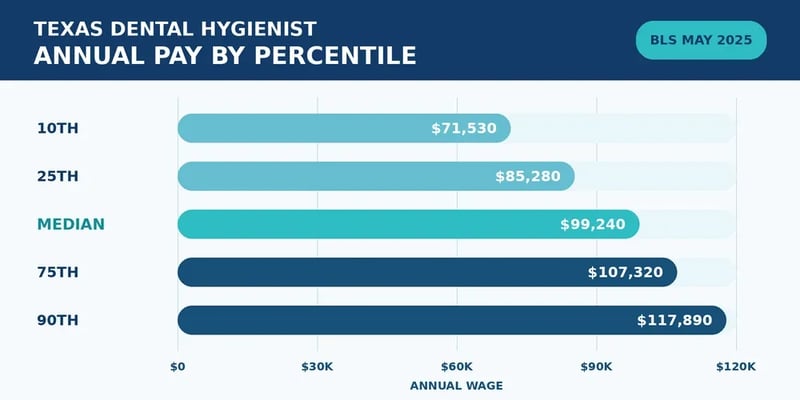
The BLS Occupational Employment and Wage Statistics program counted 16,380 dental hygienists in Texas in May 2025 and put their median pay at $99,240 a year. The mean was lower, at $96,240. The full percentile breakdown, with hourly rates in parentheses, looks like this:
- 10th percentile: $71,530 ($34.39 an hour)
- 25th percentile: $85,280 ($41.00 an hour)
- Median: $99,240 ($47.71 an hour)
- 75th percentile: $107,320 ($51.60 an hour)
- 90th percentile: $117,890 ($56.68 an hour)
Read as a monthly figure, the median works out to about $8,270 before taxes on a full-time schedule.
Job board averages differ from the BLS figure, and in this field they differ in both directions. Indeed's Texas salary page shows $48.68 an hour, an asking rate from job postings, while ZipRecruiter estimates $81,951 a year from active postings, more than $17,000 below the BLS median.
Neither is a survey of what employers actually pay, and both are skewed by the volume of part-time and per-diem postings in dental hygiene.
Texas vs. National Dental Hygienist Salary
Texas pays $1,140 more than the national median, or about 1.2%. The national median for dental hygienists was $98,100, or $47.16 an hour, in May 2025, against $99,240 and $47.71 in Texas. The state's range is narrower, though: the national 10th percentile was $74,880 and the 90th was $126,050, so Texas starts lower and tops out lower while its middle sits higher.
Take-home pay tilts the comparison a little further in Texas's favor. Texas is one of eight states with no individual income tax, per the Tax Foundation's state tax table, so a hygienist at the Texas median keeps the state income tax a hygienist in most other states would pay. The offset is real but modest.
Highest Paying Cities for Dental Hygienists in Texas
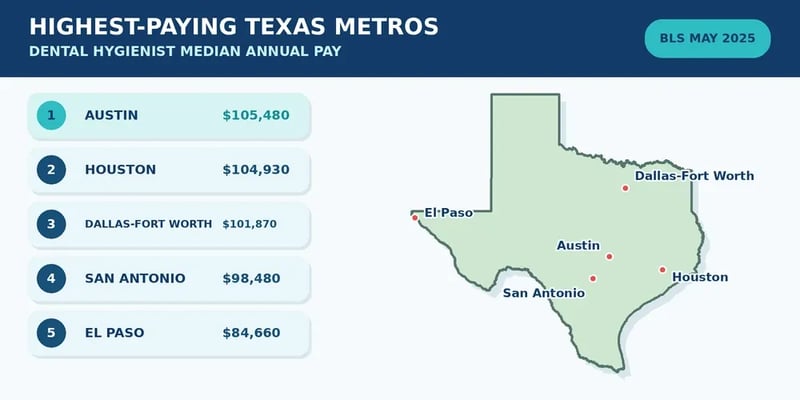
Austin is the highest paying metro in Texas for dental hygienists, followed by Houston and Dallas-Fort Worth, and the gap between the top and bottom of the state is more than $20,000 a year. The medians below are BLS metropolitan figures for May 2025.
Metro | Median annual wage |
|---|---|
Austin-Round Rock-San Marcos | $105,480 |
Houston-Pasadena-The Woodlands | $104,930 |
Dallas-Fort Worth-Arlington | $101,870 |
San Antonio-New Braunfels | $98,480 |
Killeen-Temple | $97,140 |
College Station-Bryan | $96,260 |
Lubbock | $86,340 |
El Paso | $84,660 |
McAllen-Edinburg-Mission | $82,940 |
Dallas-Fort Worth employs the most hygienists by a wide margin, 7,050 against 3,060 in Houston and 1,270 in Austin, even though it pays third. By the hour, a dental hygienist salary in Houston works out to about $50.45 at the median, Austin to $50.71, Dallas-Fort Worth to $48.98, and San Antonio to $47.34.
Along the border the picture is different: El Paso, McAllen, Brownsville, and Laredo all sit between $82,000 and $85,000.
What Affects a Dental Hygienist's Salary in Texas
Four things move a Texas hygienist's pay more than anything else, and only one of them is a credential.
Experience Level
BLS does not publish pay by years of experience, but the percentiles are the closest proxy. The 10th to 25th percentile band, $71,530 to $85,280, is the realistic starting range, the median of $99,240 is where an established hygienist lands, and the 90th percentile at $117,890 marks the top of clinical pay in the state.
Full-Time vs. Part-Time Work
Many dental hygienists work part time, and BLS notes that dentists may hire hygienists for only a few days a week, so some work for more than one dentist. That matters for reading the numbers, because BLS calculates annual wages by multiplying the hourly rate by a 2,080-hour year.
A Texas hygienist at the median $47.71 an hour earns about $59,540 a year on a three-day week and about $79,390 on four days, not $99,240. Compare offers by the hour and by the days on the schedule, not by the annual figure in the headline.
Practice Setting
Nationally, 94% of hygienists work in dentists' offices, which is also the best-paying setting BLS tracks: a median of $98,280 against $91,160 in physicians' offices and $80,830 in government roles. BLS does not break out specialty practices, so there is no official figure showing whether periodontics, orthodontics, or pediatric dentistry pays more than general practice in Texas.
Additional Credentials
Texas offers two credentials that expand what a hygienist can do. The local infiltration anesthesia certificate covers local infiltration anesthesia under a dentist's direct supervision after 12 clinical and 20 didactic hours of training, or a CODA-accredited program that includes it, plus a board-approved exam. The nitrous oxide monitoring certificate takes an 8-hour course with testing.
Neither comes with a published pay premium, but both widen the practices that can use you for the full scope of the role.
Do You Need a License to Work as a Dental Hygienist in Texas?
Yes. Unlike some allied health roles, dental hygiene is licensed in every state, and in Texas the Texas State Board of Dental Examiners issues the registered dental hygienist license. Licensure by examination requires graduation from a CODA-accredited dental hygiene program, the National Board Dental Hygiene Examination, and a clinical exam, with TSBDE currently accepting scores from ADEX and CRDTS-SRTA.
Applicants also complete the TSBDE jurisprudence assessment within a year of applying, a human trafficking prevention course required since October 2021, hands-on BLS CPR, and fingerprinting. The first license runs 18 to 30 months before renewal.
If you are still at the start of that path, Dreambound's dental hygienist prerequisites guide covers what programs ask for before you can apply, and the dental assistant vs. dental hygienist comparison covers the shorter route into a dental office.
How to Increase Your Dental Hygienist Salary in Texas
Each lever below traces back to the data above.
- Target the metros at the top of the table. The Austin median is $20,820 above El Paso's, and a move within the state changes pay more than almost anything else.
- Add days before you add credentials. On the BLS math, each extra day per week at the median rate is worth roughly $19,800 a year.
- Earn the local infiltration anesthesia and nitrous oxide monitoring certificates, which widen the practices that can hire you.
- Consider a specialty practice, especially periodontics, where scaling and root planing make up most of the schedule.
- Build seniority with one practice and negotiate against the percentiles, since the 25th to 75th percentile gap in Texas is $22,040 a year.
Job Outlook for Dental Hygienists in Texas
Texas projects 22% growth for dental hygienists from 2024 to 2034, from 15,550 jobs to 18,950, with about 1,370 openings a year, according to the state projections compiled by Projections Central. Nationally, BLS projects 8% growth from 2025 to 2035 and about 15,000 openings a year, so the Texas rate is close to three times the national one.
The two projections use different base years, which is why the 15,550 Texas job count sits below the 16,380 hygienists BLS counted in May 2025.
Frequently Asked Questions
What is the average dental hygienist salary in Texas?
The median dental hygienist salary in Texas is $99,240 a year, or $47.71 an hour, per BLS data for May 2025, and the mean is $96,240. Half of Texas hygienists earn between $85,280 and $107,320. Job boards quote different figures because they use asking rates from postings, not employer-reported wages.
Do part-time dental hygienists in Texas get paid hourly?
Yes. Employers report part-time hygienists' pay to BLS as hourly rates, and Texas job postings quote hourly figures too. The Texas median of $47.71 an hour is the useful comparison figure, since a three-day week at that rate comes to about $59,540 a year rather than the $99,240 full-time equivalent.
Who gets paid more, an RN or a dental hygienist in Texas?
Dental hygienists, at the median. Texas hygienists earned $99,240 in May 2025 against $95,970 for Texas registered nurses, a $3,270 edge. RNs have the higher ceiling, with a 90th percentile of $127,950 versus $117,890 for hygienists, so the answer flips at the top of the scale.
Can I live off being a dental hygienist in Texas?
Yes on a full-time schedule. The Texas median comes to about $8,270 a month before taxes, with no state income tax taken out, and even the 10th percentile is $71,530 a year. The caveat is hours, since a three-day week at the same hourly rate comes to about $59,540.
How long does it take to become a dental hygienist in TX?
About three years, which is the timeline BLS gives for dental hygiene programs once prerequisites are counted, followed by the NBDHE, an ADEX or CRDTS-SRTA clinical exam, and the TSBDE license application with its jurisprudence assessment and fingerprinting. Most programs award an associate degree.
What Moves Dental Hygienist Pay in Texas
Texas dental hygienist pay is competitive: a $99,240 median that sits above the national figure and above what Texas registered nurses earn, with 22% projected growth behind it.
The number that matters most, though, is not the annual median but the hourly rate multiplied by the days you actually work. Experience, metro area, and full-time versus part-time status move a Texas hygienist's pay more than anything else, and the hourly figure is what lets you compare an Austin offer against an El Paso one on equal terms.