Easiest Nursing Jobs: 8 Low-Stress Roles and Their Trade-Offs

See if you qualify for training programs
Answer a few questions in 2 minutes. Free, no commitment.
The easiest nursing jobs are usually away from hospital units that run around the clock. They include school nursing, clinic and physician's office nursing, telephone triage, case management, teaching, informatics, public health, and occupational health.
Many of these low-stress nursing jobs share a schedule advantage. The Bureau of Labor Statistics (BLS) says nurses in offices, schools, and other places without 24-hour care are more likely to work regular business hours. The pace is different, too, and O*NET data show that 19% of nursing instructors face strict deadlines every day, against 76% of acute care nurses.
The catch is that school and clinic nursing pay less than hospital work, and several of these roles ask for RN experience before you can certify.
Key Points
- No official ranking of easy nursing jobs exists, so schedule, pace, patient acuity, and physical load are what separate them.
- Nurses in offices and schools are more likely to work regular business hours than hospital nurses, who usually work shifts (BLS).
- In 2022, 46% of U.S. health workers reported feeling burned out often or very often, up from 32% in 2018 (CDC).
- Hospital nurses who left a job had about twice the odds of naming burnout as the reason, compared with clinic nurses (JAMA Network Open, 2021).
- RNs in schools and colleges earn the lowest median of the main RN settings, $78,620, while government jobs, which include federal hospitals, pay $110,780 (BLS, May 2025).

What Makes a Nursing Job Easier?
No agency publishes a list of the least stressful nursing jobs, even though burnout is common. A CDC Vital Signs report found that 46% of health workers, not only nurses, felt burned out often or very often in 2022. Four factors explain why some nursing work feels easier than the rest, and each one has public data behind it:
- Schedules are steadier away from 24-hour care. Hospital and nursing care facility nurses usually work shifts that can include nights, weekends, holidays, and on-call time. Nurses in offices and schools are more likely to work regular business hours, according to BLS work environment data.
- Pace is about time pressure, which O*NET measures as how often a job requires meeting strict deadlines.
- Patient acuity and aggression shape the emotional load, from how sick patients are to how often the work involves violent or physically aggressive people.
- Physical load adds up, since BLS notes that RNs may spend a lot of time walking, bending, stretching, and standing and are vulnerable to back injuries from lifting and moving patients.
Comparing less stressful nursing jobs on these factors works better than relying on anyone's personal ranking. O*NET's 2026 work data show how far apart nursing roles sit on pace and aggression.
How nursing roles compare on stress factors (O*NET OnLine, 2026 data):
Occupation | Meet strict deadlines every day | Aggressive-people score (0 to 100) |
|---|---|---|
Acute care nurses | 76% | 62 |
Critical care nurses | 64% | 57 |
Registered nurses (all) | 42% | 41 |
LPNs and LVNs | 67% | 47 |
Medical and health services managers | 32% | 28 |
Nursing instructors (postsecondary) | 19% | 27 |
O*NET scores contact with aggressive people from 0 for never to 100 for every day, and a score of 50 means about once a month.
Schedules add another angle. In O*NET's surveys, 91% of nursing instructors and LPNs describe their schedules as regular, compared with 87% of RNs overall and 76% of acute care nurses. Regular here means an established routine, not daytime hours.
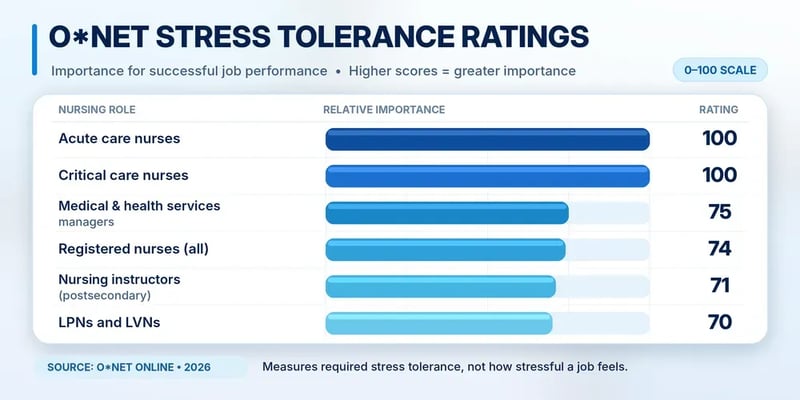
O*NET also rates how much stress tolerance helps job performance on a 0 to 100 scale. Acute care and critical care nurses score 100, while managers score 75, RNs overall 74, nursing instructors 71, and LPNs 70. Easier does not always mean shorter weeks, though. Nursing instructors face the least daily deadline pressure on the list, yet 78% of them work more than 40 hours a week.
8 Easiest Nursing Jobs (Low-Stress Roles)
These easy nursing jobs share one thing, which is distance from hands-on care at a hospital bedside. Most of them are easy RN jobs, and clinic or physician's office nursing is open to LPNs as well.
The numbering is only for reference, not a ranking, and certification details reflect each board's rules as of October 2026. For the certification rules behind the case management, informatics, and occupational health roles, our guide to nursing jobs away from the bedside goes further.
Low-stress nursing jobs compared:
Role | Why it is lower-stress | BLS pay reference (May 2025) |
|---|---|---|
School nurse | Mostly healthy students and a school-day schedule | $78,620 (RNs in educational services) |
Clinic or physician's office nurse | Scheduled visits and regular business hours | $91,230 (RNs in ambulatory care), $59,520 (LPNs in physicians' offices) |
Telephone triage or telehealth nurse | No lifting, with assessment by phone or video | $91,230 (RNs in ambulatory care) |
Case management nurse | Care coordination, often by phone | Not published by BLS |
Nurse educator | Teaching instead of patient care | $80,250 (nursing instructors) |
Nursing informatics specialist | Little or no direct patient care | Not published by BLS |
Public health nurse | Prevention and education in the community | Not published by BLS |
Occupational health nurse | Mostly healthy adult workers | Not published by BLS |
1. School Nurse
A school nurse's patients are mostly healthy children and teens, and the work centers on health plans, medications, and the students who come to the health office sick or hurt. The schedule is the big difference from a hospital unit, since BLS lists schools among places more likely to keep regular business hours.
Board certification can come later. The National Certified School Nurse credential (NCSN) looks for an RN license, a bachelor's in nursing or a qualifying master's, and 1,000 school nursing hours within 3 years. The trade-off is pay, since RNs in educational services earn a median of $78,620, the lowest of the main RN settings.
2. Clinic or Physician's Office Nurse
Clinic and physician's office nurses work through scheduled visits, giving injections, checking symptoms, and teaching patients how to manage their care. BLS reports a $91,230 median for RNs in ambulatory healthcare services, and 11% of LPNs work in physicians' offices, where their median is $59,520 (May 2025).
Clinic settings also fare better in burnout research. In a 2021 JAMA Network Open study of the 2018 national RN survey, hospital nurses who had left a job had about twice the odds of citing burnout as clinic nurses. The trade-off is pay, since the ambulatory median sits below the $100,220 hospital median.
3. Telephone Triage or Telehealth Nurse
Telephone triage and telehealth nurses decide, from a conversation, how urgently someone needs care and where to send them, so the job involves no lifting. As a pay reference, BLS reports a $91,230 median for RNs in ambulatory care.
The closest match among certifications is ANCC's ambulatory care certification (AMB-BC), which requires 2 years as an RN, 2,000 ambulatory care hours in 3 years, and 30 continuing education hours. Its test outline that took effect September 11, 2026, includes virtual and telehealth triage. The trade-off is steady call volume and decisions made without seeing the patient in person.
4. Case Management Nurse
Case management nurses coordinate care plans, discharges, and insurance coverage, often by phone, so most of the job happens away from hands-on care. BLS has no wage category for case managers, so compare the pay ranges in job postings.
The trade-off is experience, since ANCC's CMGT-BC requires 2 years as an RN. It also closes to new applicants after December 31, 2026, which leaves the Board-Certified Case Manager (CCM) credential as the main alternative.
5. Nurse Educator
Teaching replaces patient care in this role, whether you lead classes in a nursing program or run staff development for a hospital. For nursing instructors in schools and colleges, that difference shows up in the O*NET table above. They have the lowest daily deadline pressure and the lowest aggressive-people score of any occupation listed.
Postsecondary nursing instructors earn a median of $80,250 a year, according to BLS (May 2025). The trade-offs are the long weeks noted above and more school, since the Certified Nurse Educator (CNE) credential requires a master's or doctorate in nursing.
6. Nursing Informatics Specialist
Nursing informatics specialists work on the electronic health record and other clinical systems instead of working directly with patients. Pay is harder to benchmark, because BLS has no separate wage category for informatics nurses.
The trade-off is the path in. ANCC's informatics certification (NI-BC) requires a bachelor's in nursing, 2 years as an RN, 30 hours of informatics continuing education, and informatics practice hours or graduate study.
7. Public Health Nurse
Public health work is mostly prevention. Nurses in state and local health departments run screenings, immunization clinics, and health education rather than acute care. BLS notes that they may also travel to community centers, schools, and other sites. That travel is the main trade-off if you want one fixed workplace.
For pay, the posted range from each health department is the number to trust. BLS has no public health nurse category, and its $110,780 government RN median mixes in federal hospital jobs.
8. Occupational Health Nurse
Occupational health nurses look after an employer's workforce rather than hospital patients, treating on-the-job injuries and running screenings for mostly healthy adults. No BLS wage exists for this title either, so posted pay ranges are the place to compare.
The trade-off is the climb to certification, since the American Board for Occupational Health Nurses' COHN credential asks for 3,000 hours of occupational health nursing in the previous 5 years.
Easiest Nursing Specialties in the Hospital
No study ranks hospital units by ease, but nurses looking for the easiest nursing specialties in the hospital usually point to scheduled or recovery-focused units. In nursing forums, they most often name the post-anesthesia care unit (PACU), outpatient surgery, endoscopy, and postpartum when asked what the easiest nursing job in a hospital is.
The data show where stress concentrates instead. O*NET gives acute care and critical care nurses its maximum Stress Tolerance rating of 100, a score only 19 of 891 occupations share, including air traffic controllers, firefighters, and paramedics.
Burnout research adds detail. A 2025 umbrella review in BMC Nursing pooled 14 earlier reviews of nurses worldwide. In those reviews, depersonalization reached 36% among emergency nurses and 15% among primary care nurses, and ICU nurses had the highest rate of low personal accomplishment, at 46%.
Those figures are international averages, not a ranking of the least stressful nursing specialties. Nurses in those forum threads also repeat a caveat, which is that staffing and unit culture can matter as much as the specialty itself.
Do Easy Nursing Jobs Pay Well?
Among the easiest nursing jobs that pay well, clinic and other outpatient nursing comes closest in BLS data. RNs in ambulatory healthcare services, which include physicians' offices, outpatient care centers, and home health, earn a median of $91,230. That is still below the $97,550 median for all RNs, which fits the broader pattern of calmer settings paying less than hospitals.
Easy nursing jobs that pay well? RN pay by setting, May 2025:
Setting | Median RN pay (May 2025) | Typical schedule |
|---|---|---|
Government, including federal hospitals | $110,780 | Varies by agency |
Hospitals | $100,220 | Usually shifts, including nights and weekends |
Clinics, offices, and other ambulatory care | $91,230 | Offices more likely to keep business hours |
Nursing and residential care | $84,300 | Usually shifts |
Schools and colleges | $78,620 | More likely to keep business hours |
The government figure looks attractive, but it includes nurses at VA medical centers and other federal hospitals, so it says more about the employer than about easier work. Nurse managers sit in a higher-paid BLS group, medical and health services managers, with a $123,860 median, and our highest-paying nursing jobs guide compares them with advanced practice roles.
For low-stress nursing jobs that pay well, that makes clinic work the practical middle ground, while most other calmer roles trade some pay for a more predictable day.
Low-Stress Nursing Jobs for New Grads
Low-stress nursing jobs for new grads exist, but the list is shorter, because the certifications behind many calm roles require nursing experience first. ANCC's AMB-BC, NI-BC, and CMGT-BC each ask for 2 years as an RN, the NCSN asks for 1,000 school nursing hours, and the COHN asks for 3,000 occupational health hours.
The realistic starting points are clinic and physician's office roles, school nursing, and public health, since none of them needs board certification to start. Some states require a school or public health nurse credential, so check state rules and each posting.
Starting somewhere sustainable matters, too. In NCSBN's 2024 National Nursing Workforce Study, 39.9% of RNs and 41.3% of LPNs and LVNs said they intend to leave the workforce or retire within 5 years. Among those planning to leave, about 41.5% named stress and burnout as the root cause, aside from retirement.
Easiest to Do vs. Easiest to Get Into
The easiest nursing job to get into is not always the easiest one to do. The shortest path into licensed nursing is the LPN or LVN route, since practical nursing programs typically take about 1 year, according to BLS. Our guide on how to become an LPN covers the licensing steps.
The easiest jobs to do are the lower-stress roles above, and most of them need an RN license. Of the roles on this list, clinic and physician's office nursing is the clearest fit for LPNs. For a fuller timeline, see how long LPN training takes.
Frequently Asked Questions
What is the chillest nursing job?
It depends on what wears you down. The chill nursing jobs in O*NET's data are teaching and management roles, which face the least daily deadline pressure and the least aggression but often mean longer weeks. Among patient-care roles, school and clinic nursing come closest, since BLS says offices and schools are more likely to keep regular business hours.
What type of nurse does the least work?
It depends on how you measure work. By hours, LPNs and LVNs are less likely than RNs to work more than 40 hours a week, 15% against 25% in O*NET's data. By pace, nursing instructors face daily deadlines least often, at 19%, yet 78% of them work more than 40 hours.
Is psychiatric nursing low stress?
It can be, but nurses disagree. Two reviews of mental health nurses found emotional exhaustion of 25% and 28%, below the 31% reported for emergency and ICU nurses. Even so, nurses in forum discussions point to the risk of aggressive patients, and they say the unit and its staffing matter as much as the specialty itself.
Are LPN jobs less stressful than RN jobs?
It is mixed. O*NET rates stress tolerance as slightly less important to LPN work than to RN work, 70 against 74. Yet 67% of LPNs meet strict deadlines every day, compared with 42% of RNs. If you are weighing the LPN route, the pros and cons of LPN work cover the day-to-day trade-offs.
Can you be a nurse with anxiety?
Yes, and the setting can make a real difference. Roles with scheduled work and regular hours, such as clinic, school, and office-based nursing, follow a more predictable rhythm than units that run around the clock. If anxiety affects your daily life or your work, a licensed healthcare professional is the right person to help you weigh your options.
Choosing a Lower-Stress Nursing Path
Start by naming the part of the stress you most want to lose, whether that is the hours, the pace, the acuity of your patients, or the physical load. Then pick the role that removes it, and check what it pays and how much experience it asks for before you commit.
If a faster license is your starting point, compare LPN and RN programs on Dreambound to see which path fits the role you have in mind.
Related Topics
- How to Become a Registered Nurse: Step-by-Step RN Guide
- LPN vs RN (LVN vs RN): Key Differences in Scope, Pay, and Schooling
- Cheapest and Fastest LPN Programs
- 12 Best Jobs for Nursing Students (Pay and Training)