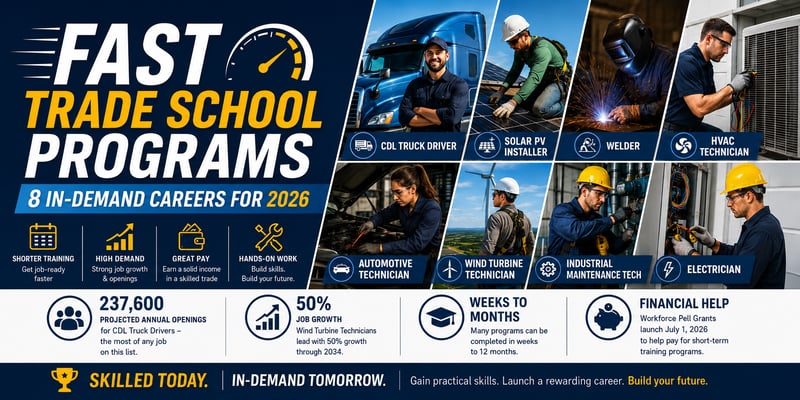
Fast Trade School Programs: 8 In-Demand Careers for 2026
See if you qualify for training programs
Answer a few questions in 2 minutes. Free, no commitment.
Fast trade school programs in 2026 range from 3-week CDL training to multi-year electrician apprenticeships, so "fast" means different things depending on the trade. Wind turbine technicians and solar PV installers lead all BLS occupation projections at 50% and 42% growth through 2034. CDL truck driving has the most projected annual openings at 237,600, followed by electricians at 81,000 and automotive technicians at 70,000. Some careers on this list are fast to enter and slow to master; others are slower to start but offer the strongest openings volume and long-term wages. Match the trade to the work first, then check what "fast" actually means in your state.
Key Points
- Fast trade school programs lead to certificates, diplomas, CDLs, or apprenticeship entry, all in less time than a four-year degree.
- Some careers are fast to start but slower to master; electrician training begins with a 4 to 12 month certificate but full state licensing usually requires a 4 to 5 year paid apprenticeship.
- Wind turbine technician and solar PV installer have the strongest BLS-projected growth rates on this list, at 50% and 42% through 2034.
- CDL truck driving has the most projected annual openings at 237,600, followed by electricians at 81,000 and automotive technicians at 70,000.
- Workforce Pell Grants are scheduled to launch July 1, 2026 and may help cover eligible 8 to 15 week training programs.
- Licensing, certification, and apprenticeship rules vary by state, so verify local requirements before enrolling.
What Counts as a Fast Trade School Program?
A fast trade school program is usually a certificate, diploma, CDL training program, or apprenticeship-entry route that takes less time than a traditional four-year degree. The program may help you build job-ready skills, but full qualification can still require state licensing, employer training, exams, or apprenticeship hours.
That distinction matters. Typical training timelines on this list:
- CDL truck driving: 3 to 7 weeks
- Solar PV installer: a few weeks to several months
- Welder: 4 to 12 months for a certificate
- HVACR: 6 months to 2 years
- Automotive service technician: 6 months to 2 years
- Wind turbine technician: 6 to 12 month certificate, often with on-the-job training afterward
- Industrial maintenance: at least 1 year of on-the-job training after high school
- Electrician: 4 to 12 month certificate, then a 4 to 5 year paid apprenticeship for full licensure
For this list, a career had to meet at least two of these filters:
- It can begin through trade school, technical school, CDL school, or an apprenticeship-entry route.
- BLS shows strong projected growth, high projected annual openings, or both.
- The work is a skilled trade, technical trade, transportation trade, or repair-focused career.
- The pathway does not usually require a bachelor's degree as the main entry route.
8 Fast Trade School Programs to Compare in 2026
The list is ordered roughly by time-to-first-job. CDL training is the fastest credential path here and has the highest projected openings. Solar and welding follow. Wind turbine and industrial maintenance sit in the middle. Electrician anchors the list because it has one of the longest training paths to full licensure despite the second-highest opening volume.
1. CDL Truck Driver
CDL truck driving is the fastest legitimate trade credential in the United States. Federally registered training providers run programs of 3 to 7 weeks, after which candidates take the CDL skills test under Federal Motor Carrier Safety Administration (FMCSA) standards.
BLS reports a median annual wage of $57,440 for heavy and tractor-trailer truck drivers in May 2024 and projects about 237,600 openings per year through 2034. Most of those openings come from replacement demand rather than net job growth, but 237,600 is still the highest projected openings figure of any occupation on this list by a wide margin.
The lifestyle realities matter as much as the credential. Long-haul drivers spend days or weeks away from home. Regional and local routes offer more home time but often lower base pay. Hazmat, tanker, and doubles/triples endorsements expand earnings but require additional testing.
- 237,600 projected annual openings, the highest on this list
- 3 to 7 week training, the shortest credential path here
- FMCSA regulates training under the Entry-Level Driver Training rule
- Endorsements expand pay and route options
2. Solar Photovoltaic Installer
Solar photovoltaic installer is BLS's #2 projected-growth occupation in the entire U.S. economy. BLS reports a median annual wage of $51,860 for solar photovoltaic installers in May 2024, with 42% projected employment growth from 2024 to 2034 and about 4,100 openings per year.
Solar PV installers assemble, install, and maintain solar panel systems on rooftops and other structures. Most employers provide on-the-job training, and short certificate programs at trade schools and community colleges range from a few weeks to several months. NABCEP PV Installation Professional certification is the benchmark credential. OSHA 10 or OSHA 30 safety training is a common employer expectation, especially for utility-scale and commercial roles.
- 42% projected growth through 2034
- 4,100 projected annual openings
- NABCEP and OSHA credentials are widely expected by employers
One program preparing students for this work: Solar Technician Diploma at Centura College Norfolk Campus is a 7-month in-person program that prepares students for NCCER Solar PV Installer, OSHA 30, and NABCEP Associate certifications.
3. Welder
Welding belongs on this list, but the growth picture is worth knowing up front. BLS reports a median annual wage of $51,000 for welders, cutters, solderers, and brazers in May 2024. Growth is projected at just 2% from 2024 to 2034, which is slower than the average for all occupations.
Despite the slow growth, BLS projects about 45,600 openings per year, driven largely by replacement demand as experienced welders retire. Programs typically run 4 to 12 months and teach MIG, TIG, stick, flux-core, blueprint reading, and safety practices. American Welding Society (AWS) certifications are the most widely accepted industry credential.
Honest trade-off: Welding has the slowest projected growth of any trade on this list, but openings volume is strong (45,600 per year) and cross-industry demand is real across manufacturing, construction, shipbuilding, and fabrication.
If this trade fits your goals, Welding at Southern Careers Institute Austin is a 27-week hybrid program (700 clock hours) covering general welding.
4. HVACR Technician
HVACR technicians install, maintain, and repair the heating, cooling, ventilation, and refrigeration systems that keep homes, schools, hospitals, and commercial buildings running. The work involves refrigerant handling under EPA Section 608 certification, electrical components, system testing, customer communication, and emergency repairs.
BLS reports a median annual wage of $59,810 for HVACR mechanics and installers in May 2024, with 8% projected growth from 2024 to 2034 and about 40,100 openings per year. State licensing rules vary, so confirm requirements in your state before choosing a program. HVACR program timelines commonly range from 6 months for a short certificate to 2 years for an associate degree.
- 8% projected growth, faster than the all-occupations average of 3%
- 40,100 projected annual openings
- EPA Section 608 certification required for refrigerant handling
- Year-round demand across residential, commercial, and refrigeration sectors
One Dreambound program for this trade: HVAC at Penn Foster is an online self-paced program covering refrigeration, electrical systems, and residential and light commercial HVACR. EPA certification exam cost is covered by tuition.
5. Automotive Service Technician
Automotive service technicians inspect, maintain, and repair cars and light trucks, increasingly using diagnostic tools tied to electric and hybrid systems, advanced driver-assistance systems, and emissions controls. BLS reports a median annual wage of $49,670 for automotive service technicians and mechanics in May 2024 and projects about 70,000 openings per year through 2034.
Training programs typically run 6 months to 2 years, and ASE (Automotive Service Excellence) certification is the most commonly preferred credential. Demand for technicians with EV and hybrid-system experience is rising, especially in metro areas with expanding electric vehicle adoption.
- 70,000 projected annual openings
- ASE certification is the most commonly preferred credential
- Rising demand for EV and hybrid-system technicians
An online option for this trade: Auto Repair Technician Career Diploma at Penn Foster is an online program that prepares students for ASE certification exams covering engine repair, automatic transmission and transaxle work, and other core ASE areas.
6. Wind Turbine Technician
Wind turbine technician is BLS's #1 projected-growth occupation in the entire U.S. economy. BLS reports a median annual wage of $62,580 for wind turbine technicians in May 2024 and projects 50% employment growth from 2024 to 2034. The catch is volume: only about 2,300 openings per year, since the field is still small in absolute terms.
Wind technicians inspect, maintain, and repair turbines, which often means climbing 200+ foot towers, working in variable weather, troubleshooting mechanical, electrical, and hydraulic systems, and traveling across remote job sites. BLS classifies the entry path as postsecondary nondegree award plus long-term on-the-job training. Certificate programs commonly run 6 to 12 months, with associate degrees taking about two years. GWO Basic Safety Training is a frequent employer expectation.
- 50% projected growth, the fastest of any U.S. occupation
- 2,300 projected annual openings (small absolute volume)
- Strong wage for a sub-2-year training path
- Comfort with heights, weather, and travel is part of the work
If wind turbine work fits your goals, Wind Turbine Technician Diploma at Centura College Norfolk Campus is a 12-month in-person program with day or evening course schedules.
7. Industrial Maintenance Technician
Industrial maintenance has the highest median annual wage on this list. BLS groups this work under industrial machinery mechanics, machinery maintenance workers, and millwrights, and reports a median annual wage of $63,510 for industrial machinery mechanics and maintenance workers in May 2024, with 13% projected growth from 2024 to 2034 and about 54,200 openings per year.
These workers install, maintain, and repair the factory equipment that runs manufacturing plants, power facilities, and large warehouses. The training path is honest about its length: BLS notes that industrial machinery mechanics and maintenance workers usually need at least a year of on-the-job training after high school. Most millwrights complete a multi-year apprenticeship.
Best fit for: Students who want mechanical troubleshooting, factory and plant work, and the highest wage on this list. The trade-off is a longer training timeline before full proficiency.
8. Electrician
Electrician is the longest path on this list, but the openings volume is second only to CDL truck driving. BLS reports a median annual wage of $62,350 for electricians in May 2024, with 9% projected growth from 2024 to 2034 and about 81,000 openings per year.
A 4 to 12 month certificate program builds foundational skills, but full state journeyman licensing typically requires a 4 to 5 year paid apprenticeship that combines classroom hours and on-the-job training. Demand pressure from data center construction, EV charging infrastructure, and grid modernization is driving the strongest electrician hiring market in decades.
- 81,000 projected annual openings, second-highest on this list
- 9% projected growth, three times the all-occupations average
- 4 to 5 year apprenticeship is the standard path to full licensure
- Strong long-term wage and specialization potential
A Dreambound program for this path: Electrical Technician Certificate at Houston Career Institute is a 42-week in-person program that prepares students for the State of Texas Electrical Trainee (ET) certification.
How to Choose the Right Fast Trade School Program
The right fast trade school program isn't always the shortest one. Compare speed, openings, pay, licensing steps, and how well the work fits your daily life.
Start with the Work, Not the Credential
Before comparing programs, look at three to five entry-level job postings in your area for each trade you're considering. Notice what the daily routine actually looks like, what hours are involved, how much travel is required, and which credentials show up in the requirements.
A simple way to narrow your target:
- For the fastest credential path, look at CDL truck driving.
- For clean-energy fieldwork with the strongest projected growth, look at solar or wind.
- For classic repair and installation trades, look at HVACR or electrical.
- For shop-based vehicle work or factory mechanical work, look at automotive or industrial maintenance.
- For metalwork that applies across multiple industries, look at welding.
Compare the True Cost of Training
Tuition alone rarely tells you what a program actually costs. Before signing, confirm:
- Total tuition, fees, and any required textbooks or course materials
- Tools, uniforms, safety gear, and testing fees
- Whether an exam voucher is included or charged separately
- Hands-on lab time, externships, and supervised hours
- Whether financial aid, payment plans, employer reimbursement, or workforce funding may apply
A lower upfront price isn't always better. A program that costs more but includes labs, exam vouchers, instructor support, and career services often produces stronger outcomes than a cheap self-study option.
Verify State Licensing and Certification Rules
For licensed trades, state rules often matter more than program length. HVACR, electrical work, CDL driving, and some specialty welding work may require state exams, apprenticeship hours, or registration beyond program completion. Solar PV installer roles often expect NABCEP and OSHA credentials even where no state license is required.
A training program can prepare you for these requirements, but it doesn't replace state exams, licenses, or employer credentials. Verify what your target state and employer actually require before you enroll.
Compare Hands-On Training and Career Support
Strong trade programs offer enough lab and field time that you can describe specific skills in an interview. They also offer career services: resume help, externships, employer connections, or placement assistance.
Compare a few programs side by side. Differences in lab access, instructor experience, and career services often matter more than small differences in tuition.
Paying for a Fast Trade School Program in 2026
Fast trade school programs vary widely in cost. Some students pay out of pocket. Others use payment plans, employer tuition support, state workforce funding (including WIOA), scholarships, or federal financial aid where eligible.
A 2026 update worth tracking is Workforce Pell. On March 6, 2026, the U.S. Department of Education issued proposed rules for Workforce Pell under the Working Families Tax Cuts Act. Starting July 1, 2026, students may be able to use Pell Grant funds for eligible workforce programs of 150 to 599 clock hours that can be completed in 8 to 15 weeks. Programs must be approved by the state governor after consultation with the workforce board, and must meet completion and job placement benchmarks.
Eligibility is still being finalized at the state level. Students should not assume every short program will qualify, and the rollout may extend into the 2026-27 academic year as states certify their first batches of eligible programs.
When comparing cost, don't look only at tuition. Ask what's included and what's separate. Tools, safety equipment, books, exam fees, drug testing, background checks, transportation, and licensing costs can change the real price of training. The better question often isn't "what's the cheapest program?" It's "which program has the right training, schedule, cost, and licensing prep for the trade I want?"
Dreambound is a free platform that helps you compare trade school programs across the United States. Filter programs by the certification each one prepares you for and the time commitment that fits your schedule.
More Programs on Dreambound
Dreambound's broader catalog includes additional programs across welding, HVACR, electrical work, and automotive service, plus options for CDL truck driving and industrial maintenance, which aren't featured in the career entries above. Confirm current tuition, format, length, certification preparation, and any in-person requirements on each program page before applying.
Welding Programs
- Maritime Welding at Advanced Technology Institute (Virginia Beach, VA), a shipyard and structural pipe welding focus
- Underwater Welding at The Ocean Corporation (Houston, TX), a commercial diving and underwater welding specialty
- Combination Welding at Centura College Newport News (Newport News, VA)
HVACR Programs
- Commercial HVAC at Houston Career Institute (Houston, TX), with a commercial refrigeration focus
- HVAC and Refrigeration Associate Degree at Advanced Technology Institute (Virginia Beach, VA)
- HVAC at Centura College Newport News (Newport News, VA)
- Refrigeration and HVAC at IntelliTec College Colorado Springs (Colorado Springs, CO)
- HVAC at Northbridge University Tampa (Tampa, FL)
Electrician Programs
- Residential Electrician at Penn Foster, an online self-paced option
- Construction Electrician at Centura College Norfolk (Norfolk, VA), with a construction focus
- Electrical Technology at San Joaquin Valley College Fresno (Fresno, CA)
- Electrical Diploma at Northbridge University Orlando (Orlando, FL)
- Spanish-Language Electrical Diploma at Northbridge University Kissimmee (Kissimmee, FL)
Automotive Programs
- Automotive Technology Diploma at Advanced Technology Institute (Virginia Beach, VA)
- Automotive Technician at IntelliTec College Albuquerque (Albuquerque, NM)
- Diesel Mechanics and Heavy Truck Maintenance at Penn Foster, a heavy-vehicle and large-engine specialty
- Automotive Technology Certificate at Institute for Business and Technology
Frequently Asked Questions
What is the fastest trade career?
CDL truck driving is the fastest trade career on this list. Federally registered CDL training programs run 3 to 7 weeks, after which candidates take the CDL skills test. Solar photovoltaic installer training can also be completed in weeks to a few months. Welding certificates typically run 4 to 12 months. HVACR and automotive technician programs range from 6 months to 2 years. Electrician training begins with a 4 to 12 month certificate, but full state licensing usually requires a 4 to 5 year paid apprenticeship.
What trade has the most job openings in 2026?
Tractor-trailer truck driving has the most projected annual openings on this list, with BLS projecting about 237,600 openings per year from 2024 to 2034. Electricians follow with about 81,000. Automotive service technicians have about 70,000. Industrial machinery mechanics, maintenance workers, and millwrights have about 54,200. Welders have about 45,600. HVACR technicians have about 40,100. Wind and solar lead on growth rate but have smaller absolute volumes at 2,300 and 4,100 per year, respectively.
What is the highest-paying fast trade school program?
Among the careers on this list, industrial maintenance has the highest median annual wage at $63,510 in May 2024, followed closely by wind turbine technician at $62,580 and electrician at $62,350. HVACR technicians earn $59,810. CDL truck drivers earn $57,440. Solar PV installers earn $51,860. Welders earn $51,000. Automotive service technicians earn $49,670. Wages vary significantly by state, employer, experience level, and specialty.
How much does a fast trade school program cost?
Fast trade school program costs vary widely by trade, school type, and credential. Short certificate programs may run from a few thousand dollars to around $15,000. Diploma and associate degree programs often run higher, depending on the institution and length. Aside from tuition, plan for tools, books, safety gear, exam fees, background checks, and licensing costs that may not be included. Starting July 1, 2026, eligible students may also be able to use Workforce Pell Grants for qualifying 8 to 15 week training programs at Title IV-eligible institutions.
Picking the Trade That Matches Your Goals
Speed without fit is just a faster way to land in the wrong career. The right fast trade school program is the one whose openings, wages, training depth, and daily work realities line up with what you want from a first job, and whose licensing path you can actually complete in your state.
Compare programs on Dreambound by trade, format, length, and certification preparation.