Google IT Support Certificate vs. CompTIA A+: Which Should You Get First?
See if you qualify for IT Support programs
Answer a few questions in 2 minutes. Free, no commitment.
Most beginners are better served starting with the Google IT Support Professional Certificate, then adding CompTIA A+ afterward if they are targeting employers that specifically list it. Google sets no prerequisites and costs about $147 to $294, against $548 in A+ exam fees. Which one is better for you comes down to three things: the employers you are aiming at, your budget, and whether you want a vendor-neutral hardware and operating system credential, which is A+, or a structured route from help desk into entry-level IT, which is Google.
Key Points
- The Google IT Support Certificate is online, self-paced, three to six months, lower cost, and built for complete beginners.
- CompTIA A+ is vendor-neutral and takes two proctored exams, Core 1 and Core 2.
- A+ appears in the DoD 8140 baseline list for Technical Level I roles; the Google certificate does not.
- The two are not mutually exclusive, and Coursera issues a joint badge to anyone who earns both.
What Each Certificate Actually Covers
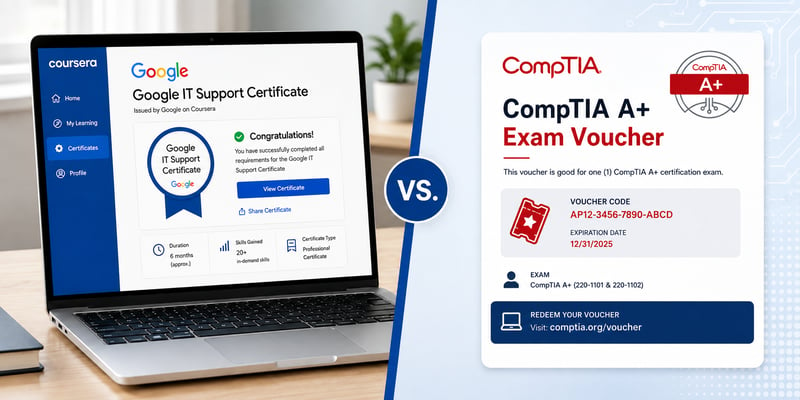
Both cover entry-level IT support, but they test it differently. Google teaches the material and assesses it through coursework. CompTIA teaches nothing and assesses it through two exams.
- Google IT Support Professional Certificate: troubleshooting, customer service, networking, operating systems, system administration, and security basics, delivered through Coursera video coursework and hands-on labs across five subject courses. It carries an ACE recommendation worth up to 15 college credits at participating institutions.
- CompTIA A+: hardware, networking, mobile devices, virtualization and cloud concepts, operating systems, security, and operational procedures, split across two required exams, Core 1 (220-1201) and Core 2 (220-1202), each capped at 90 questions over 90 minutes.
Cost, Format, and Time to Complete
The Google certificate costs less, and the gap is wider than most comparisons show.
Factor | Google IT Support Certificate | CompTIA A+ |
|---|---|---|
Format | Self-paced online video course | Two proctored exams |
Typical time | 3 to 6 months | Varies by self-study pace, 12 months per voucher |
Cost structure | $49 a month subscription | $274 per exam voucher |
Total cost | About $147 to $294 | $548 for both exams |
Prerequisites | None | None required, 12 months experience recommended |
The two pricing models pull in opposite directions. Google charges by the month, so finishing in three months costs half what finishing in six does. CompTIA sells a single-use voucher good for "either the A+ Core 1 or A+ Core 2 exam," so certifying means buying two at $274 each, and a failed attempt means buying a third.
Each voucher is also valid for 12 months from purchase. A self-paced timeline stays open-ended right up until you buy one.
Renewal is the line item most comparisons miss. CompTIA A+ is valid for three years and needs 20 continuing education units to renew. The Google certificate does not expire.
One more cost trap. A+ is on version 15, and Core 1 and Core 2 must come from the same version, with no mixing allowed. Version 14 retired on September 25, 2025, so study material written for the older exams no longer maps to what you will sit.
Which One Do Employers Actually Recognize?
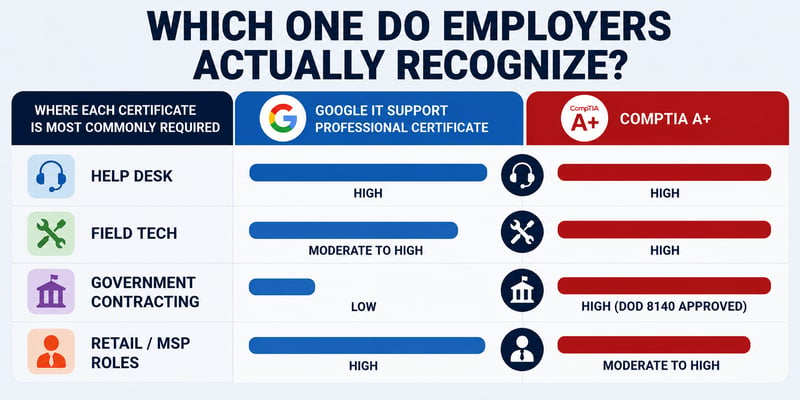
Neither certificate produces a job on its own. What they signal differs, and only one of them appears in a published federal standard.
CompTIA A+ is an approved baseline certification under DoD 8140, the Department of Defense framework that replaced the older 8570 directive. CompTIA names the approved 8140 work roles as technical support specialist, system administrator, and cyber defense infrastructure support specialist. The Department of Defense listing is blunter about the experience level, stating that "the A+ or Network+ certification qualify only for Technical Level I and cannot be used for Technical Level II positions." Inside a federal agency or a defense contract, that listing is a gate, not a preference.
Google's certificate has no equivalent federal listing. What it has is a private employer network. Google states that the program connects graduates with "+150 top employers" through a job board, plus access to CareerCircle for coaching, mock interviews, and resume tools. That is Google's published claim about its own program, and it applies to graduates of the certificate rather than to the wider hiring market.
Break-fix and field technician work sits across both. A+ Core 1 is the hardware half: installing, configuring and maintaining hardware and mobile devices, then troubleshooting hardware and connectivity faults. The Google certificate covers the customer-facing half, including end-to-end customer support. Holding both is the combination the Coursera dual credential recognizes.
Which Should Beginners Start With?
Google, if you are starting from zero. CompTIA says so itself.
The A+ Core 1 exam page lists "12 months of hands-on experience in an IT support specialist job role" as the recommended background. It is a recommendation, not a prerequisite, but someone who has never worked a help desk would be sitting an exam written for people who already have. That is worth knowing before paying $274 twice.
So the Google certificate is the softer entry: no prerequisites, coursework sequenced from fundamentals upward, and a fraction of the exam cost. Start with A+ instead if you already have hands-on hardware exposure from a job, a home lab, or military service, or if you are targeting a posting or a federal contract that names A+ outright. In that second case the Google certificate does not substitute, and going Google-first costs you months.
This is a sequence, not a fork. Coursera issues a Google/CompTIA dual credential badge to anyone who completes the Google IT Support Professional Certificate and passes CompTIA A+ ce. The two were built to stack.
CompTIA A+ Programs on Dreambound
If you would rather learn in a classroom than a video player, several schools run technician programs that build toward A+ alongside Network+ and Security+. Dreambound puts vocational training programs from schools across the country side by side, so the comparison happens before you commit.
Computer and Network Technician - Asher College, Sacramento
- Format: In person
- Prepares students for CompTIA IT Fundamentals, CompTIA A+, Network+, and Security+
Computer and Network Technician - Asher College, Las Vegas
Also available in Dallas.
- Format: Hybrid
- Prepares students for CompTIA IT Fundamentals, CompTIA A+, Network+, and Security+
Computer Systems Technician Certificate and Diploma - IntelliTec College, Albuquerque
Also available in Colorado Springs.
- Format: Hybrid
- Prepares students for CompTIA IT Fundamentals, A+ Certified Technician, Network+, Security+, Server+, and Linux+
A stack that runs A+ through Network+ and Security+ points past the help desk toward the network administrator career, which is where those credentials usually lead. Line these up against the self-study route on Dreambound before you pick a lane.
How Google IT Support Compares to Other Certificates
Four other comparisons come up often, and three of them are not really competitions.
Google IT Support vs. Google IT Automation with Python
Sequential, not alternative. Coursera lists the automation certificate at advanced level, seven courses, about six months, and its page recommends taking IT Support first for anyone with no IT background. It adds scripting and automation on top of support skills.
Google IT Support vs. Google Data Analytics
Different career tracks entirely. Data Analytics is a nine-course, six-month beginner program pointed at junior data analyst and business intelligence roles. Choose by the job you are targeting, not by which certificate looks stronger.
Google IT Support vs. IBM IT Support
Both are beginner Coursera certificates aimed at different certification tiers. IBM's nine-course program runs about three months and states that it prepares learners for the CompTIA ITF+ and Tech+ exam, a rung below A+, with the exam fee not included. Google's coursework maps to A+ objectives instead, and Google publishes a 150-plus employer network where IBM publishes no equivalent figure.
Google IT Support vs. Microsoft IT Support Specialist
Microsoft's six-course program runs about three months and is built around its own stack, Microsoft 365, Power Automate, Windows, and Azure, with a 50% discount voucher toward the MS-900 exam. Google's coursework is platform-neutral. If the environment you want to work in runs on Microsoft, the vendor-specific version has an argument.
Frequently Asked Questions
Is the Google IT Support Certificate as good as CompTIA A+?
They are different kinds of credential. Google's is a completed course series; A+ is a proctored exam credential named in the DoD 8140 baseline list. For learning the material, Google works. For roles that name A+ in writing, it does not substitute.
Do I need both certificates?
No, but they were built to stack, and Coursera issues a joint Google/CompTIA badge for holding both. The usual sequence is Google for the coursework, then A+ for the credential. Whether the second is worth $548 depends on the roles you want.
Which one is cheaper?
The Google certificate, by a wide margin. It runs $49 a month over three to six months, about $147 to $294 total. A+ costs $274 per exam voucher and needs two exams, so exam fees alone reach $548 before study material.
Does CompTIA A+ expire?
Yes. A+ is valid for three years from the date you pass, and renewal takes 20 continuing education units. The Google certificate does not expire, which widens the long-term gap beyond the upfront comparison.
Can I get a help desk job with just the Google certificate?
It is possible, and Google states the program connects graduates to an employer network of more than 150 companies. No certificate produces a job by itself. Hands-on evidence counts too, whether from a home lab, a previous role, or a technician program you can compare on Dreambound.
Which certificate should I get first as a complete beginner?
Google. CompTIA's own Core 1 page recommends 12 months of hands-on IT support experience before sitting for A+, so a true beginner would be taking an exam written for someone further along.
Choosing Your First IT Support Credential
CompTIA recommends a year of hands-on experience before A+, and Coursera issues a badge for holding both. That describes a sequence, not a fork.
Only a written requirement changes the order. When a posting or a federal contract names A+, that goes first. Otherwise budget and speed point the same way, and Google is the cheaper, faster start.
To build the hands-on half in a classroom, compare the technician programs on Dreambound that run A+ through Security+.