Highest-Paying Nursing Jobs in 2027: Salaries, Degrees, and Top-Paying States

See if you qualify for training programs
Answer a few questions in 2 minutes. Free, no commitment.
The highest-paying nursing job is nurse anesthetist (CRNA), with a median of $236,590 a year according to the Bureau of Labor Statistics (May 2025), followed by nurse midwives at $134,040 and nurse practitioners at $132,300. The highest-paid nurses share two things: a graduate degree and national certification. Registered nurses earn a median of $97,550, and the gap between that figure and the top of the list is the clearest case for going back to school.
Where you work matters too. Setting and state can move RN pay by tens of thousands of dollars a year, and California RNs earn a median of $140,270. Every figure on this page comes from the same BLS release, so the jobs compare on equal terms.
Key Points
- Nurse anesthetists are the highest-paid nurses, with a median of $236,590 a year (BLS, May 2025).
- Nurse midwives ($134,040) and nurse practitioners ($132,300) come next, and all three roles require a graduate degree and national certification.
- Registered nurses earn a median of $97,550, and RNs in government jobs earn $110,780.
- California pays RNs the most of any state, with a median of $140,270, and San Jose leads all metro areas at $216,740.
- Jobs for nurse anesthetists, midwives, and practitioners are projected to grow 36% from 2025 to 2035, six times the RN rate.

Highest-Paid Nursing Jobs Compared
Every figure in the table comes from the BLS Occupational Outlook Handbook (May 2025 wages, pages updated August 27, 2026), so the jobs compare on the same basis. BLS reports growth for the three advanced practice roles as one group.
Job | Median annual pay | Typical education | Growth, 2025 to 2035 |
|---|---|---|---|
Nurse anesthetist (CRNA) | $236,590 | Doctoral nurse anesthesia program after ICU experience as an RN | 36% (all APRNs) |
Nurse midwife (CNM) | $134,040 | Graduate degree from an ACME-accredited program | 36% (all APRNs) |
Nurse practitioner (NP) | $132,300 | MSN or DNP plus national certification | 36% (all APRNs) |
Nurse administrator | $123,860 | Bachelor's degree typical | 24% |
Registered nurse (RN) | $97,550 | ADN, BSN, or diploma plus an RN license | 6% |
The nurse administrator row uses the BLS category for medical and health services managers, and the RN median rises to $110,780 in government jobs. BLS lists a bachelor's degree as the typical entry education for RNs, though ADN and diploma paths lead to the same license. For comparison, nursing instructors earn a median of $80,250 and licensed practical nurses $64,400, so even the lowest-paid job in the table clears both by a wide margin.
The 5 Highest-Paying Nursing Jobs, Ranked
The best paying nursing jobs are advanced practice or leadership roles, and the ranking below runs in pay order. Each entry covers what the job is, where it pays most, and the path in.
1. Nurse Anesthetist (CRNA): The Highest-Paid Nurse
Certified registered nurse anesthetists give anesthesia and monitor patients before, during, and after procedures. They work in operating rooms, delivery rooms, ambulatory surgery centers, dental and specialty offices, and the military. In rural U.S. counties, CRNAs make up more than 80% of anesthesia providers, according to the American Association of Nurse Anesthesiology (AANA). Median pay is $236,590, the highest nurse salary BLS tracks, and the agency counts 54,500 jobs. Alaska ($341,210) and New York ($321,030) pay the highest state medians.
The path is the longest in nursing. You need an RN license and critical care experience, which BLS lists as 1 year at minimum for admission, though AANA says CRNAs average three years. Then comes a doctoral nurse anesthesia program, since every accredited program now awards a doctorate for entry into practice. AANA puts the total at 8 to 8.5 years of education and experience, and CRNAs complete recertification requirements every 4 years.
2. Nurse Midwife (CNM)
Certified nurse midwives provide gynecologic care, prenatal visits, labor and birth care, and postpartum follow-up, and some also provide primary care to women. Median pay is $134,040. It is the smallest of the three advanced practice jobs, with 8,200 positions nationwide, so openings are fewer. California pays the highest state median at $203,840, with Massachusetts next at $159,800.
The path runs through an RN license, a graduate midwifery program accredited by the Accreditation Commission for Midwifery Education (ACME), and the national certification exam from the American Midwifery Certification Board (AMCB), followed by a state license.
3. Nurse Practitioner (NP)
Nurse practitioners diagnose and treat patients, order and interpret tests, and prescribe medication in many states. Median pay is $132,300, with 336,300 jobs, by far the largest advanced practice group, and BLS projects NP employment alone to grow 41% from 2025 to 2035. California ($168,520) and New Jersey ($159,310) pay the highest state medians.
Across the three advanced practice roles combined, outpatient care centers pay the highest median ($143,370), followed by hospitals ($142,240). BLS does not publish NP pay by setting or specialty on its own, which is why the family, psychiatric, and acute care NP figures you see elsewhere come from job boards rather than government data. Our nurse practitioner salary guide separates entry-level from experienced pay.
The path is an RN license, an MSN or DNP, a national certification exam in your population focus, and an APRN license from your state board.
4. Nurse Administrator or Director of Nursing
BLS counts nurse managers, directors of nursing, and nursing home administrators among medical and health services managers, who earn a median of $123,860. Government ($136,130) and hospitals ($133,580) pay the most, and clinical managers often run a single department, such as intensive care. Some positions may require an RN license, and nursing home administrators may also have years of experience as a registered nurse.
Growth is 24% from 2025 to 2035, with about 62,300 openings a year, and a bachelor's degree is the typical entry education. The figure covers all health services managers, not only nurses, so treat it as the range for leadership roles rather than a nurse-specific median. Our breakdown of hospital management salaries shows how pay changes by title.
5. Registered Nurse (RN)
The RN license is the base of every job above. Median pay is $97,550, the top 10% earn more than $137,470, and 3,465,400 RNs work in the U.S., so the role has more openings than the other four combined, about 180,800 a year.
Pay depends on setting: government $110,780, hospitals $100,220, ambulatory care $91,230, nursing and residential care $84,300, and educational services $78,620. By detailed industry, the federal executive branch pays RNs the highest median at $121,260 (BLS OEWS). If you are starting from scratch, our guide on how to become a registered nurse walks through the degree, the NCLEX, and licensure.
Graduate Nursing Programs on Dreambound
The top three jobs on this list require a graduate degree, and the partnered online programs below lead to them. For campus options, compare graduate nursing classes near you by state and city.
Nurse Practitioner Programs
Master of Science in Nursing in Family Nurse Practitioner - Herzing University
- Format: Online
- Length: 48 credits
- Includes 585 clinical hours, with Herzing helping to secure placement
Master of Science in Nursing in Psychiatric Mental Health Nurse Practitioner - Herzing University
- Format: Online
- Length: 48 credits
- Includes 540 clinical hours with a clinical placement guarantee
M.S.N. in Adult-Gerontology Primary Care Nurse Practitioner - South University
- Format: Online
- Graduates are eligible to sit for the national AGPCNP certification exam (ANCC or AANPCP)
Nurse Leadership and Informatics Programs
MSN in Nursing Administration - Colorado Technical University
- Format: Online
- Taught in a 5-week class format, covering leadership, change, innovation, and quality outcomes
M.S.N. in Nursing Informatics - South University
- Format: Online
- Graduates are eligible to sit for the national nursing informatics certification exam
APRN Doctorate Programs
Nursing, DNP - APRN - Regent University
- Format: Online
- Builds clinical skills and knowledge for advanced practice nursing roles
Dreambound has no partnered nurse anesthesia or midwifery programs. If those are your targets, look for programs accredited by the Council on Accreditation of Nurse Anesthesia Educational Programs (COA) or by ACME.
Higher-Paying RN Specialties and Settings
If you searched for the highest paying RN jobs, here is the honest answer: BLS reports one wage for all registered nurses, so no government source ranks RN specialties by pay. The specialty figures on other lists come from job boards and self-reported surveys, and they are not comparable to the BLS medians above.
What BLS does publish is pay by setting, and the spread is large. Government RNs earn a median of $110,780 and hospital RNs $100,220, against $78,620 in educational services, and by detailed industry the federal executive branch leads at $121,260. State is the other signal, covered in the next section. The highest paying nursing specialties below are the roles that open those settings or add a credential, with no dollar figures attached.
Clinical Nurse Specialist (CNS)
A clinical nurse specialist is an advanced practice nurse who leads care in one area, such as oncology or critical care, and the role requires a graduate degree and certification. BLS counts clinical nurse specialists inside its registered nurse category, so it publishes no separate wage.
Critical Care (ICU) Nurse
ICU nurses care for the sickest hospital patients, and it is the experience nurse anesthesia programs require before admission, which makes it the usual first step toward the top of this list. Most ICU jobs sit in hospitals, the second-highest-paying RN setting. Our look at the pros and cons of critical care nursing covers the schedule and the stress.
Nursing Informatics
Informatics nurses blend clinical work with data, electronic health records, and systems design, and the work can sit in hospitals, software vendors, or government agencies. An MSN specialization is one route in, including the South University program above, and a national certification exam follows the degree.
Travel Nursing
Travel nurses take short contracts, often 13 weeks, through staffing agencies, with pay quoted by the week and set by each contract. No government source publishes travel nurse pay, so this page gives no figure. Our guide to how much travel nurses make uses agency and job-board data, with the caveats that come with it.
Pay by Location
Location moves RN pay more than almost anything else. California RNs earn a median of $140,270, against $97,550 nationally, and four other states pay more than $109,000 at the median.
State | Median annual pay | Median hourly pay | 90th percentile |
|---|---|---|---|
California | $140,270 | $67.44 | $213,320 |
Hawaii | $136,320 | $65.54 | $147,830 |
Oregon | $129,010 | $62.02 | $155,010 |
Washington | $124,200 | $59.71 | $161,910 |
Alaska | $109,480 | $52.64 | $149,070 |
RN pay in the five highest-paying states, BLS Occupational Employment and Wage Statistics, May 2025.
The rest of the top 10 are New York ($109,440), New Jersey ($106,500), Massachusetts ($104,550), Nevada ($103,670), and Connecticut ($102,740). Metro areas push higher still: San Jose-Sunnyvale-Santa Clara pays RNs the highest median in the country at $216,740, followed by Vallejo ($203,290) and San Francisco-Oakland-Fremont ($186,610), and the top seven metro areas are all in California.
High-paying areas also carry higher living costs, so compare offers with rent and taxes in mind. Our registered nurse salary by state guide lists all 50 states and the hourly, monthly, and starting figures behind them.

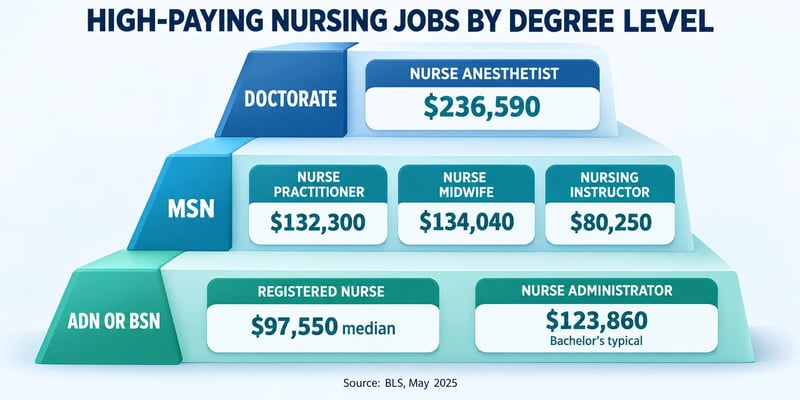
High-Paying Nursing Jobs by Degree Level
Nursing jobs that pay well exist at every degree level, but the biggest jumps come with graduate degrees. The nursing career ladder runs from CNA and LPN through RN, MSN, and doctoral roles, and each rung changes the ceiling.
With an ADN or BSN
An RN license opens the $97,550 median and the higher-paying settings, government and hospitals. A bachelor's degree is also the typical entry education BLS lists for health services managers, which makes the BSN the usual route to nurse administrator and director roles. Many hospitals prefer BSN-prepared nurses for leadership tracks, so if you hold an ADN, compare BSN programs near you before you commit to a graduate degree.
With an MSN
The master's degree sits behind nurse practitioner and nurse midwife roles, clinical nurse specialists, nurse leaders, and informatics. It also opens teaching. Nursing instructors earn a median of $80,250, and their jobs are projected to grow 17% from 96,100 to 112,600 between 2025 and 2035. BLS lists a doctorate as typical for postsecondary teachers, with a master's enough at some community colleges. Among the highest paying nursing master's degrees, the NP track leads on both pay and openings.
With a Doctorate
Nurse anesthesia programs now award doctoral degrees, and the Doctor of Nursing Practice is the highest practice degree for APRNs and nurse leaders. A DNP does not change the BLS median for a role, but it is the entry ticket for the highest-paid one. The programs section above lists a partnered DNP option.
Frequently Asked Questions
Can an RN make $200,000 a year?
Yes, in the highest-paying areas. RNs in the San Jose metro area earned a median of $216,740 in May 2025, and Vallejo's median was $203,290. Nationally, the top 10% of RNs earned more than $137,470, so $200,000 usually takes a Bay Area job or an advanced practice role such as nurse anesthetist ($236,590 median).
Can a nurse make $300,000 or $500,000 a year?
Yes to $300,000, for a small group. In May 2025, the top 10% of nurse anesthetists earned more than $300,000 in 32 states, and more than $400,000 in Florida ($416,000) and South Carolina ($401,600). No nursing occupation reaches $500,000 at the 90th percentile in any state, so BLS data does not support it.
Do nurse practitioners make more than registered nurses?
Yes. Nurse practitioners earned a median of $132,300 in May 2025, compared with $97,550 for registered nurses, a gap of about $34,750 a year. The difference reflects the graduate degree, national certification, and APRN license that NPs need, along with the authority to diagnose, treat, and in many states prescribe.
What is the highest-paying nursing job without a master's degree?
Nurse leadership. BLS counts nurse managers and directors among medical and health services managers, who earned a median of $123,860 in May 2025 with a bachelor's degree as the typical entry education. Among bedside roles, RNs in government jobs earned a median of $110,780, the highest RN setting BLS reports.
Which high-paying nursing jobs are growing fastest?
Nurse anesthetists, nurse midwives, and nurse practitioners, which BLS projects to grow 36% from 2025 to 2035 with about 32,200 openings a year. Medical and health services managers follow at 24%, nursing instructors at 17%, and registered nurses at 6%, though the RN base is so large that it still adds about 180,800 openings a year.
How long does it take to get a high-paying nursing job?
An RN license comes first, which takes two to four years depending on the degree. Nurse practitioner and nurse midwife roles add a graduate program, and AANA puts nurse anesthetist preparation at 8 to 8.5 years of education and experience. Our guide to how long RN training takes breaks down each starting path.
Choosing a High-Paying Nursing Path
The highest paying nursing careers reward graduate education and national certification, but setting and state matter almost as much. A San Jose RN job pays more at the median than a nurse practitioner role in any state, so pick the path that fits how long you can study and where you want to live.
If the top of the list is the goal, the sequence is fixed: RN license, critical care experience, then a doctoral nurse anesthesia program. If you want a shorter climb, an MSN opens nurse practitioner, midwife, leadership, and informatics roles within a few years. Dreambound lists graduate nursing programs by format and location, so you can compare the options before you apply.
Related Reading
- What Affects Critical Care Nurse Pay? Education, Experience and Location
- Psychiatric Nurse Salary by State: Where Psychiatric Nurses Earn the Most
- How to Increase Your Operating Room Nurse Salary: Certifications, Skills and Career Moves
- Licensed Practical Nurse Salary by State: Where LPNs Earn the Most