Hospital Management Salary: What to Expect by Role

See if you qualify for Health Information Management programs
Answer a few questions in 2 minutes. Free, no commitment.
Hospital management salary depends on which job the title covers. BLS reports a 2025 median of $123,860 for medical and health services managers, the occupation that includes hospital administrators, and $133,580 for those working in hospitals, with the top 10% earning more than $224,340. The same search also returns hospital case managers, who are usually nurses or social workers paid on a clinical scale, and operations and project managers, who sit between staff and executive pay.
Education moves the number too: BLS lists a bachelor's degree as the typical entry credential, some employers prefer a master's, and ACHE's FACHE credential requires one. The gap between sources is the first thing to understand, because job-posting averages for the title "hospital manager" run almost $50,000 below the BLS median.
Key Points
- Hospital manager and administrator salaries vary widely by facility size and setting; BLS's 2025 medians run from $100,520 in nursing and residential care facilities to $136,130 in government, with hospitals at $133,580.
- Hospital case managers are typically clinical professionals, often nurses or social workers, whose pay reflects that background rather than a standard administrative track.
- An MBA or master's in healthcare or hospital management is associated with higher earning ceilings, particularly for larger facility leadership roles.
- Operations and project management roles within hospitals sit between general staff and top administrator pay.

What Is Hospital Management?
Hospital management is the administrative, financial, and operational leadership of a healthcare facility: budgets, staffing, compliance, contracts, and the systems that keep a hospital running, as opposed to the clinical work of diagnosing and treating patients. BLS classifies the people who do it as medical and health services managers, who plan, direct, and coordinate the business activities of healthcare providers, and counts 640,400 of them in 2025, with hospitals employing 28%.
The line between administrative and clinical is not clean. Case managers coordinate discharge planning and insurance reviews from inside the clinical workflow, usually with a nursing or social work license, and many department managers are clinicians who moved into supervision. The roles below are sorted by what the job is, because that is what sets the pay.
Hospital Manager Salary
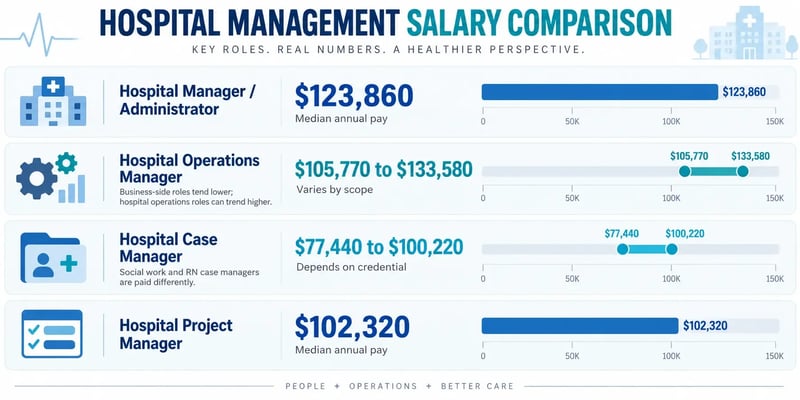
A hospital manager or administrator earned a median of $123,860 in 2025 according to BLS, and the setting moves that figure by more than $35,000. BLS's May 2025 medians by industry:
- Government, excluding education and hospitals: $136,130
- Hospitals: $133,580
- Outpatient care centers: $116,060
- Offices of physicians: $105,770
- Nursing and residential care facilities: $100,520
The lowest 10% of the occupation earned less than $73,390 and the highest 10% more than $224,340, a spread that tracks facility size and scope more than title.
BLS does not publish pay by bed count, so the setting medians are the closest published proxy for size: a single-site clinic manager sits near the physicians' office figure, and a hospital or system administrator near or above the hospital figure. Title changes little of this. Hospital Administrator, Healthcare Manager, and Hospital Manager describe the same responsibilities at different employers, and BLS counts all of them in one occupation.
Job-posting averages tell a different story because they count titles, not occupations. Indeed's average for postings titled "hospital manager" is $74,440 from 855 salaries, updated August 30, 2026, a figure that includes department-level roles a BLS survey would classify elsewhere. When the two numbers disagree, the BLS figure describes the occupation and the posting average describes whatever employers chose to call the job.
Hospital Operations Manager Salary
A hospital operations manager runs the day-to-day machinery, staffing logistics, patient flow, department coordination, and supply and vendor contracts, rather than leading the facility. BLS has no separate line for the title. Operations managers who run clinical departments fall under medical and health services managers, with the $133,580 hospital median above; those who run the business side fall under general and operations managers, who earned a median of $105,770 in 2025 across all industries.
Posting data again runs lower. ZipRecruiter puts the national average for "hospital operations manager" at $63,456 as of September 7, 2026, with the 25th percentile at $41,000 and the 90th at $108,500, a range wide enough to hold a shift supervisor and a director of operations under the same title. Read an operations offer by scope, the number of departments, employees, and budget dollars under the role, because scope is what moves it from the posting average toward the BLS medians.
Hospital Case Manager Salary
Hospital case managers are paid on a clinical scale, not an administrative one, because they are typically registered nurses or licensed social workers. They coordinate care plans, discharge planning, and insurance and utilization review, and their pay tracks the license behind the title. BLS reports a 2025 median of $100,220 for registered nurses in hospitals and $77,440 for social workers in hospitals, against $67,880 for healthcare social workers overall.
The certification confirms the pattern. The Commission, formerly CCMC, which has certified more than 50,000 Certified Case Managers, sets CCM eligibility rules that require a current license such as an RN or LCSW, or a bachelor's or master's degree in a health or human services field, plus 12 to 24 months of case management experience before a candidate can sit for the exam.
A nurse case manager and a social work case manager can share an office and a job description and still land more than $20,000 apart, because the underlying credential is priced differently.
Aggregators blur this. ZipRecruiter's "hospital case manager" average is $51,494, a figure that mixes unlicensed coordinators into the same title; a licensed RN case manager should compare offers against the nursing figures, not that average.
Hospital Project Manager Salary
A hospital project manager runs defined initiatives with a start and an end: an electronic health record rollout, a facility expansion, a process improvement program. That is distinct from the ongoing operations role. BLS groups the job under project management specialists, who earned a median of $102,320 in 2025, with the top 10% above $167,970. Healthcare-specific posting data lands close to that: ZipRecruiter's healthcare project manager average is $110,338 as of August 24, 2026, with the 75th percentile at $124,100 and top earners near $155,000.
Two things move the figure: technical scope, since an EHR implementation carries more budget than a departmental workflow project, and whether the project manager owns the budget and vendor contracts or coordinates for someone who does.
Does an MBA or Degree in Hospital Management Increase Salary?
A degree in healthcare administration is associated with higher pay at every step, and the master's is where the ceiling moves. BLS lists a bachelor's degree as the typical entry credential for medical and health services managers and notes that some employers prefer a master's. Across all occupations, BLS's 2025 earnings table puts full-time workers with a master's degree at $1,876 a week, against $1,578 with a bachelor's and $1,135 with an associate's, about a 19% premium for the master's over the bachelor's.
The credential that marks executive-level work spells it out. ACHE's FACHE, which the college calls the most recognized credential of a healthcare leader's competency, requires a master's or other post-baccalaureate degree, five years of healthcare management experience, and a passed Board of Governors exam. An MBA with a healthcare concentration and an MHA both qualify; CAHME accredits 175 graduate healthcare management programs, and BLS does not separate MBA pay from MHA pay at the same level.
The ladder runs in three steps. An associate degree supports coordinator and office-management roles, a bachelor's in healthcare administration supports entry to mid-level administrative roles, and a master's or MBA is the usual expectation for executive and multi-facility leadership.
Healthcare Administration Programs on Dreambound
Dreambound is a free marketplace where you can compare healthcare administration degrees by level, format, and length before you apply. The six programs below are two at each degree level, and Dreambound lists more than 60 other healthcare administration programs alongside them.
Associate Degrees
Associate of Science in Health Administration Services - Colorado Technical University
- Format: Online
- 5-week class format
A.A.S. - HealthCare Administration - Swedish Institute College of Health Sciences
- Format: Online
- Length: Twenty-one months (seven quarters)
- Eligible to sit for the CPB (AAPC) and CRCS (AAHAM) billing certification exams during the program
Bachelor's Degrees
Healthcare Administration - Bachelor's - MCI - Virginia Beach, VA
- Format: Hybrid
- Length: Less than 2.5 years on a year-round schedule
- Two tracks: acute care and long-term care
BS Healthcare Administration - Southern New Hampshire University
- Format: Online
- Transfer up to 90 credits
Master's Degrees
Master of Science in Healthcare Management - General - Colorado Technical University
- Format: Online
- 5-week class format
- Study financial management, HR management, and strategic planning
Master's Degree in Healthcare Management - American InterContinental University
- Format: Online
- Part of a university system accredited by the Higher Learning Commission
Factors That Affect Hospital Management Salary
Four things move a hospital management salary more than the job title does.
- Facility size and type. The American Hospital Association counts 6,100 U.S. hospitals, 5,121 of them community hospitals and 1,797 of those rural. A small rural hospital and a large academic medical center both employ an administrator, and the budget under that person's signature sets the pay. BLS's setting medians, from $100,520 in nursing and residential care facilities to $136,130 in government, with hospitals at $133,580, are the published version of the same effect.
- Geographic location. Pay follows cost of living and hospital density, and BLS publishes state and metro wages for medical and health services managers in its Occupational Employment and Wage Statistics tables; the national median of $123,860 is the midpoint of a wide map.
- Years of experience. BLS lists fewer than 5 years of related experience as the typical entry point, and the spread from under $73,390 to over $224,340 reflects experience and scope as much as setting, from a first coordinator job to a facility with hundreds of employees.
- Multi-site or system responsibility. AHA counts 3,567 community hospitals inside a health system. A director who answers for several facilities carries a bigger budget and more employees than a single-site administrator, and pay follows that footprint.
Frequently Asked Questions
What is the difference between a hospital manager and a hospital case manager?
A hospital manager runs the business side of a facility, budgets, staffing, compliance, and contracts, and is paid as a medical and health services manager, a 2025 BLS median of $133,580 in hospitals. A hospital case manager coordinates individual patients' care plans and discharges, usually as a licensed nurse or social worker, and is paid on that clinical scale.
Do you need a master's degree to become a hospital administrator?
Not to start. BLS lists a bachelor's degree as the typical entry credential for medical and health services managers, with some employers preferring a master's. A master's or other post-baccalaureate degree is required for ACHE's FACHE credential and is the usual expectation for executive and multi-facility roles. Nursing home administrators also need a state license in every state.
What is the highest paying job in hospital management?
Facility and system executive roles pay the most. The top 10% of medical and health services managers earned more than $224,340 in 2025, and BLS puts the median for chief executives across all industries at $213,990. BLS does not publish hospital-only CEO pay, so figures above those levels come from individual health systems' disclosures rather than a national survey.
Is hospital case management a clinical or administrative role?
Clinical. Hospital case managers assess patients, plan discharges, and manage utilization review, which is why The Commission requires a license such as an RN or LCSW, or a health or human services degree, before a candidate can sit for the CCM exam. Their pay follows that license: BLS reports a 2025 median of $100,220 for registered nurses in hospitals.
Does an MBA increase salary more than a healthcare specific master's degree?
BLS does not separate the two at the same job level. Its 2025 earnings data prices the master's level as a whole at about 19% above a bachelor's, and ACHE accepts either degree for the FACHE credential. Choose by the role you want, an MBA for finance and operations, an MHA for clinical operations and policy, and compare both on Dreambound.
Which Hospital Management Salary Applies to You
"Hospital management salary" is not one number. It is a BLS occupation median of $123,860, a hospital median of $133,580, a posting average near $74,440 for the same two words, and a case manager scale that follows a nursing or social work license rather than an administrative ladder. Match the figure to the job, the license, and the degree it expects, and the ranges stop contradicting each other.
If the number you want sits at the top of that range, the path runs through a bachelor's degree first and a master's or MBA second; you can compare healthcare administration programs at every level on Dreambound.