How Long Does It Take to Become a Registered Nurse?

See if you qualify for Registered Nurse programs
Answer a few questions in 2 minutes. Free, no commitment.
Becoming a registered nurse takes about 2 to 4 years for most people: roughly 2 years for an Associate Degree in Nursing (ADN) or 4 years for a Bachelor of Science in Nursing (BSN). Add 1 to 4 months after graduation to pass the NCLEX-RN and receive a state license. Two shortcuts exist: an accelerated BSN runs 12 to 18 months for bachelor's degree holders, and an LPN-to-RN bridge adds about 1 year of nursing coursework to an active LPN license. Part-time study, unfinished science prerequisites, and state board processing each stretch those timelines. The Bureau of Labor Statistics reports a $97,550 median annual wage for registered nurses (May 2025) and projects about 180,800 openings a year through 2035. The fastest route depends less on catalog length than on the credits and credentials you already hold.
Key Points
- An ADN takes about 2 years of full-time study and a BSN about 4 years, and both make you eligible to sit for the NCLEX-RN.
- Accelerated BSN programs run 12 to 18 months, prerequisites included, for students who already hold a bachelor's degree in another field (AACN, May 2026).
- LPN-to-RN bridge programs add about 1 year of nursing classes on top of an active LPN license.
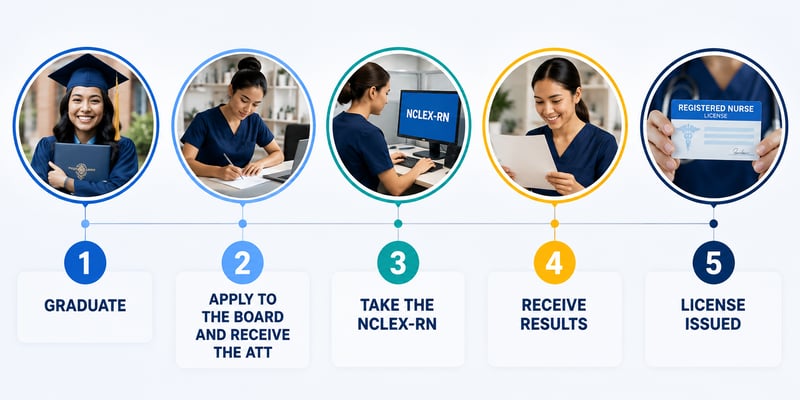
- After graduation, plan on 1 to 4 months for exam authorization, the NCLEX-RN, official results, and license issuance, depending on your state board.
- Registered nurses earned a median of $97,550 in May 2025, and BLS projects 6% employment growth from 2025 to 2035.

How Long Registered Nurse Training Takes
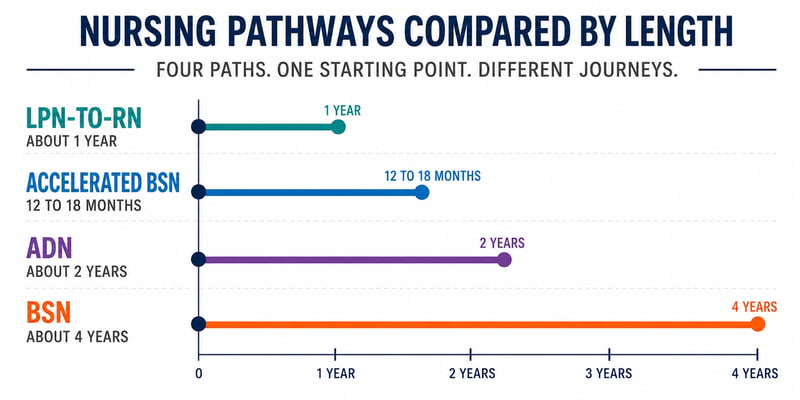
Registered nurse training takes about 2 years for an ADN and about 4 years for a BSN, with accelerated and bridge options in between. Every pathway ends at the same point: graduation from an approved program and eligibility to sit for the NCLEX-RN, the licensing exam used in every state.
Pathway | Best fit for | Typical program length | Credential earned |
|---|---|---|---|
Associate Degree in Nursing (ADN or ASN) | Starting from a high school diploma | About 2 years full time (4 semesters of nursing courses) | Associate degree |
Bachelor of Science in Nursing (BSN) | First-time college students; employers that require a BSN | About 4 years | Bachelor's degree |
Accelerated BSN (ABSN) | Non-nursing bachelor's degree holders, usually with a 3.0 GPA | 12 to 18 months, prerequisites included | Bachelor's degree |
LPN-to-RN bridge | Licensed LPNs or LVNs | About 1 year of nursing classes, plus any general education owed | Associate degree |
Hospital diploma program | Students near a hospital-based program | 2 to 3 years | Diploma |
Entry-level master's (direct-entry MSN) | Bachelor's degree holders aiming at a master's | About 2 to 3 years | Master's degree |
Catalog length excludes prerequisites, and that gap is why the North Carolina Board of Nursing calls the associate route "generally two years in length" while BLS puts ADN and diploma programs at 2 to 3 years. At Northeast Texas Community College, the 4-semester, 60-credit ADN sits behind Anatomy and Physiology I and II, Microbiology, Introductory Statistics, Lifespan Growth and Development, an English or speech course, and a philosophy course: 24 credit hours, about 2 full-time semesters. Budget 1 to 2 extra semesters if you hold none of them.
AACN's May 2026 fact sheet counts 340 accelerated BSN programs in 2025 and puts them at 12 to 18 months including prerequisites. The bridge figure is Johnson County Community College's: 1 year of classes across 3 semesters plus any general education still owed, on top of an active LPN license. Starting from zero, becoming an LPN takes about 12 to 18 months first.
Full-Time vs Part-Time Study
The table assumes full-time study, and course load is where nursing school timelines diverge. Part-time and evening tracks take longer because nursing courses and their clinical rotations run in a set sequence, so a lighter load spreads that sequence, clinical hours included, across more semesters. Part-time completion times are set school by school, so ask each program for its own figure rather than the catalog length. Accelerated programs sit at the opposite extreme: AACN describes them as full-time with no breaks between sessions, which is how a BSN compresses into 12 to 18 months.
How Long the NCLEX-RN Takes
For registered nurses there is no separate certification step: the credential that lets you work is the state license, and the national exam between graduation and that license is the NCLEX-RN from the National Council of State Boards of Nursing (NCSBN). The exam runs a maximum of 5 hours, including the introductory screen and every break, and delivers anywhere from 85 to 150 items. You can sit for it as soon as your state board issues the Authorization to Test (ATT).
Stage | How long it takes | Source |
|---|---|---|
Authorization to Test after a complete application | Up to 10 business days in North Carolina; valid for 180 days | NC Board of Nursing |
Scheduling and sitting the exam | Depends on Pearson VUE appointment availability; exam day capped at 5 hours | NCSBN |
Unofficial results | 2 business days through the Quick Results Service where the board participates; $7.95 fee | NCSBN |
Official results | Within 6 weeks; North Carolina about 4 weeks, California 2 to 3 weeks | NCSBN, NC Board of Nursing, California BRN |
Retake if needed | 45 days between attempts, up to eight attempts a year | NCSBN |
Official results come only from your board of nursing, within 6 weeks of the exam. In 2025, 86.7% of the 192,916 first-time U.S.-educated candidates passed, according to NCSBN's 2025 NCLEX Examination Statistics, published in June 2026. A failed attempt adds roughly 2 months once the 45-day wait, a new appointment, and a second results window are counted, and closer to 3 with official results.
How Long RN Licensing Takes
How long it takes to get your RN license varies more by state than any other step, so two board-published examples beat a national guess. In North Carolina, once the application, the program director's verification, and the Pearson VUE registration are in, the North Carolina Board of Nursing issues the ATT within about 10 business days, and official results follow about 4 weeks after the exam. In California, the Board of Registered Nursing lists a 10 to 12 week processing window for licensure-by-examination applications as of August 20, 2026, and posts NCLEX results in 2 to 3 weeks. Graduates who apply for an interim permit receive it within 24 to 48 hours of the board approving their exam application, and it lasts 6 months or until the first NCLEX result arrives.
Background checks and other requirements vary by state, according to BLS. Paperwork is what stalls a license: North Carolina will not declare you eligible until it holds every required document and fee, and California starts its processing clock only when every required document has arrived. File the application, fingerprints, and exam registration as early as your program allows, ideally during the final semester, so board processing overlaps with your last weeks of class.
Total Time From Start to Working
The arithmetic is simple: take the program length from the pathway table, add 1 to 2 semesters of prerequisites where they apply, then add 1 to 4 months for exam authorization, testing, results, and board processing. The totals below are estimates, not published averages.
Starting point | Pathway | Estimated time to RN license |
|---|---|---|
High school diploma, no college credits | Prerequisites, then ADN | About 2.5 to 3 years |
High school diploma, no college credits | BSN | About 4 to 4.5 years |
Science prerequisites already completed | ADN | About 2 to 2.5 years |
Bachelor's degree in another field | Accelerated BSN | About 1 to 2 years |
Active LPN or LVN license | LPN-to-RN bridge | About 1 to 1.5 years |
ADN-prepared RN who wants a BSN | RN-to-BSN while working | Already licensed; 1 to 2 years for the degree (AACN) |
Two dates matter, and they are not the same: the day training ends and the day you can work. The diploma ends the first; the license ends the second, with the exam and board processing in between. Some states shorten that gap with an interim permit; California's lets a graduate practice under the direct supervision of a registered nurse until the first exam results arrive. Check your board's current processing page before you commit to an employer start date. If you are a CNA, start from the first two rows; CNA training counts toward RN eligibility only where a school accepts it as transfer credit.
Dreambound lists registered nurse programs from schools across the country in one place. Compare ADN, BSN, accelerated BSN, and LPN-to-RN options there by length against the row that matches your starting point.
Factors That Affect Your RN Timeline
Prerequisites and Transfer Credit
Prerequisites are the most common hidden semester. Anatomy and Physiology I and II, Microbiology, Statistics, and Lifespan Growth and Development sit in front of the nursing courses at Northeast Texas Community College, and Johnson County Community College adds College Algebra, Composition I, and Introduction to Psychology, each passed with a C or higher. Schools set their own rules on which credits transfer, so get an official transfer evaluation from each program before you plan around courses you took years ago.
Admission Cycles and Waitlists
Programs with more applicants than seats rank them by GPA and entrance exam score; at Northeast Texas Community College, that means a TEAS composite score of 58.7% or higher. A missed cycle costs a semester or a full year, depending on how often the program admits a class. Apply to more than one program in the same cycle so a single rejection does not reset your nursing school timeline.
ADN Now, BSN Later, or BSN First
BLS lists a bachelor's degree as the typical entry-level education for registered nurses, while noting that licensed graduates of all three program types qualify for entry-level staff nurse positions and that employers, particularly hospitals, may require a bachelor's degree. AACN reports a strong employer preference for new nurses with baccalaureate preparation. The counterweight is the RN-to-BSN route: AACN counts 701 RN-to-BSN programs, more than 600 at least partially online, taking 1 to 2 years for working RNs. The exam barely separates the paths: 86.1% of associate degree graduates and 87.6% of baccalaureate graduates passed on the first try in 2025. The choice is time to a first paycheck against the credential some hospitals require or prefer from the start; the full path for either is in our guide on how to become a registered nurse.
Frequently Asked Questions
What is the fastest way to become an RN?
The fastest way to become an RN depends on your starting point: an ADN with no college credits (about 2.5 to 3 years to a license), an accelerated BSN with a non-nursing bachelor's degree (about 1 to 2 years), or an LPN-to-RN bridge with an LPN license (about 1 to 1.5 years). No route skips the NCLEX-RN or state licensure. Compare registered nurse programs on Dreambound by pathway to find yours.
Can you become an RN in 2 years?
Yes, if your science prerequisites are finished and you study full time, the nursing coursework in an ADN program runs about 2 years. Count the NCLEX-RN and state licensing and your first RN shift lands closer to 2.5 years after you start. Beginning with no college credits pushes the total to about 3 years.
What is a 2-year RN degree called?
A 2-year RN degree is an Associate Degree in Nursing (ADN), also titled an Associate of Science (ASN) or Associate of Applied Science in Nursing. ADN graduates sit for the same NCLEX-RN and receive the same RN license as BSN graduates; the degree affects which roles some employers consider you for, not the license itself.
How long does it take to get NCLEX results?
Official NCLEX results come from your state board of nursing within 6 weeks of the exam; North Carolina cites about 4 weeks and California posts them in 2 to 3 weeks. Where the board participates in NCSBN's Quick Results Service, you can see unofficial results 2 business days after testing for a $7.95 fee.
Is becoming an RN hard?
Most first-time candidates pass the exam: 86.7% of first-time U.S.-educated candidates passed the NCLEX-RN in 2025, according to NCSBN, and associate and baccalaureate graduates finished within two points of each other. The harder parts are getting admitted, since seats are limited, and keeping pace with sequenced clinical rotations. A failed attempt costs a 45-day wait and a second appointment, not the career.
Planning Your Registered Nurse Timeline
Choose the pathway by what you already hold: a bachelor's degree points to an accelerated BSN, an LPN license points to a bridge, and a clean slate points to an ADN for speed or a BSN for the hospitals that require one.
Then work the calendar backward from the license, not the diploma. Prerequisites, application cycles, the NCLEX-RN, and board processing each run on their own clock, and only the last one ends it. Compare registered nurse programs on Dreambound by pathway and length, and read your state board's processing page before you promise an employer a start date.
Related Guides
- How to Become a Registered Nurse in North Carolina
- How to Become a Registered Nurse in California
- How to Become a Registered Nurse in Texas
- Licensed Vocational Nurse vs Registered Nurse