How Much Does a Phlebotomist Make in Florida?
See if you qualify for Phlebotomy programs
Answer a few questions in 2 minutes. Free, no commitment.
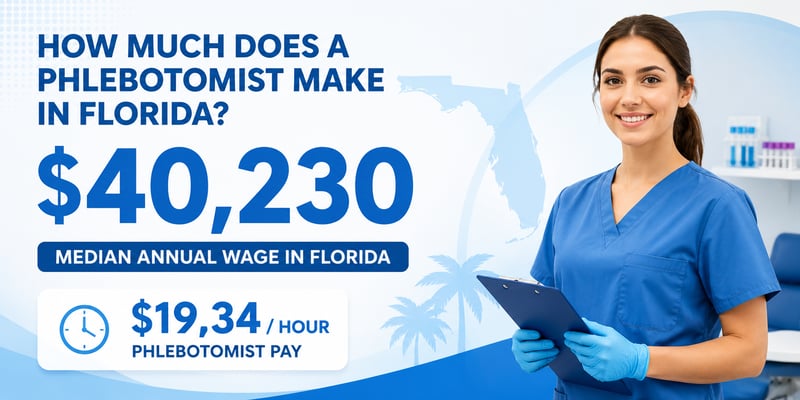
Phlebotomists in Florida earn a median annual wage of $40,230, or $19.34 an hour, according to the most recent Bureau of Labor Statistics data (OEWS, May 2025). That figure sits about 11% below the $45,230 national median for the occupation, but it comes with a genuinely fast, accessible path into healthcare and no state licensing requirement to clear first.
Key Points
- Florida's median phlebotomist salary is $40,230 a year, compared to $45,230 nationally.
- Typical pay in Florida ranges from about $35,560 (entry level) to $48,190 (experienced, top earners).
- Florida does not require a state license for phlebotomists. Employers screen candidates on national certifications instead.
- The highest paying Florida metro areas cluster around $45,000 a year.
- Nationally, phlebotomy is projected to grow 6% through 2034, with about 18,400 openings a year across the country.
Average Phlebotomist Salary in Florida
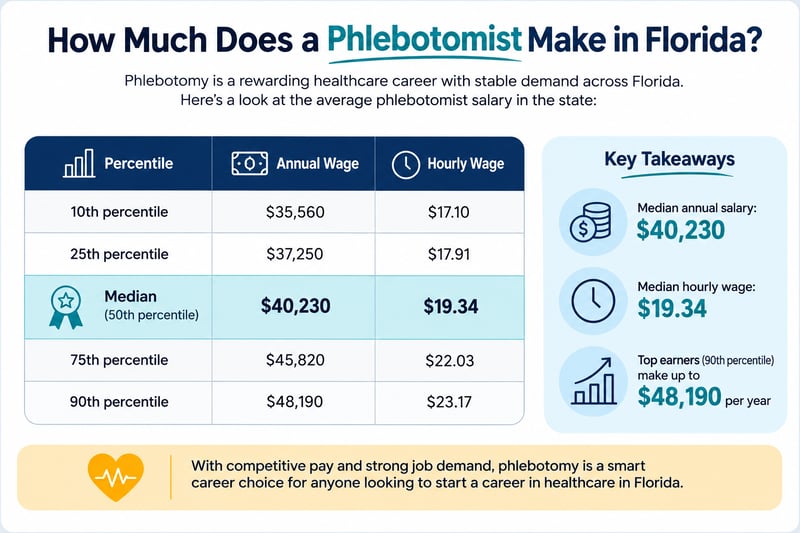
According to the Bureau of Labor Statistics Occupational Employment and Wage Statistics survey (May 2025), phlebotomists in Florida earn the following, from the lowest paid tenth of the workforce to the highest paid tenth:
Percentile | Annual Wage | Hourly Wage |
10th percentile | $35,560 | $17.10 |
25th percentile | $37,250 | $17.91 |
Median (50th percentile) | $40,230 | $19.34 |
75th percentile | $45,820 | $22.03 |
90th percentile | $48,190 | $23.17 |
This is the most reliable public benchmark available, since it draws on a large, ongoing employer survey rather than self reported job listings. That said, you will see other numbers if you search around, and it is worth understanding why they differ before you use any of them to set expectations.
Job board estimates tend to bounce around quite a bit. Indeed puts the statewide average closer to $19.66 an hour based on job postings from the past three years. Glassdoor's self reported salary data lands higher, around $43,846 a year. Salary.com's compensation modeling puts the average nearer $39,091. None of these are wrong exactly, they are just measuring slightly different things: some blend in part time roles, some rely on what people choose to report themselves, and some are modeled off job postings rather than actual paychecks. The BLS median is the steadiest number to plan around, and the job board figures are useful mainly for sanity checking a specific offer against what others in your area are seeing.
Florida vs. National Phlebotomist Pay
Florida's $40,230 median trails the national median of $45,230 by roughly $5,000 a year. Part of that gap is offset by the fact that Florida has no state income tax, so take home pay narrows the difference somewhat compared to a state with similar wages and an income tax on top. It is not, however, a full offset. At this income level the state tax savings amount to a modest sum each year, and it is worth weighing against Florida's cost of living in the specific city you are considering, particularly housing and insurance costs in the coastal metros where phlebotomist pay tends to be highest.
Highest Paying Cities for Phlebotomists in Florida
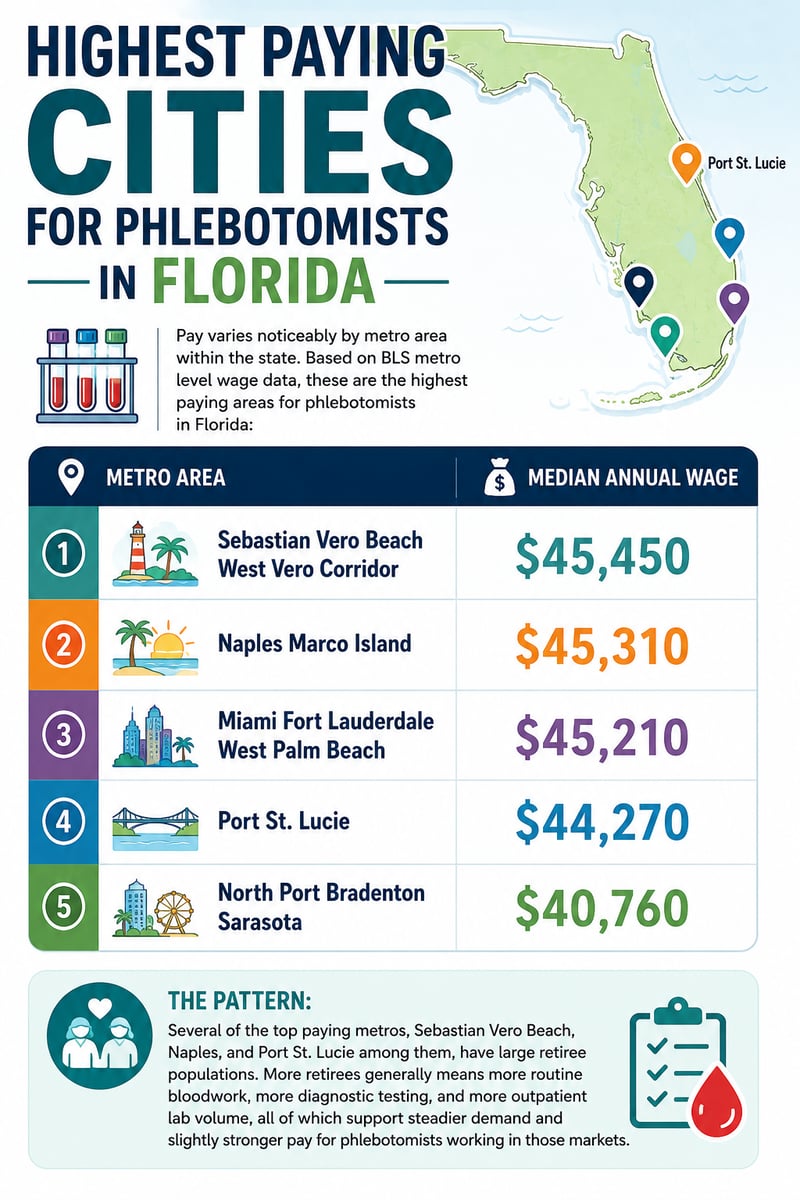
Pay varies noticeably by metro area within the state. Based on BLS metro level wage data, these are the highest paying areas for phlebotomists in Florida:
Metro Area | Median Annual Wage |
Sebastian Vero Beach West Vero Corridor | $45,450 |
Naples Marco Island | $45,310 |
Miami Fort Lauderdale West Palm Beach | $45,210 |
Port St. Lucie | $44,270 |
North Port Bradenton Sarasota | $40,760 |
There is a pattern here worth noticing. Several of the top paying metros, Sebastian Vero Beach, Naples, and Port St. Lucie among them, have large retiree populations. More retirees generally means more routine bloodwork, more diagnostic testing, and more outpatient lab volume, all of which support steadier demand and slightly stronger pay for phlebotomists working in those markets.
What Affects a Phlebotomist's Pay in Florida
Experience Level
Like most healthcare support roles, pay climbs with time on the job. Someone just finishing a certificate program will typically start closer to the 10th or 25th percentile figures above. Phlebotomists with a few years of experience, particularly those who have picked up specialized skills like pediatric or geriatric draws, tend to move toward the middle and upper end of the range. Lead phlebotomists and trainers, who take on scheduling, quality control, or new hire training, are the ones most likely to reach the 75th and 90th percentile figures.
Work Setting
Where you work matters almost as much as how long you have worked. National BLS data on pay by industry shows outpatient care centers tend to offer the highest average wages for phlebotomists, followed by diagnostic and medical laboratories, then hospitals, then physician's offices. If maximizing pay is a priority, outpatient centers and larger diagnostic labs are generally worth targeting over a small private practice.
Certification
Florida does not require phlebotomists to hold any particular certification by law, but in practice, it functions as the industry's stand in for a license. Employers commonly look for one of the following:
- Certified Phlebotomy Technician (CPT) through the National Healthcareer Association (NHA)
- Phlebotomy Technician (PBT) through the American Society for Clinical Pathology (ASCP)
- Registered Phlebotomy Technician (RPT) through American Medical Technologists (AMT)
- Certifications through the National Center for Competency Testing (NCCT) or the American Medical Certification Association (AMCA)
Holding one of these credentials rarely changes the posted pay range for a job on its own, but it does change whether you get hired for that job in the first place, and it tends to open the door to the higher paying settings and larger employers described above.
Shift and Schedule
Night, weekend, and holiday shifts commonly carry a differential of a dollar or two per hour on top of base pay. Per diem and travel phlebotomy positions, where you fill in temporary staffing gaps across facilities, often pay a meaningful premium over a standard staff role, though usually without the same benefits or schedule stability.
Do You Need a License to Work as a Phlebotomist in Florida?
No. Florida's Department of Health does not issue a state license or state certification for phlebotomists, and there is no state exam to pass before you can legally draw blood in a clinical setting here. This puts Florida in a different position from states like California, Louisiana, Nevada, and Washington, which do require a state issued phlebotomy license.
That does not mean certification is optional in any practical sense. Nearly every hospital, laboratory, and clinic in Florida requires or strongly prefers a national certification from one of the bodies listed above before they will hire you. In effect, the national certification exam has become Florida's real gatekeeper for entering the field, even though it is not a state mandated one.
How to Increase Your Phlebotomist Salary in Florida
A few moves tend to make the biggest difference in what you can earn:
- Get certified before applying. A national certification widens the pool of employers willing to interview you and is often the deciding factor between two otherwise similar candidates.
- Target outpatient centers and large diagnostic labs. These settings tend to pay above hospitals and physician offices on average.
- Consider a top paying metro. If you have flexibility on location within Florida, areas like Naples, Sebastian Vero Beach, and the Miami metro post some of the state's strongest wages.
- Look into per diem or travel phlebotomy. These roles typically pay a premium over standard staff positions, in exchange for less predictable scheduling.
- Add a complementary skill. Phlebotomists who also hold an EKG technician certification or lab assistant training often qualify for slightly higher paying, broader scope roles.
- Move into a lead or training role. Experienced phlebotomists who take on team lead, quality control, or new hire training responsibilities are typically the ones reaching the top of the pay range.
Job Outlook for Phlebotomists in Florida
Nationally, the Bureau of Labor Statistics projects 6% employment growth for phlebotomists from 2024 to 2034, faster than the average for all occupations, with about 18,400 openings projected each year. Florida's growing population and large share of older residents point toward steady, ongoing demand for routine bloodwork, diagnostic testing, and lab services, all of which rely directly on phlebotomists. That combination of accessible entry requirements and consistent demand is a large part of why phlebotomy remains a popular first step into a healthcare career in the state.
Frequently Asked Questions
What is the average phlebotomist salary in Florida?
The median phlebotomist salary in Florida is $40,230 a year, or $19.34 an hour, according to BLS data from May 2025. Average figures reported by job sites vary somewhat depending on their data source, typically ranging from about $39,000 to $44,000 a year.
How much do entry level phlebotomists make in Florida?
Entry level phlebotomists in Florida generally start around $35,560 a year, which reflects the 10th percentile of statewide BLS wage data. Pay tends to rise fairly quickly in the first couple of years as new phlebotomists gain speed, accuracy, and additional skills.
Which Florida city pays phlebotomists the most?
The Sebastian Vero Beach West Vero Corridor area posts the highest median wage in the state at $45,450 a year, followed closely by Naples Marco Island and the Miami Fort Lauderdale West Palm Beach metro.
Do you need a license to work as a phlebotomist in Florida?
No. Florida does not require a state license or state certification for phlebotomists. Most employers do require a national certification, such as the NHA's Certified Phlebotomy Technician credential, even though it is not legally mandated by the state.
Does certification increase a phlebotomist's pay in Florida?
Certification tends to affect whether you are hired more than it directly changes a posted pay rate. Certified candidates typically qualify for a wider range of employers, including higher paying outpatient centers and larger diagnostic labs, which indirectly leads to better pay over time.
How does Florida's phlebotomist salary compare to the national average?
Florida's median of $40,230 a year runs about 11% below the national median of $45,230. Florida's lack of a state income tax offsets part of that gap, though not all of it.
Can a phlebotomist make $50,000 a year in Florida?
It is possible but uncommon. The 90th percentile for Florida phlebotomists sits at $48,190 a year according to BLS data, so $50,000 or more typically requires several years of experience, a lead or supervisory role, or a shift into a higher paying specialty like travel phlebotomy.
What is the fastest way to become a phlebotomist in Florida?
Most phlebotomy certificate programs in Florida take between four and eight months to complete, after which you sit for a national certification exam. Since there is no separate state licensing process, that certification is typically the last step before you can start applying for jobs.
Bottom Line
Florida pays phlebotomists somewhat below the national median in raw dollars, but the field remains one of the more accessible entry points into healthcare in the state. There is no state license standing between you and a paycheck, training typically takes well under a year, and pay climbs in fairly predictable ways: get certified, work in the right setting, and consider location if you have the flexibility to do so.