How Much Does a Police Officer Make? Police Officer Salary Guide for 2027
See if you qualify for Criminal Justice programs
Answer a few questions in 2 minutes. Free, no commitment.
A police officer in the US earns an average of $79,200 a year, or $38.08 an hour, according to May 2025 Bureau of Labor Statistics (BLS) data. The median was $76,210, and the middle 80% of officers earned between $47,510 and $115,120.
How much does a police officer make in a given job? Location, rank and department explain most of the difference. State averages run from $47,010 in Mississippi to $112,980 in California, and sergeants and lieutenants average more than $109,000 in local departments. Overtime, incentive pay and pensions come on top of base pay. Here is the full police officer salary breakdown, with starting pay, rank, state rankings, department types, benefits and ways to earn more.
Key Takeaways
- The average police officer earns about $79,200 per year or $38.08 per hour in the US, and the median is $76,210 a year, according to May 2025 BLS data.
- Starting pay varies by department: the lowest-paid 10% of officers earn under $47,510, while sergeants and lieutenants in local departments average $109,170.
- The highest-paying states are California, Washington and Alaska, each averaging more than $100,000.
- Overtime, court pay, shift differentials and education bonuses can add to base pay; BLS reports that paid overtime is common, though no government source publishes a national share.
- Detectives, sergeants and specialty units can earn more than patrol officers: local sergeants and lieutenants average $109,170, and federal criminal investigators average $127,760.
- Pensions and benefits add significant value beyond salary, and federal officers can retire at 50 with 20 years of service.
- BLS annual figures assume a full-time year of 2,080 hours (40 hours a week for 52 weeks), so the $38.08 hourly average equals $79,200 a year. Overtime changes real earnings.
What Does a Police Officer Do?
Core responsibilities
Police and sheriff's patrol officers enforce laws, patrol assigned areas, respond to calls for service, make arrests, write reports and testify in court. According to the BLS Occupational Outlook Handbook, patrol officers are the most common type of police and detectives. Detectives gather facts and collect evidence for criminal cases. Patrol work can also include community policing.
Types of law enforcement agencies
Officers work for city police departments, county sheriff's offices, state police and highway patrols, federal agencies, and transit, railroad and campus police forces. Government employs 96% of police and detectives, and educational services employ 3%. Corrections is a separate career; Dreambound's guide to correctional officer salary by state covers that pay.
Requirements
BLS reports that candidates usually must be at least 21 years old and meet rigorous physical and personal qualifications. Applicants need at least a high school diploma, and some departments and federal agencies require college coursework or a degree. Most officers graduate from their agency's training academy before on-the-job training. Candidates may face physical and written exams, interviews, and polygraph and drug tests, and a felony conviction or drug use may disqualify them. Each state's Peace Officer Standards and Training (POST) board, such as California POST, sets certification rules.
Average Police Officer Salary in 2027
The BLS Occupational Employment and Wage Statistics survey counts 670,520 police and sheriff's patrol officers (SOC 33-3051). Its May 2025 figures are the latest available.
National average annual salary
The average police officer salary in the US was $79,200 a year in May 2025, and the median was $76,210. The median is the midpoint of all officers, so a small group of high earners moves it less than the average.
National average hourly wage
The average police officer hourly wage was $38.08, and the median was $36.64. BLS reports that paid overtime is common, and OEWS wage figures do not include overtime pay.
Pay range by percentile
Pay Metric | Hourly | Annual |
|---|---|---|
Low (10th percentile) | $22.84 | $47,510 |
Median | $36.64 | $76,210 |
Average | $38.08 | $79,200 |
High (90th percentile) | $55.35 | $115,120 |
The middle half of officers earned between $28.50 and $46.93 an hour, or $59,290 to $97,600 a year, based on the 25th and 75th percentiles.
Why figures differ between BLS, job boards and department pay schedules
BLS surveys employers about what they pay officers already on the payroll, from new hires to veterans near the top of their scale. Job boards show advertised pay for open positions, which often reflects starting rates. Department pay schedules list each step from academy to top pay. The next BLS release, covering May 2026, is expected in spring 2027, so a police officer salary for 2026 or 2027 quoted before then is an estimate or a posted rate.
Police Officer Starting Salary
Stage | Typical Annual Pay |
|---|---|
Academy recruit | NYPD $55,942; LAPD $93,730 or $97,363 starting rate |
First-year officer | $47,510 nationally (BLS 10th percentile, all officers) |
After probation | Set by each department; NYPD reaches $109,352 after 5.5 years, and LAPD's range tops out at $127,660 |
BLS does not publish starting pay, so the national row uses the 10th percentile, and the other rows come from each department's own pay schedule.
What new officers earn during academy vs. after graduation
The starting salary for police officers depends on the department. The NYPD's 2026 police officer exam notice lists a minimum salary of $55,942. The LAPD's salary page lists ranges for Police Officer I and II that start at $93,730 and $97,363.
Probationary period pay
BLS reports that police officers usually become eligible for promotion after a probationary period. Pay during probation follows each department's step schedule, and raises after probation are set by the department or its labor contract.
Starting pay in large cities vs. small towns
In the BLS data, officers in metropolitan areas averaged about $82,280, while those in nonmetropolitan areas averaged about $61,060, and the NYPD and LAPD start well above the national 10th percentile.
Signing and relocation bonuses
Some departments offer signing, lateral-transfer or relocation bonuses to fill vacancies. Amounts and conditions are set by each department, and no government source publishes a national figure.
Police Officer Pay by Experience and Rank
Rank / Role | Avg. Annual Salary | Avg. Hourly |
|---|---|---|
Police Officer (entry) | $47,510 (10th percentile) | $22.84 |
Police Officer (5+ years) | $76,210 (median) | $36.64 |
Detective | $83,000 (local government detectives, mean) | $39.90 |
Sergeant | $109,170 (local government supervisors, mean) | $52.49 |
Lieutenant | $109,170 (same BLS group as sergeants) | $52.49 |
Captain | No verified national figure | No verified national figure |
Chief of Police | No verified national figure | No verified national figure |
BLS does not publish pay by years of experience, so percentiles stand in for experience levels. Sergeants and lieutenants are both counted as first-line supervisors of police and detectives, whose BLS example titles include police lieutenant and traffic sergeant. BLS does not publish separate pay for captains or police chiefs.
Step increases and longevity pay
Department pay plans raise pay in steps tied to years of service, and some add longevity pay after a set number of years. The NYPD schedule, for example, rises from $55,942 to $109,352 at the completion of five and a half years. Step amounts and timing come from each department's pay plan or labor contract.
How long promotions typically take
BLS reports that promotions to corporal, sergeant, lieutenant and captain usually depend on written exam scores and on-the-job performance, after a probationary period. A bachelor's degree may be required for lieutenant or higher. BLS lists less than five years of related experience as typical for first-line supervisors of police and detectives.
Police Officer Salary by State
Top 10 highest-paying states
These were the highest paying states for police officers by average annual wage in May 2025, from the BLS wage profile for police and sheriff's patrol officers.
Rank | State | Avg. Annual | Avg. Hourly |
|---|---|---|---|
1 | California | $112,980 | $54.32 |
2 | Washington | $104,140 | $50.07 |
3 | Alaska | $101,770 | $48.93 |
4 | New Jersey | $93,700 | $45.05 |
5 | Delaware | $93,210 | $44.81 |
6 | Illinois | $92,450 | $44.45 |
7 | Colorado | $90,550 | $43.54 |
8 | Hawaii | $90,360 | $43.44 |
9 | Oregon | $87,990 | $42.30 |
10 | New York | $87,110 | $41.88 |
The District of Columbia, which is not a state, averaged $92,390. California also employs the most officers, about 65,940.
Lowest-paying states
Mississippi had the lowest average at $47,010, or $22.60 an hour, followed by Arkansas ($49,850), Louisiana ($51,250), Alabama ($55,130) and West Virginia ($55,900). The gap between California and Mississippi is $65,970 a year. Every state's average, plus DC, is in the full state table.
Pay by region
Weighted by the number of officers in each state, West / Pacific states (Alaska, California, Hawaii, Oregon and Washington) averaged about $109,690. The Northeast averaged about $85,670, the Mountain states $80,600, the Midwest $77,320 and the South $67,460. These regional figures are calculated from BLS state averages.
Pay by Department Type
Agency Type | Avg. Annual Salary | Notes |
|---|---|---|
Municipal / city police | $78,460 | BLS local government figure; includes county sheriff's offices |
County sheriff's office | Included in the local government figure | BLS does not separate city and county officers |
State police / highway patrol | $92,010 | BLS state government figure |
Federal (FBI, DEA, US Marshals) | $127,760 | GS scale; federal criminal investigators, with 25% availability pay |
Transit / campus police | Transit $91,810; campus $68,530 | Transit and railroad police; campus police at colleges and universities |
All figures are BLS averages for May 2025. Local governments employ 573,740 patrol officers, and state governments 57,190. FBI agents, DEA (Drug Enforcement Administration) agents and deputy US marshals fall under the BLS detectives and criminal investigators occupation.
Local vs. state vs. federal: pay and benefits compared
The average state trooper salary, which covers state police and highway patrol officers, was $92,010, about $13,550 more than local officers earned. Federal criminal investigators averaged $127,760 and receive availability pay of 25% of basic pay, according to the Office of Personnel Management (OPM), on top of locality pay set in the OPM federal pay tables. Uniformed federal police officers, whom BLS counts with patrol officers, averaged less, at $79,390.
Pay by City Size
Large metro departments vs. small-town departments
Officers in metropolitan areas averaged about $82,280 in May 2025, compared with about $61,060 in nonmetropolitan areas, a gap of about $21,220. The 10 metros with the most police officers averaged about $90,410, though pay varies widely among them: Los Angeles averaged $112,320, while Atlanta averaged $63,300. These averages are calculated from BLS metro and nonmetro area figures, weighted by employment.
Top-paying cities
City | Avg. Annual Salary |
|---|---|
San Jose-Sunnyvale-Santa Clara, CA | $143,520 |
San Francisco-Oakland-Fremont, CA | $130,190 |
Vallejo, CA | $127,150 |
Napa, CA | $124,360 |
Santa Rosa-Petaluma, CA | $118,750 |
Redding, CA | $117,570 |
Santa Cruz-Watsonville, CA | $115,630 |
Seattle-Tacoma-Bellevue, WA | $114,880 |
Carson City, NV | $114,270 (about 110 officers) |
San Luis Obispo-Paso Robles, CA | $112,820 |
Figures are BLS metro area averages for May 2025. Carson City's estimate covers about 110 officers, so it can shift more from year to year.
Overtime, Bonuses and Additional Pay
Overtime and court appearance pay
BLS reports that paid overtime is common for police. Under the Fair Labor Standards Act and 29 CFR 553.230, public agencies can set a work period for law enforcement, with overtime due after 171 hours in a 28-day period or a proportional number for shorter periods. At the $38.08 average, time and a half is about $57.12 an hour, so five overtime hours a week adds about $14,850 a year. Court appearance pay is set by department policy or labor contract.
Shift differentials (night, weekend, holiday)
BLS notes that shift work is necessary because police protect the public at all hours. Some departments add a differential for nights, weekends or holidays, but no government source publishes a national figure.
Education and language incentive pay
Some states and departments pay extra for education. Under Florida Statutes 943.22, officers receive $30 a month for a community college degree, an additional $50 a month for a bachelor's degree, and $120 a month for completing 480 hours of approved advanced training, up to $130 a month in total. BLS notes that knowledge of a foreign language is an asset in many federal agencies and regions, and some departments pay a language stipend.
Specialty assignment and training pay
Some departments pay a stipend for specialty assignments or advanced training, such as K-9, SWAT or motorcycle duty. Florida's $120 monthly advanced-training incentive is one state example. Specialty pay amounts are otherwise set by each department.
Off-duty and secondary employment
Some departments allow officers to work approved off-duty jobs, such as event or traffic details. Rules and pay rates are set by each department, and no government source tracks these earnings nationally.
Benefits and Pension
Pension plans and retirement age
In March 2026, 92% of state and local government workers had access to retirement benefits, according to BLS. Police pension plans are run by a city, county or state, which sets the retirement age and contribution rate. Federal law enforcement officers can retire at age 50 with 20 years of covered service, or at any age with 25 years, and must separate at 57. Whether officers also pay into Social Security depends on their state's Section 218 agreement with the Social Security Administration, so some police officers are covered and others are not.
Health insurance and disability coverage
In March 2026, 89% of state and local government workers had access to medical care benefits, according to the BLS employee benefits survey. Those figures cover all state and local workers, not police alone. Disability coverage terms vary by plan and state.
Paid leave and uniform allowances
Among state and local government workers, 93% had access to paid sick leave, 68% to paid holidays and 61% to paid vacation in March 2026. Uniform and equipment allowances are set by each department or labor contract.
The real value of total compensation
Salary is only part of police pay. A pension, employer-paid health coverage, paid leave and allowances add value that does not show up in the BLS wage figures. Compare the full package when weighing offers, including the employer's pension contribution and retirement age.
Specialized Roles and Higher-Paying Positions
Role | Avg. Annual Salary |
|---|---|
Detective / Investigator | $83,000 (local government detectives) |
K-9 Officer | No verified national figure |
SWAT / Tactical Team | No verified national figure |
Traffic and Motorcycle Unit | No verified national figure |
Federal Agent | $127,760 (federal criminal investigators) |
The detective figure in this table is the BLS average for detectives and criminal investigators in local government. Across all employers, detectives and criminal investigators averaged $99,430, a figure that includes federal agents. K-9, tactical and traffic assignments are counted as patrol officers, and BLS does not publish separate pay for them.
Cost of Living and Real Take-Home Pay
Salary adjusted for cost of living
To compare pay across states, divide the average salary by the state's Bureau of Economic Analysis (BEA) regional price parity and multiply by 100. A state with an index of 110 has prices 10% above the US average, so $110,000 there buys about what $100,000 buys at national prices.
Estimated take-home pay after taxes and pension contributions
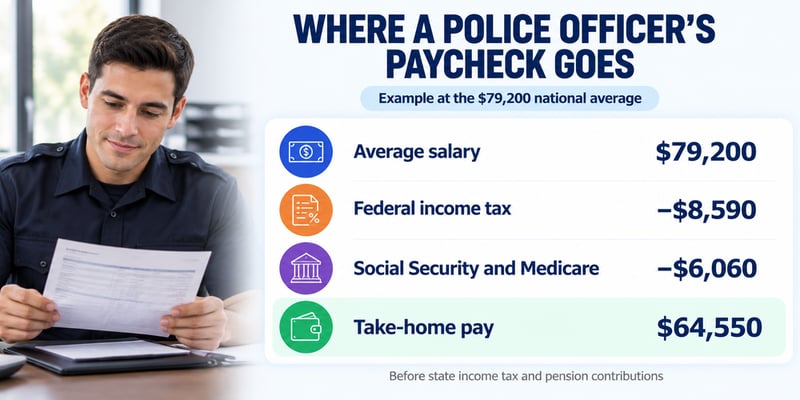
As a worked example, take a single filer earning the $79,200 national average in 2026. After the $16,100 standard deduction, federal income tax under the 2026 rates in IRS Revenue Procedure 2025-32 comes to about $8,590. Social Security and Medicare taxes at 7.65% take about $6,060 more, leaving about $64,550. That example leaves out state income tax and pension contributions, which vary by state and department. Officers not covered by Social Security do not pay the 6.2% Social Security tax.
Best states for cost-adjusted police pay
State | Avg. Salary | Price Index | Adjusted Value |
|---|---|---|---|
California | $112,980 | 110.7 | $102,040 |
Alaska | $101,770 | 102.4 | $99,420 |
Washington | $104,140 | 107.0 | $97,320 |
Delaware | $93,210 | 99.8 | $93,390 |
Illinois | $92,450 | 100.0 | $92,490 |
Colorado | $90,550 | 103.1 | $87,870 |
Iowa | $76,280 | 87.8 | $86,920 |
Nevada | $86,470 | 100.0 | $86,490 |
Minnesota | $85,130 | 98.6 | $86,320 |
New Jersey | $93,700 | 108.8 | $86,120 |
The price index is the BEA 2024 regional price parity for all items, where the US equals 100. Adjusted values are calculated from May 2025 BLS averages. Iowa, which ranks outside the top 10 for pay, moves to seventh after adjusting for prices.
Job Outlook
BLS growth projection and annual openings
The BLS employment projections show employment of police and sheriff's patrol officers growing 3.5% from 2025 to 2035, from about 693,200 jobs to 717,300, the same rate projected for all occupations. BLS expects about 51,500 openings a year, many of them to replace officers who move to other occupations or retire.
Trends shaping demand
BLS notes that even when crime rates fall, demand for police services to maintain public safety is expected to continue. Staffing shortages, retention bonuses, recruitment campaigns and new technology vary by department, and BLS does not publish national figures on them.
How to Increase Your Police Officer Salary
Earn a degree or certifications
A degree can add incentive pay in some states, such as Florida's monthly education incentive, and BLS notes that a bachelor's degree may be required for lieutenant or higher. Some federal agencies also require college coursework or a degree.
Pursue promotion and specialty units
Sergeants and lieutenants in local departments, whom BLS counts together, averaged $109,170, about $30,710 more than local patrol officers. Detectives in local government averaged $83,000. Promotion usually depends on exam scores and performance after probation.
Move to a higher-paying department or state
California, Washington and Alaska average more than $100,000, and California metros such as San Jose and San Francisco top $130,000. State police average $92,010, compared with $78,460 in local departments. Check each state's POST rules before moving, since certification may not transfer automatically.
Use overtime and secondary employment wisely
Overtime pays at least time and a half once an officer passes the threshold for the work period, and five extra hours a week at the national average adds about $14,850 a year. Approved off-duty details can add more, within department limits.
Frequently Asked Questions
How much does a police officer make per year?
Police and sheriff's patrol officers earned an average of $79,200 a year in May 2025, according to BLS, and the median was $76,210. The lowest-paid 10% earned under $47,510, and the top 10% earned more than $115,120. Overtime and incentive pay can raise yearly earnings above these base figures.
How much does a police officer make per hour?
The average police officer hourly wage was $38.08 in May 2025, and the median was $36.64. State averages ranged from $22.60 an hour in Mississippi to $54.32 in California. Overtime is paid at time and a half once an officer passes the threshold for the department's work period.
What is the average police officer salary in the US?
The average police officer salary in the US was $79,200 a year, or $38.08 an hour, in May 2025, based on BLS data for about 670,520 police and sheriff's patrol officers. The median, which is less affected by high earners, was $76,210 a year.
How much do police officers make when they start?
Starting pay depends on the department. The NYPD's 2026 exam notice lists a minimum salary of $55,942, and the LAPD's pay ranges start at $93,730 and $97,363. Nationally, the lowest-paid 10% of police officers earned under $47,510 in May 2025.
How much do police officers make in their first year?
First-year pay is usually the department's starting step. BLS does not publish pay by experience, but the 10th percentile was $47,510 and the 25th percentile $59,290 in May 2025. Large departments pay more, such as the NYPD's $55,942 minimum and the LAPD's $93,730 starting rate.
Which state pays police officers the most?
California pays police officers the most, with an average of $112,980 a year, or $54.32 an hour, in May 2025. Washington followed at $104,140 and Alaska at $101,770. California stays first even after adjusting for its prices, which are the highest of any state.
Which state pays police officers the least?
Mississippi pays police officers the least, with an average of $47,010 a year, or $22.60 an hour, in May 2025. Arkansas followed at $49,850 and Louisiana at $51,250. Prices in these states are well below the US average, which narrows the gap in real pay.
How much do police detectives make?
Detectives in local government earned an average of $83,000 a year, or $39.90 an hour, in May 2025. Across all employers, detectives and criminal investigators averaged $99,430, a figure raised by federal agents, who averaged $127,760. BLS notes that in large departments, officers may be promoted to detective.
How much do police sergeants make?
BLS counts sergeants with first-line supervisors of police and detectives. In local government, that group averaged $109,170 a year, or $52.49 an hour, in May 2025. Across all employers, the average was $112,190, and the top 10% earned more than $165,110.
How much do state troopers make?
Police officers employed by state governments, which include state troopers and highway patrol officers, earned an average of $92,010 a year, or $44.24 an hour, in May 2025. That is about $13,550 more than the $78,460 average for officers in local departments.
How much do federal police officers make?
Federal police officers in the BLS patrol officer occupation averaged $79,390 a year in May 2025. Federal criminal investigators, such as FBI agents and deputy US marshals, averaged $127,760. Criminal investigators also receive availability pay of 25% of basic pay, according to OPM.
Do police officers get paid overtime?
Yes. BLS reports that paid overtime is common for police. Under federal rules, public agencies can use a special work period for law enforcement, with overtime due after 171 hours in 28 days or a proportional amount for shorter periods. Overtime pays at least time and a half.
Can police officers make six figures?
Many do. The top 10% of police officers earned more than $115,120 in May 2025, and California, Washington and Alaska average over $100,000. Sergeants and lieutenants in local departments averaged $109,170, and the NYPD's schedule reaches $109,352 after five and a half years.
How much do police chiefs make?
BLS does not publish a separate figure for police chiefs. Their pay is set by each city, county or department and depends heavily on department size. For comparison, the top 10% of first-line supervisors of police and detectives earned more than $165,110 in May 2025.
Do police officers get a pension?
State and local police pension plans are run by a city, county or state, with terms that vary by plan. Federal law enforcement officers can retire at 50 with 20 years of service, or at any age with 25 years. Some officers also pay into Social Security.
How much do police academy recruits get paid?
Recruit pay is set by each department, and some departments hire only certified academy graduates. The NYPD's 2026 exam notice lists a minimum salary of $55,942, and the LAPD's pay ranges start at $93,730 and $97,363. No government source publishes a national recruit figure.
Does a college degree increase a police officer's salary?
It can. Florida pays officers $30 a month for a community college degree and an additional $50 for a bachelor's degree under state law. BLS notes that a bachelor's degree may be required for promotion to lieutenant or higher, and some federal agencies require a degree.
How much do police officers make in California, Texas and New York?
In May 2025, police officers averaged $112,980 a year in California, $76,160 in Texas and $87,110 in New York, according to BLS. California ranks first among the states, New York tenth. Texas employs about 63,100 officers, close to California's 65,940.
Is being a police officer a good career?
It offers above-average pay for an entry requirement of a high school diploma: the $76,210 median is higher than the $50,980 median for all occupations. BLS projects 3.5% job growth from 2025 to 2035, with about 51,500 openings a year. The work can be stressful and dangerous.
How do police officer salaries compare to correctional officer salaries?
Police and sheriff's patrol officers earned a median of $76,210 in May 2025, about $17,270 more than the $58,940 median for correctional officers and jailers. Police employment is projected to grow 3.5% from 2025 to 2035, while correctional officer jobs are projected to decline.
Comparing Police Officer Pay by State, Rank and Department
The average police officer earns $79,200 a year, or $38.08 an hour, and the middle 80% of officers earn between $47,510 and $115,120. California, Washington and Alaska average more than $100,000, while Mississippi averages $47,010. How much a police officer makes in a given job depends on location, rank and department: promotion to sergeant or lieutenant, a move to state police, or a high-paying metro can raise pay well above the national figure. Overtime, incentive pay, pensions and benefits add more on top of base salary. Dreambound helps people compare training programs for law enforcement and related careers. Wage figures come from the BLS Occupational Employment and Wage Statistics survey for May 2025 unless another source is named.
Police Officer Salary by State (Full Table)
# | State | Avg. Annual Salary | Avg. Hourly Wage | Rank |
|---|---|---|---|---|
1 | Alabama | $55,130 | $26.51 | 47 |
2 | Alaska | $101,770 | $48.93 | 3 |
3 | Arizona | $81,720 | $39.29 | 17 |
4 | Arkansas | $49,850 | $23.96 | 49 |
5 | California | $112,980 | $54.32 | 1 |
6 | Colorado | $90,550 | $43.54 | 7 |
7 | Connecticut | $83,920 | $40.35 | 13 |
8 | Delaware | $93,210 | $44.81 | 5 |
9 | Florida | $75,320 | $36.21 | 24 |
10 | Georgia | $58,520 | $28.14 | 45 |
11 | Hawaii | $90,360 | $43.44 | 8 |
12 | Idaho | $70,860 | $34.07 | 28 |
13 | Illinois | $92,450 | $44.45 | 6 |
14 | Indiana | $75,130 | $36.12 | 26 |
15 | Iowa | $76,280 | $36.67 | 22 |
16 | Kansas | $61,450 | $29.55 | 41 |
17 | Kentucky | $59,840 | $28.77 | 44 |
18 | Louisiana | $51,250 | $24.64 | 48 |
19 | Maine | $69,830 | $33.57 | 33 |
20 | Maryland | $82,400 | $39.62 | 15 |
21 | Massachusetts | $83,230 | $40.01 | 14 |
22 | Michigan | $70,310 | $33.80 | 32 |
23 | Minnesota | $85,130 | $40.93 | 12 |
24 | Mississippi | $47,010 | $22.60 | 50 |
25 | Missouri | $62,520 | $30.06 | 39 |
26 | Montana | $69,540 | $33.43 | 34 |
27 | Nebraska | $75,290 | $36.20 | 25 |
28 | Nevada | $86,470 | $41.57 | 11 |
29 | New Hampshire | $70,630 | $33.96 | 29 |
30 | New Jersey | $93,700 | $45.05 | 4 |
31 | New Mexico | $66,700 | $32.07 | 36 |
32 | New York | $87,110 | $41.88 | 10 |
33 | North Carolina | $61,390 | $29.51 | 42 |
34 | North Dakota | $72,400 | $34.81 | 27 |
35 | Ohio | $76,730 | $36.89 | 20 |
36 | Oklahoma | $63,120 | $30.34 | 38 |
37 | Oregon | $87,990 | $42.30 | 9 |
38 | Pennsylvania | $81,910 | $39.38 | 16 |
39 | Rhode Island | $78,760 | $37.86 | 18 |
40 | South Carolina | $60,420 | $29.05 | 43 |
41 | South Dakota | $64,320 | $30.93 | 37 |
42 | Tennessee | $61,830 | $29.72 | 40 |
43 | Texas | $76,160 | $36.62 | 23 |
44 | Utah | $78,760 | $37.87 | 19 |
45 | Vermont | $70,560 | $33.92 | 30 |
46 | Virginia | $70,450 | $33.87 | 31 |
47 | Washington | $104,140 | $50.07 | 2 |
48 | West Virginia | $55,900 | $26.88 | 46 |
49 | Wisconsin | $76,560 | $36.81 | 21 |
50 | Wyoming | $67,080 | $32.25 | 35 |
51 | District of Columbia | $92,390 | $44.42 | Not ranked (not a state) |
Figures are BLS May 2025 averages for police and sheriff's patrol officers (SOC 33-3051). Rank is by average annual salary among the 50 states; the District of Columbia is shown but not ranked.