How to Become a Cybersecurity Specialist in New Hampshire
See if you qualify for Cybersecurity programs
Answer a few questions in 2 minutes. Free, no commitment.
To become a cybersecurity specialist in New Hampshire, you build a foundation through a college degree or a shorter bootcamp, earn industry certifications like CompTIA Security+, and gain hands-on experience in an entry-level IT or security role. No state license is required, so your degree and certifications are what qualify you. Information security analysts in the state earn a median of $124,000 a year, according to BLS, and the field is projected to grow 29% nationally through 2034. What sets the path here apart is New Hampshire’s defense sector, led by employers like BAE Systems, which shapes the certifications that matter most.
Key Points
- Cybersecurity specialists protect networks, systems, and data from attacks, and the role does not require a state license in New Hampshire.
- You can qualify through an associate or bachelor’s degree, or a faster certification bootcamp, depending on your timeline and budget.
- Industry certifications carry as much weight with local employers as any single degree, especially in the defense sector.
- Information security analysts in New Hampshire earn a median $124,000 a year (BLS, May 2025), and the field is projected to grow 29% nationally from 2024 to 2034.
- Most people reach an entry-level role in two to four years through a degree, or in several months to a year through a bootcamp paired with certifications.
Cybersecurity Specialist in New Hampshire at a Glance
Career Snapshot | Detail |
|---|---|
Typical entry education | Bachelor’s degree per BLS, though associate degrees and bootcamps are common entry routes |
Common fields of study | Cybersecurity, information technology, computer science |
State license | None required in New Hampshire |
Credential employers screen for | CompTIA Security+ at entry level, CISSP or CISM at senior level |
Projected job growth (2024 to 2034) | 29% nationally for information security analysts |
Median pay in New Hampshire | $124,000 a year, or $59.62 an hour (BLS, May 2025) |
Typical time to first role | Two to four years via degree, several months to a year via bootcamp plus certification |

What Is Cybersecurity? The Three Core Principles
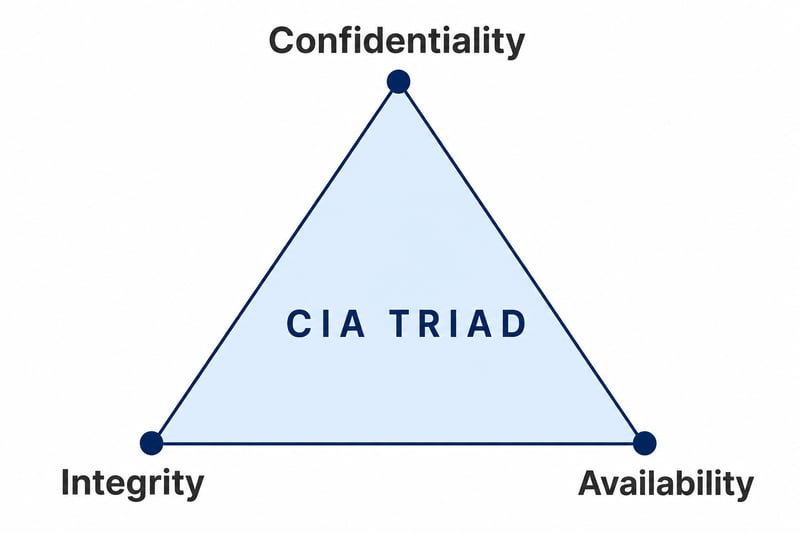
The federal Cybersecurity and Infrastructure Security Agency describes cybersecurity as the practice of protecting networks, devices, and data from unauthorized access or criminal use, and of ensuring the confidentiality, integrity, and availability of information. Those last three words are the framework the whole field is built on. Confidentiality means only authorized people can see the data. Integrity means the data has not been altered without authorization. Availability means the systems and data are there when legitimate users need them. Every control a specialist puts in place traces back to at least one of the three.
What a Cybersecurity Specialist Does
A cybersecurity specialist protects an organization’s networks, systems, and data from breaches, intrusions, and other digital threats. The job blends monitoring, investigation, and prevention. On a given day, a specialist might review security alerts, patch vulnerabilities, run threat assessments, and respond when something gets through.
Each of those tasks maps back to the three principles above. Access reviews and encryption protect confidentiality. Patching, logging, and change control protect integrity. Backup testing and incident response protect availability. Framing the work this way is also useful in interviews, because hiring managers often ask candidates to explain why a control matters rather than just name it.
In New Hampshire, these roles sit across a few core industries. The state’s defense contractors handle classified and controlled information that demands strict security controls, its hospitals and health-tech firms protect patient data, and its financial-services employers guard accounts and transactions. That mix means a specialist here might work in a security operations center, a compliance role, or hands-on network defense.
How to Become a Cybersecurity Specialist in New Hampshire
Most people reach an entry-level cybersecurity role in New Hampshire within two to four years through a degree, or in under a year through a bootcamp paired with certifications. Which route fits depends on your budget, your timeline, and whether you already have IT experience.
Step 1: Build Your Foundation With a Degree or Bootcamp
Start by getting the core knowledge, either through a college degree or a focused bootcamp. A high school diploma or its equivalent is the only baseline requirement to begin. From there, an associate degree covers the fundamentals in about two years, a bachelor’s degree, which BLS lists as the typical entry education, runs about four, and a bootcamp can move you through the core material in a matter of months. The state has both routes close to home: Southern New Hampshire University in Manchester offers online cybersecurity degrees, the public University of New Hampshire offers degree programs in the field, and Nashua-based Unique System Skills runs certification bootcamps. If you already work in IT, you can often transfer that experience and some certifications toward a degree and shorten the path.
Compare cybersecurity programs available to New Hampshire students on Dreambound to see how degree and bootcamp options line up by format and length.
Step 2: Earn the Certifications Employers Screen For
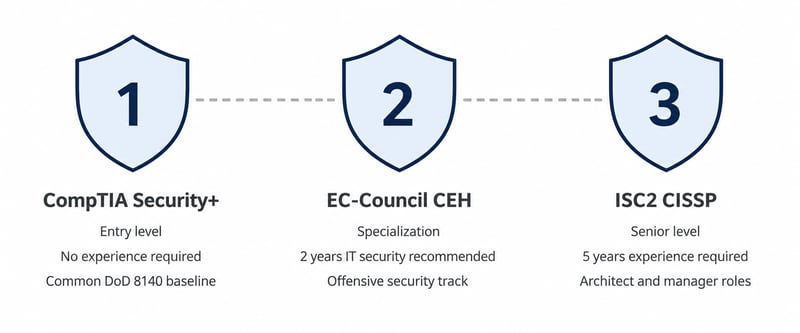
In hiring, certifications often carry as much weight as the degree, because they prove specific, current skills. CompTIA Security+ is the standard entry-level credential and the one employers most commonly list for junior roles. From there, specialists often add the EC-Council Certified Ethical Hacker for offensive security work, or the ISC2 CISSP once they have the experience it requires, which is typically five years. If you plan to work with a defense contractor, the certification you choose matters even more.
Cost is worth planning for early, because exam fees are usually out of pocket unless an employer or a funded training program covers them.
Certification | Exam cost (USD) | Experience required | Where it fits |
|---|---|---|---|
CompTIA Security+ | About $425 to $440 for a voucher | None required, about two years of IT background suggested | First security job, and the common DoD 8140 baseline |
EC-Council CEH | Priced with training packages, plus a $100 eligibility application fee for self-study candidates | Two years of IT security recommended | Offensive security and penetration testing tracks |
ISC2 CISSP | $749, plus a $135 annual maintenance fee | Five years of paid work experience | Senior specialist, architect, and manager roles |
$575 members, $760 non-members | Experience application required after passing | Audit, risk, and compliance work | |
$575 members, $760 non-members | Experience application required after passing | Security management and leadership |
Exam fees listed are the published prices as of August 2026. Certifying bodies adjust pricing periodically, so confirm the current fee before you register.
Step 3: Gain Experience and Move Into a Specialist Role
Most specialists do not start in security. They enter through a related IT job, such as help desk, network administration, or systems support, then move into security after a year or two of learning how real infrastructure works. Entry-level security titles to target include SOC analyst, security analyst, and information security analyst.
That first IT job is doing more than filling time. Help desk work teaches you how users actually behave, network administration teaches you what normal traffic looks like, and both make the alerts you will triage later far easier to read. Employers know this, which is why a candidate with two years of hands-on IT and a Security+ often interviews better than a candidate with a degree and no production experience.
Step 4: Build Practical Skills Outside the Classroom
Coursework and certifications prove you know the concepts. Practical work proves you can apply them, and it is the part most entry-level candidates skip.
- Capture the Flag competitions. CTF events give you deliberately vulnerable systems to break into or defend under time pressure. Free platforms like TryHackMe and Hack The Box run guided rooms and challenges you can work through at your own pace, and the write-ups you produce afterward double as portfolio pieces.
- The National Cyber League. NCL runs seasonal individual and team competitions built for students and career changers, covering areas like log analysis, cryptography, and network traffic analysis. Competitors receive a performance report breaking down their results by skill area, which is a rare thing to be able to hand a hiring manager alongside a resume.
- A home lab. A few virtual machines on a spare laptop are enough to practice setting up a firewall, running a vulnerability scan, or collecting logs into a SIEM. Documenting what you built and what broke is often more persuasive in an interview than the lab itself.
- Open-source and community contributions. Writing detection rules, documenting a tool, or reporting a bug through a coordinated disclosure program all leave a public record of your work.
Featured Cybersecurity Programs on Dreambound
Dreambound lets you compare cybersecurity programs across the country, including degrees and bootcamps available to New Hampshire students, in one place.
AS in Cybersecurity - Southern New Hampshire University
- Format: Online
- Tuition: $320 per credit (60 credits)
- Transfers into SNHU’s NSA-validated BS in Cybersecurity
BS in Cybersecurity - Southern New Hampshire University
- Format: Online
- Structured as six 8-week terms per year
- Recognized as an NSA-validated program of study
Cybersecurity Essentials - Unique System Skills
- Format: Online
- Tuition: $6,210
- Prepares students for the EC-Council Ethical Hacking certification
- WIOA-approved, which can cover tuition for eligible New Hampshire residents
Both SNHU degrees are delivered online from a Manchester-based university, so if you want to weigh them against in-person and hybrid options nearby, the cybersecurity classes in Manchester page lists what is available in that area. Dreambound also lists SNHU’s online master’s in cybersecurity for advancement and a Nashua-based cloud security bootcamp for specialization. You can browse these and other cybersecurity programs on Dreambound to find the format and pace that fit your goals.
Paying for a Cybersecurity Program in New Hampshire
Cybersecurity programs in New Hampshire run from a few thousand dollars for a bootcamp to more for a full degree, and several funding routes can bring the cost down. Workforce Innovation and Opportunity Act (WIOA) funding, administered through the state, can cover approved training for eligible residents, including some of the bootcamp options listed on Dreambound. Veterans and service members can often put GI Bill benefits toward degree programs and some certifications, which matters in a state with a large defense presence. Degree programs like SNHU’s may qualify for federal financial aid through the FAFSA, and some employers offer tuition reimbursement for job-relevant coursework.
Cybersecurity Specialist Salary in New Hampshire
Information security analysts in New Hampshire earn a median wage of $124,000 a year, or $59.62 an hour, according to May 2025 BLS Occupational Employment and Wage Statistics data. That sits right at the national median for the occupation, which is a strong figure for a field you can enter without a four-year degree. Nationally, the work is projected to grow 29% from 2024 to 2034, much faster than the average across all jobs, with about 16,000 openings a year.
Pay here tracks the strength of the local market. Demand concentrates in the state’s defense, health-tech, and financial-services employers, where security work is business-critical rather than optional, and where senior and specialized roles push well above the median.
Where Cybersecurity Specialists Work in New Hampshire
The title looks similar across job postings, but the day-to-day work changes a great deal depending on who signs the paycheck. Four employer types account for most of the openings in the state.
Defense contractors and their suppliers. Concentrated in the southern tier around Nashua, Merrimack, and Hudson. Expect controlled environments, formal documentation, and certification requirements written into the contract. Many of these roles require or lead to a security clearance.
State and local government. The New Hampshire Department of Information Technology runs the state’s cyber incident response plan, maintains a cybersecurity policy library, and operates reporting channels for municipalities and school administrative units. Public-sector pay usually sits below private-sector pay at the same level, but the work covers a wide range of systems, and the state administers federal cybersecurity grant funding that supports local government security work.
Private sector, especially health tech and financial services. These roles are shaped by regulation. Health-tech and hospital employers work against HIPAA requirements and patient-data protection, while financial-services employers work against fraud prevention, transaction monitoring, and audit expectations. Compliance-flavored certifications carry extra weight here.
Freelance and consulting. Independent consultants and small firms serve the many New Hampshire businesses too small to staff a security team, handling assessments, policy work, and incident cleanup. This route generally needs several years of employed experience first, since clients are buying judgment rather than supervision.
New Hampshire’s Defense Sector and DoD 8140 Certifications
New Hampshire’s cybersecurity job market is shaped by its defense industry to a degree most states are not. BAE Systems, one of the state’s largest private employers, runs major defense-electronics operations in Nashua, Merrimack, and Hudson, alongside other contractors and suppliers across the southern part of the state. Financial-services employer Fidelity Investments in Merrimack and health-tech company Athenahealth in Manchester are two more of the region’s largest employers, both running substantial technology and security operations.
Working for a defense contractor comes with a specific credential requirement worth planning for early. Under the Department of Defense 8140 framework, which replaced the older DoD 8570, personnel in cybersecurity roles on defense contracts must meet qualification requirements for their assigned work role, and the department publishes qualification matrices listing the certifications that satisfy them. For many entry and intermediate roles, CompTIA Security+ appears on those lists, which is one reason the certification carries so much weight with employers here. If a defense-sector career is your goal, that makes Security+ an early priority.
A second thing to plan for is clearance. Many defense roles require an active or obtainable security clearance, and the sponsoring employer initiates that process after an offer rather than something you can pursue on your own. U.S. citizenship is a standard prerequisite, and the investigation takes months, so postings often distinguish between cleared candidates and clearable ones.
Stay Current: Professional Associations and Communities
Cybersecurity changes faster than most fields, and most certifications require continuing education credits to stay active. Professional bodies are the usual way people cover both at once.
- ISC2 administers the CISSP and offers chapter meetings, continuing-education webinars, and the entry-level Certified in Cybersecurity credential for people early in the path.
- ISACA administers CISA and CISM and leans toward governance, audit, and risk management, which suits specialists moving toward compliance work.
- ISSA, the Information Systems Security Association, runs local chapters and general-practitioner programming, and New England chapters draw members from across the region.
- SANS Institute publishes free reading rooms, webcasts, and newsletters alongside its paid training, and its research output is widely used as a reference by working practitioners.
Local meetups and regional security conferences are worth adding to that list. In a state this size, the person who reviews your resume may well be someone you have met at one.
Frequently Asked Questions
How long does it take to become a cybersecurity specialist?
It usually takes two to four years through a degree, or several months to about a year through a bootcamp paired with certifications. The exact timeline depends on your starting point. Someone already working in IT can move into a security role faster than someone starting from scratch.
Do you need a degree to work in cybersecurity in New Hampshire?
No. New Hampshire has no state license or degree mandate for cybersecurity work. Many specialists hold a bachelor's degree, which BLS lists as the typical entry path, but others break in through an associate degree or a bootcamp paired with credentials like CompTIA Security+. On Dreambound, you can weigh degree and bootcamp options side by side to see which fits your timeline.
How much does the CompTIA Security+ exam cost, and is it worth taking before applying for jobs?
A Security+ voucher runs roughly $425 to $440 as of August 2026, and bundles that add practice material or a retake cost more. Taking it before you apply is usually the stronger move in New Hampshire, because Security+ appears on DoD 8140 qualification lists and defense-sector postings frequently screen for it. Holding the credential first means you meet the filter rather than asking an employer to wait while you earn it.
What is the difference between CompTIA Security+ and CISSP for a first cybersecurity job?
Security+ is the entry credential and CISSP is not. Security+ has no experience requirement and covers foundational security concepts, so it is the one to target for a first role. CISSP requires five years of paid work experience across its domains and is aimed at senior specialists, architects, and managers. Candidates who pass the CISSP exam without the experience become an ISC2 Associate until they accumulate it.
Do you need a security clearance to work for a defense contractor in New Hampshire?
It depends on the role. Some positions at defense employers support unclassified corporate systems and need no clearance, while roles touching classified or controlled program information do. Clearances are sponsored by the employer after an offer, require U.S. citizenship, and take months to process, so job postings usually specify whether an active clearance is required or whether the employer will sponsor one.
Can you become a cybersecurity specialist through a bootcamp alone, without a degree?
It is possible, and it happens most often for people who already have IT experience to pair with the training. A bootcamp plus a certification like Security+ can qualify you for entry-level security work in New Hampshire, since no license or degree is mandated. Starting with no technical background at all, the more common route is a bootcamp followed by a help desk or support role, then a move into security once you have production experience.
Can you make $200,000 a year in cybersecurity?
Yes, though it is not the norm. Information security analysts earn a median of $124,000 a year in New Hampshire, and senior specialists, security architects, and managers in high-cost markets can reach $200,000 or more. Getting there usually takes years of experience plus advanced certifications like the CISSP.
Is 40 too old to start a cybersecurity career?
No. Cybersecurity hires on demonstrated skill and certifications rather than age, and career-switchers from IT, the military, and other analytical fields are common. Prior work experience, especially in IT, networking, or the military, often shortens the path rather than lengthening it.
Is a two-year cybersecurity degree worth it?
For many people, yes. An associate degree costs less and takes about half the time of a bachelor's, and it can qualify you for entry-level roles or transfer into a bachelor's later. In New Hampshire, SNHU's associate degree transfers directly into its NSA-validated bachelor's, so the credits are not wasted if you continue.
Planning Your Cybersecurity Path in New Hampshire
The strongest move here is to match your training to where the jobs actually are. Because the state's defense contractors and their DoD 8140 qualification requirements drive so much of the demand, earning CompTIA Security+ early gives you a credential that holds up whether you finish a degree or a bootcamp. You do not need a state license, and you do not need to pick the longest path to be taken seriously.
Once you know whether a degree or a faster bootcamp fits your situation, look through New Hampshire's cybersecurity options on Dreambound to find one that matches your budget and schedule.