How to Become a Registered Nurse: Step-by-Step RN Guide
See if you qualify for Registered Nurse programs
Answer a few questions in 2 minutes. Free, no commitment.
To become a registered nurse (RN), you graduate from a state-approved nursing program, pass the NCLEX-RN, and get licensed by the board of nursing in the state where you plan to work. The biggest decision is your degree. An Associate Degree in Nursing (ADN) is the fastest, lowest-cost route, while a Bachelor of Science in Nursing (BSN) takes longer and is the degree some employers, particularly hospitals, require. Both lead to the same exam and the same license. If you already hold a bachelor's degree in another field, an accelerated BSN takes 12 to 18 months. Registered nurses earned a median of $97,550 in May 2025, and the Bureau of Labor Statistics projects about 180,800 openings a year through 2035. Each state board issues its own license, so where you plan to work shapes the process as much as your degree does.
Key Points
- Every RN takes the same three steps: finish a state-approved nursing program, pass the NCLEX-RN, and get a state license.
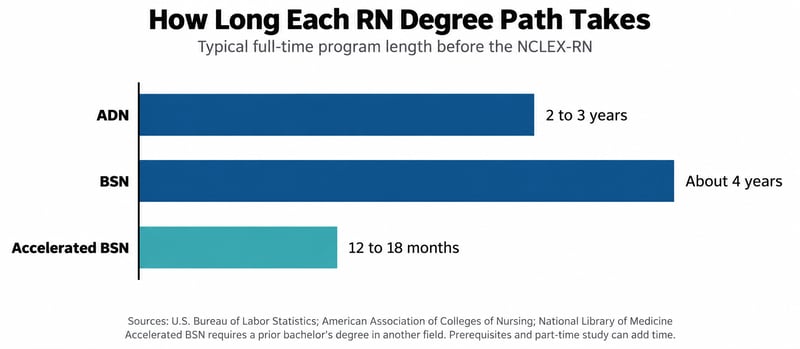
- An ADN takes about 2 to 3 years, a BSN about 4, and an accelerated BSN 12 to 18 months if you already hold a bachelor's degree.
- The NCLEX-RN costs $200 to register (rising to $350 on Feb. 1, 2027), has 85 to 150 items, and lasts up to 5 hours.
- ADN and BSN graduates pass the NCLEX-RN at nearly the same rate: 86.1% and 87.6% on the first try in 2025.
- New York requires RNs licensed after June 18, 2020 to earn a BSN within 10 years of licensure.
What Does a Registered Nurse Do?
A registered nurse is a licensed nurse who assesses patients, gives medications and treatments, and plans and coordinates care.
Day to day, an RN's professional responsibilities include:
- Assessing patients' conditions.
- Recording medical histories and symptoms.
- Administering medicines and treatments.
- Setting up care plans or contributing to existing ones.
- Consulting and collaborating with doctors and other healthcare professionals.
- Operating and monitoring medical equipment.
- Helping perform diagnostic tests and analyzing the results.
- Teaching patients and their families how to manage illnesses or injuries.
According to the Bureau of Labor Statistics, hospitals employ 59% of registered nurses, followed by ambulatory healthcare services at 19%, nursing and residential care facilities at 6%, government at 5%, and educational services at 3%. For a deeper breakdown of these clinical environments, the American Nurses Association offers a fuller overview of what the role involves.
Some registered nurses oversee licensed practical nurses, nursing assistants, and home health aides. See how the roles compare in LPN vs RN and CNA vs RN.
Registered Nurse Requirements at a Glance
The core requirements are the same in every state, while each state board and each school sets the details.
Requirement | What it involves | Source |
|---|---|---|
Education | Graduate from a state-approved ADN, BSN, or diploma program | BLS |
Licensing exam | NCLEX-RN: 85 to 150 items, up to 5 hours, $200 ($350 from Feb. 1, 2027) | NCSBN / NCLEX.com |
State license | Apply to your state board; background checks and other requirements vary by state | BLS |
State extras (example) | New York: infection control and child abuse reporting coursework, and a BSN within 10 years for RNs licensed after June 18, 2020 | NYSED |
Program admission | Set by each school: science prerequisites, an entrance exam such as the TEAS or HESI, GPA, background check, immunizations | Varies by program |
How to Become a Registered Nurse Step by Step
How to become an RN follows the same four steps in every state, from your first school application to an active state license.
Step 1: Meet the Admission Requirements
Each nursing program sets its own admission requirements and application deadlines, so check them with every school on your list before you apply.
Requirements differ by program and may include:
- Science Prerequisite Courses: Completing classes such as anatomy, physiology, and microbiology.
- Standardized Entrance Exams: Taking a nursing pre-admission test, such as the TEAS (Test of Essential Academic Skills) or the HESI (Health Education Systems, Inc.) exam.
- Academic Benchmarks: Meeting the minimum cumulative grade point average (GPA) the program sets.
- Health and Safety Clearances: Passing a criminal background check and submitting proof of up-to-date immunizations before clinical rotations begin.
Step 2: Complete a State-Approved Nursing Program
To sit for the NCLEX-RN, you must graduate from a program approved by your state board of nursing. National accreditation from the Accreditation Commission for Education in Nursing (ACEN) or the Commission on Collegiate Nursing Education (CCNE) is separate, and it matters for transferring credits, going on to a BSN or graduate degree, and some employers.
The primary educational pathways include:
- Associate Degree in Nursing (ADN): Takes two to three years to complete at a local community college or technical school.
- Bachelor of Science in Nursing (BSN): Requires four years of traditional study at a university.
- Accelerated BSN (ABSN): Takes 12 to 18 months for individuals who already hold a bachelor's degree in a non-nursing field.
Every academic route pairs classroom instruction with supervised, hands-on clinical hours in real healthcare settings. If a program lists its format as "online," this means your theoretical coursework is completed via a web portal while your required clinical rotations still take place in person. Fully online nursing degrees are completion programs, such as RN-to-BSN, for nurses who already hold an RN license.
For the full timeline by path, including prerequisites and board processing, see how long it takes to become a registered nurse.
Step 3: Pass the NCLEX-RN Exam
After graduation, you take the NCLEX-RN, the uniform national licensing exam used by every state board.
The primary logistics of the exam include:
- Registration Cost: The baseline testing fee is $200 per attempt, rising to $350 on Feb. 1, 2027, according to the NCLEX fee schedule.
- Test Format: The exam uses computerized adaptive testing, presenting a variable format of 85 to 150 questions.
- Time Constraints: You have a maximum of five hours to complete the entire test.
- The ATT Window: Once your board approves you, you get an Authorization to Test (ATT). You must test within the dates on it, which your board sets.
In 2025, 86.7% of first-time U.S.-educated candidates passed, according to NCSBN's 2025 NCLEX Examination Statistics. Under the NCSBN retake policy, candidates who do not pass can retake the exam after at least 45 test-free days, and some boards require a longer wait.
Step 4: Apply for Your State License
You apply for licensure to the board of nursing in the state where you plan to work. The board confirms your education, reviews your background check, and makes you eligible to test. After you pass the NCLEX-RN, it issues your license.
Some boards add their own requirements. New York, for example, requires approved coursework in child abuse identification and reporting for licensure, and infection control coursework every four years for practicing RNs. Timing also differs by state. The North Carolina Board of Nursing asks candidates to register with Pearson VUE at least two weeks before finishing their program, while the California Board of Registered Nursing lists 10 to 12 weeks to process exam applications. Check your board's current steps before you set a start date.
ADN vs BSN: Which Nursing Path Fits You
Your choice depends on your current starting point, your personal timeline, and where you want your healthcare career to go. An Associate Degree in Nursing (ADN) and a Bachelor of Science in Nursing (BSN) both lead to the exact same RN license. What differs is the completion time, the upfront educational costs, and where each credential can take you long-term.
An ADN is the shorter, lower-cost path to the NCLEX-RN. A BSN takes longer to earn. According to the Bureau of Labor Statistics, licensed graduates of all three program types (bachelor's, associate's, and diploma) qualify for entry-level staff nurse jobs, but employers, particularly hospitals, may require a bachelor's degree. New York requires RNs licensed after June 18, 2020 to earn a BSN within 10 years.
The exam barely separates the paths: 86.1% of ADN graduates and 87.6% of BSN graduates passed the NCLEX-RN on the first try in 2025, according to NCSBN.
Nursing Degree Path | Typical Timeline | Core Educational Focus & Best For |
|---|---|---|
ADN (Associate Degree in Nursing) | 2 to 3 Years | The fastest, lowest-cost structural route into clinical practice. |
BSN (Bachelor of Science in Nursing) | About 4 Years | Traditional university path; the degree some hospital employers require, and often necessary for administrative roles. |
Accelerated BSN (ABSN Pathway) | 12 to 18 Months | Fast-track university path designed for students who already hold a bachelor's degree in a non-nursing field. |
LPN / LVN to RN Bridge | Varies by school; see the LPN vs RN guide | Specialized bridge curriculum for practicing practical nurses looking to upgrade their license. |
Another path is to start with an ADN, get licensed, and finish a BSN later through an RN-to-BSN program, including online options.
Educational costs separate these two routes as well. A community-college ADN is usually the lowest-cost path, while a traditional four-year university BSN runs considerably higher. Your total out-of-pocket balance will also depend on your local residency status, how many prerequisite courses you have already completed, and specific program fees. Federal student aid through the FAFSA, alongside institutional school scholarships, can help offset the tuition costs of either selection.
Featured Nursing Programs on Dreambound
These RN programs are listed on Dreambound. Each links to its listing, where you can check the format, location, and any published program length.
Associate Degree in Nursing (ADN) Programs
Nursing (RN) Associate's - ECPI University, Charlotte, NC
- Format: Hybrid
AAS in Nursing - Las Vegas College, Las Vegas, NV
- Format: In-person
Bachelor of Science in Nursing (BSN) Programs
Bachelor of Science in Nursing - Northbridge University College of Nursing, Tampa, FL
- Format: In-person
- Length: 3 years
Bachelor of Science in Nursing - Herzing University, Milwaukee, WI
- Format: Online
- Length: 3 years, year-round
- Clinical hours: 585
These programs are a small sample of the RN listings on Dreambound. You can also compare associate degree nursing programs near you and BSN programs near you, or browse RN programs near you by state.
RN Pay and Job Outlook
The Bureau of Labor Statistics reports these national figures for registered nurses:
- Median pay of $97,550 a year, or $46.90 an hour, in May 2025.
- The lowest 10% earned less than $68,940, and the highest 10% earned more than $137,470.
- Employment is projected to grow 6% from 2025 to 2035, faster than the average for all occupations, with about 180,800 openings a year.
Working as an RN Across States
The national NCLEX-RN exam is standardized across the country, but your physical nursing license is not. Each individual state board issues its own distinct RN license, and how easily you can practice across state lines depends entirely on the Nurse Licensure Compact.
Through the Nurse Licensure Compact, a multistate license allows working nurses to practice across 43 member jurisdictions without forcing them to apply separately for local credentials in each area.
However, California and New York are not compact members. If you are licensed in a compact jurisdiction and want to move your career to California or New York, you must submit a formal application for a brand-new license by endorsement. Furthermore, if you change your primary residence from one compact state to another, you have a strict 60-day window to apply for a license in your new home state.
Some candidates face additional rules on top of the national standard:
- New York State Requirements: Under the BSN in 10 law, RNs licensed after June 18, 2020 who hold an associate degree are legally required to earn a BSN within 10 years of initial licensure. New York also mandates specialized training modules covering infection control and child abuse reporting.
- International Candidates: If you completed your nursing education outside the United States, your state board reviews it before you can take the NCLEX-RN, and the process differs by state. Texas and Virginia require a report from a board-approved credential evaluation service, and Virginia's approved list includes TruMerit™ (formerly CGFNS International). California reviews transcripts directly. Both also require an English proficiency exam for some applicants, such as those whose nursing program was not taught in English, with exemptions set by each board.
Frequently Asked Questions
What do you need to get into a registered nurse program?
Exact requirements are set by each individual institution. Programs may expect applicants to complete foundational science prerequisite courses, meet a minimum cumulative grade point average (GPA), and take an entrance exam such as the TEAS or HESI. Programs may also require a criminal background check and up-to-date immunizations. Check each school's requirements and deadlines before you apply.
Can you become a registered nurse online?
No, a pre-licensure RN program cannot be completed fully online. All initial nursing tracks require supervised, in-person clinical hours inside actual healthcare facilities, which rules out a fully remote option for your first license. While a program may be marketed as "online," this simply means your textbook coursework is delivered via a web portal while your clinical rotations remain on-site. Fully online nursing degrees are completion programs, such as RN-to-BSN, for nurses who already hold an RN license. To see which programs offer coursework online, compare online registered nursing classes.
How much does the NCLEX-RN cost?
Registration costs $200 today and rises to $350 on Feb. 1, 2027. Changing the nursing regulatory body you registered with costs $50, according to NCLEX.com.
Is a nurse the same as a registered nurse?
Not always. "Nurse" also covers licensed practical and vocational nurses, who finish a program of about a year and pass the NCLEX-PN. RNs finish an ADN, BSN, or diploma and pass the NCLEX-RN.
Do ADN and BSN graduates take the same licensing exam?
Yes. Both take the NCLEX-RN and get the same license. First-time pass rates in 2025 were 86.1% for ADN graduates and 87.6% for BSN graduates, according to NCSBN.
Can a CNA or LPN become a registered nurse?
Yes. A CNA follows the same path as any other applicant: complete an ADN or BSN program, then pass the NCLEX-RN. An LPN or LVN can also choose an LPN-to-RN bridge program, which is designed for licensed practical and vocational nurses, before taking the NCLEX-RN.
Choosing Your Path to Becoming an RN
The core administrative steps required to become a registered nurse are consistent nationwide, but two major decisions will shape your overall experience: the degree you choose to start with, and the specific state where you plan to build your career.
An ADN is the shorter route to the NCLEX-RN and a first license. A BSN takes longer and is the degree some employers, particularly hospitals, require. Your state's compact membership decides how easily your license travels across state lines.
Dreambound lists associate and bachelor's RN programs by format and location. Whichever degree you choose, your license comes from the board in the state where you plan to live and work, so check that board's requirements, and whether the state belongs to the Nurse Licensure Compact, before you apply.