How to Become a Surgical Tech: Steps, Education, and Certification
See if you qualify for Surgical Technician programs
Answer a few questions in 2 minutes. Free, no commitment.
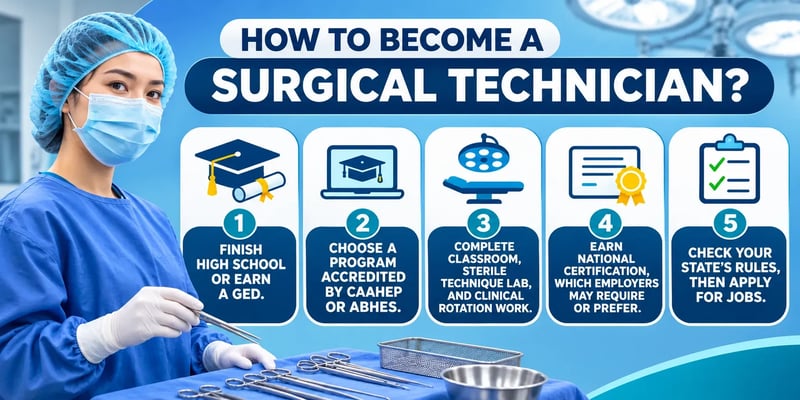
Here is how to become a surgical tech: finish high school or earn a GED, check your state's rules, then choose a surgical technology program accredited by CAAHEP or ABHES. After the coursework and clinical rotations, earn a national certification and start applying for jobs. According to the Bureau of Labor Statistics (BLS), employers may require or prefer certification, and some states regulate the job.
The program you pick matters most, because the Certified Surgical Technologist (CST) exam is open only to graduates of CAAHEP or ABHES accredited programs and to military program graduates. A second exam, the TS-C, accepts a wider set of routes. You will see the job called a surgical tech, a surgical technician, or a surgical technologist, and BLS uses the last of those.
Key Points
- Pick an accredited program first, since it decides which national exam you can take.
- Two exams exist, the CST from NBSTSA and the TS-C from NCCT, and they accept different routes.
- BLS reports a median wage of $64,650 and projects 5% job growth from 2025 to 2035.
- State rules vary, so check yours before you choose a program.

How to Become a Surgical Tech in 5 Steps
Five steps take you from applicant to working surgical technologist.
- Finish high school or earn a GED.
- Check your state's rules.
- Choose a program accredited by CAAHEP or ABHES.
- Finish the coursework and clinical rotations.
- Earn national certification, then apply for jobs.
1. Finish High School or Earn a GED
This is the starting requirement at the two college programs we checked. San Francisco State University's online certificate asks for a high school diploma and a minimum age of 18, while Skyline College accepts a diploma or a GED. Some programs also expect science courses before you apply, which the requirements section below covers.
2. Check Your State's Rules
Some states regulate surgical technologists, according to BLS, through certification, registration, or a rule placed on hospitals. Knowing this early tells you whether a credential is mandatory where you plan to work and how soon you would need it. Texas, New York, and Colorado are covered further down.
3. Choose a Program Accredited by CAAHEP or ABHES
Accreditation is the main thing to verify, because it decides which national exam you can take later. Confirm a program's status in CAAHEP's directory before you apply, then compare length and cost across the programs that pass.
4. Finish the Coursework and Clinical Rotations
You will learn in two settings: a classroom and lab first, then supervised time in real operating rooms. Even programs that teach online place you in person for the clinical portion.
5. Earn National Certification, Then Apply for Jobs
BLS notes that employers may require or prefer certification, so plan for the exam as you near graduation. The CST and the TS-C are the two options, and your program decides which one is open to you. Once you are certified, start applying to employers such as hospitals.
Surgical Tech Requirements Before You Apply
Programs set their own admission rules, so the list changes from school to school. Two programs that rank for this search show the range. San Francisco State University's online certificate asks applicants to be 18 with a high school diploma. Skyline College asks for a diploma or GED, plus anatomy with a lab, medical terminology, and microbiology, each passed with a C or better.
Those two examples show how education requirements for a surgical tech program can stack up: a diploma first, then college-level science courses. Skyline adds more after acceptance, including a physical exam, immunization records, a background check, a drug test, and a current basic life support certificate from the American Heart Association.
Read each program's admission page before you plan your timeline, since a missing prerequisite can delay your application.
Surgical Tech Training: What an Accredited Program Covers
Surgical tech training combines classroom study, sterile technique practice in a lab, and supervised clinical rotations in operating rooms. Surgical technologists typically need a certificate or an associate degree from an accredited program, according to the BLS training requirements, and students gain hands-on experience in clinical settings.
Accreditation is the checkpoint. The NBSTSA CST eligibility rules require graduation from a CAAHEP or ABHES accredited surgical technology program, with a separate route for military program graduates. You can confirm a program's status in CAAHEP's accredited program search, which lists only programs that are currently accredited or hold a Letter of Review.
When you are ready to narrow your list, use our guide to compare accredited surgical tech programs by clinical hours, cost, and schedule.
Certificate or Associate Degree?
Kaiser Permanente's surgical technologist pathway says surgical technologists typically need an associate degree and puts total program time at 13 to 24 months. Certificates run shorter.
Format | Length | Best suited for |
|---|---|---|
Certificate or diploma | From 4 months online (Preppy) | A shorter route when the TS-C exam fits your goals |
Associate degree | 13 to 24 months; 18 months at Rockford Career College | The CST route through a CAAHEP accredited program |
Skyline College's catalog and Austin Community College's program notice both say that graduates of CAAHEP accredited programs have needed at least an associate degree since August 2021. That is why the CST route sits in the associate degree row.
How Many Years Does It Take to Become a Surgical Tech?
Plan on roughly one to two years for an associate degree and several months for a certificate, with time for your exam on top. Admission steps and prerequisites can add time before your first class, and our guide to how long surgical tech programs take breaks the timeline into stages.

Certification in Brief: The Two National Exams
The CST, from NBSTSA, has the narrower entry: accredited program graduates and military program graduates. The TS-C from NCCT accepts more routes, including a student and graduate route tied to NCCT-authorized programs, an experience route, and a military route. Employers and states decide which credential they accept, and our guide to how the CST and TS-C compare covers eligibility, fees, and renewal.
Do You Need a State License?
It depends on where you work. Some states regulate surgical technologists, according to BLS, and the rules take different forms: certification, registration, or a requirement placed on hospitals and other facilities.
Texas puts the rule on employers. Under Chapter 259 of the Health and Safety Code, a facility may employ a graduate of an accredited program for 180 days after graduation, then needs proof of certification. Exceptions cover military training, federal service, and people already working in the field before September 2009. Our guide to the Texas surgical tech facility requirement explains how the rule works.
New York's Public Health Law asks surgical technologists to complete an accredited program and hold a credential from a nationally accredited organization. Employees who finish an accredited program may work up to 12 months before earning it, and 15 hours of continuing education are due each year. The details sit in our guide to New York's surgical technology law.
Colorado uses registration instead. Surgical technologists register with the state's Division of Professions and Occupations, and registrations expire every March 31, as covered in our guide to Colorado's annual surgical technologist registration.
For any other state, check the health department or licensing board before you finalize your plan.
Can You Become a Surgical Tech Without School or Online?
Coursework can be completed online at some programs, but the clinical portion happens in person. Preppy's online program, for example, places students at a local healthcare facility for its externship. That is the realistic version of how to become a surgical tech online: online classes, in-person clinical training. Our guide to how online surgical tech training works shows which parts you can complete from home.
Skipping school altogether is harder. A certificate or associate degree from an accredited program is the typical route, according to BLS, and both the CST and the Texas facility rule start with an accredited program. The TS-C experience route is no shortcut either. NCCT asks for at least 3 years of full-time, verifiable surgical technology experience within the past 5 years, so it fits someone already working in an operating room, not someone starting out.
What Surgical Techs Earn and the Job Outlook
Surgical technologists earned a median annual wage of $64,650 as of May 2025, and the occupation held 118,400 jobs in 2025, according to BLS. Hospitals employ 71% of them. The same source projects 5% growth from 2025 to 2035, faster than the 3% average for all occupations. Our guide to what surgical techs earn per year breaks pay down further.
Training Options You Can Compare on Dreambound
Dreambound is a free platform that helps you compare training programs across the United States. The three programs below are listed on Dreambound: two associate degrees and one certificate. None of their program pages names a programmatic accreditor such as CAAHEP or ABHES, so check each one in CAAHEP's search before you apply. Preppy's program prepares you for the TS-C rather than the CST.
Associate Degree Programs
AAS in Surgical Technology - Rockford Career College (Rockford, IL)
- Format: Hybrid
- Length: 18 months (102 quarter credit hours)
- Includes multiple supervised externship modules in hospitals and surgical centers
Surgical Technology Associate's - ECPI University (Manassas, VA)
- Format: Hybrid
- Offered at the Northern Virginia campus in Manassas, with financial aid available to those who qualify
Certificate Program
Online Surgical Tech Certificate - Preppy
- Format: Online
- Length: From 4 months
- Tuition: $1,599 total
- Includes local externship placement at a healthcare facility and prepares you for the NCCT TS-C exam, a different credential from the CST

Frequently Asked Questions
Is it hard to get into a surgical tech program?
Admission difficulty depends on the school and its prerequisites. Skyline College, for example, requires anatomy, medical terminology, and microbiology with a C or better, then admits about 20 students by lottery from the applicants who meet them. Once admitted, you move through classroom, lab, and clinical work.
Can you become a surgical tech without a degree?
Yes, certificate programs exist, and BLS lists a certificate as a typical way in. The difference shows up at the exam: a certificate that prepares you for the TS-C leads to a different credential than an accredited associate degree program that opens the CST. Compare programs on Dreambound to see which credential each one points to.
What is the difference between a surgical technician and a surgical technologist?
BLS uses surgical technologist as the main title and gives operating room technician as another name for the job, and NBSTSA certifies surgical technologists. The sources we reviewed do not define a separate technician role, so read the duties and requirements in a job posting rather than relying on the title. Our guide to what a surgical technician does covers the day-to-day work.
What should I do first if I am still in high school?
Finish your diploma or GED, then check the prerequisites of programs near you before you graduate, so no admission window catches you short. Our guide to steps to take in high school goes further.
Is surgical tech a good career?
It can be a good fit if you like detailed, team-based work in a hospital. Most surgical technologists work in hospitals and spend much of their time on their feet, according to BLS, and employment is projected to grow faster than average.
Your Next Step Toward a Surgical Tech Career
Your program choice decides whether the CST stays open to you, so verify accreditation before anything else.
Compare surgical tech programs on Dreambound by format and length, check each one's accreditation in CAAHEP's search, and look up your state's rules before you apply.