How to Find an Entry-Level Nursing Job in California
See if you qualify for training programs
Answer a few questions in 2 minutes. Free, no commitment.
To find an entry-level nursing job in California, choose your entry point (CNA, LVN, or new grad RN) and get the California credential before you apply. Then apply to new graduate residency cohorts and entry-level roles in more than one region. The market for nursing jobs in California rewards that order. In 2024-25, 83.6% of the state's new RN graduates were working in nursing in California, but 4.9% could not find a job, the highest share since 2015-16 (BRN, August 2026).
Demand has not gone anywhere: California projects about 22,890 RN, 8,160 LVN, and 17,270 nursing assistant openings a year through 2034. The calendar matters as much as the resume, though, because some residency application windows stay open for three days and many programs require an active California license by a fixed date.
Key Points
- California hires entry-level nurses at three levels: CNAs (CDPH certificate after 160 training hours), LVNs (BVNPT license after a program of at least 1,530 hours), and new grad RNs (BRN license after an ADN, BSN, or entry-level master's).
- At California's large health systems, new grad RN hiring runs through residency cohorts with fixed application windows, and Kaiser Permanente and Stanford Health Care do not accept an interim permit in place of a California RN license.
- In 2024-25, 83.6% of new RN graduates were working in nursing in California and 4.9% could not find a job (BRN).
- Every region except the Central Coast has an RN shortage in 2026, led by Sacramento at 8.1% (UCSF for the BRN, April 2026).
- California RNs earn a median of $140,270 a year, and the lowest-paid 10% earn $101,260 or less (BLS, May 2025).

Step 1: Choose Your Entry Point (CNA, LVN, or New Grad RN)
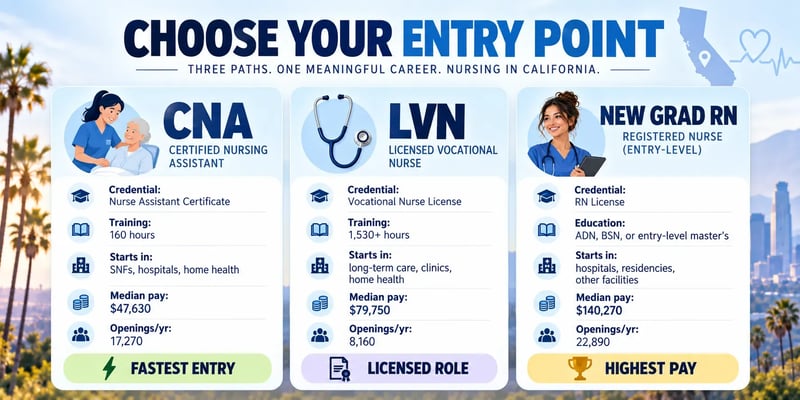
Entry-level nursing jobs in California come through three doors, and each one has its own credential, training length, and first employers. Where you start on the nursing career ladder decides how long training takes, who hires you first, and what the first paycheck looks like.
Entry point | California credential (agency) | Minimum training | Where new hires start | California median pay (BLS, May 2025) | Openings per year, 2024-2034 |
|---|---|---|---|---|---|
CNA | Nurse Assistant Certificate (CDPH) | 160 hours (60 classroom, 100 supervised clinical) | Skilled nursing facilities, hospitals, home health | $47,630 ($22.90 an hour) | 17,270 |
LVN | Vocational nurse license (BVNPT) plus the NCLEX-PN | At least 1,530 hours (576 theory, 954 clinical) | Skilled nursing and long-term care, clinics, home health, state correctional facilities | $79,750 ($38.34 an hour) | 8,160 |
New grad RN | RN license (BRN) plus the NCLEX-RN | BRN-approved ADN, BSN, or entry-level master's | Hospitals 61.0% of 2024-25 graduates, paid residencies 9.6%, other healthcare facilities 7.7%, long-term care 4.7% (BRN) | $140,270 ($67.44 an hour) | 22,890 |
Pay figures are BLS 2025 wage data for California and openings are Projections Central's 2024 to 2034 outlook, both published through O*NET OnLine.
CNA: The Fastest Way In
Training is short, and it can be free. Under the federal nurse aide training rules, nursing facilities cannot charge aides who are employed or hold a job offer when training starts. The state must also reimburse costs on a pro rata basis for aides hired within 12 months of finishing.
CDPH requires Live Scan fingerprinting with your training and exam application before any patient contact, and the competency exam runs through a CDPH-approved testing vendor. For CNA jobs with no experience, the shortest route is to become a CNA in California through a program at or partnered with a skilled nursing facility, where that no-charge rule applies.
LVN: A Licensed Role Without a Degree
The BVNPT licenses vocational nurses who are at least 17, have finished 12th grade or its equivalent, complete an approved program, pass the NCLEX-PN, and clear DOJ and FBI fingerprints. Processing the license takes 4 to 6 weeks once everything is in, and full-time programs run 12 to 14 months.
Many new LVNs start in skilled nursing, clinics, and home health, and the state's Licensed Vocational Nurse (CDCR) classification requires only a valid California LVN license and pays $3,983 to $7,500 a month. If you are weighing the two licenses, the guides on how to become an LVN in California and LVN vs. RN cover the trade-offs.
New Grad RN: Residency or Direct Hire
New grad RN jobs in California come two ways: a residency cohort, which is a paid, structured transition with a preceptor and classes, or a direct-hire new grad position on a unit that trains you itself. The BRN's 2024-25 survey shows where graduates landed. Hospitals hired 61.0%, paid residencies 9.6%, other healthcare facilities 7.7%, and long-term care 4.7%, and another 0.6% were in unpaid residencies. Step 3 compares the residency programs, and the entry-level registered nurse jobs outside hospitals get their own section in Step 5.
Step 2: Get Your California License Before You Apply
The order matters because California residency programs set hard license rules, and an application without the right credential can be screened out before anyone reads it. Each rule below comes from the program's own page:
- Kaiser Permanente requires an active California RN license and does not accept interim permits.
- Stanford Health Care wants a California RN license by a posted date and also rejects interim permits ("interim is not the same as a temporary CA RN license").
- Cedars-Sinai requires the license before you apply.
- UCLA Health, UC Davis Health, and Scripps Health want it by the program start date.
Credential | Agency | Exam | Processing time and notes |
|---|---|---|---|
CNA certificate | CDPH | Competency evaluation through a CDPH-approved testing vendor after an approved 160-hour program | Live Scan fingerprinting goes in with the training and exam application, before any patient contact |
LVN license | BVNPT | NCLEX-PN | 4 to 6 weeks to process the license under the BVNPT's summary of requirements, and applicants must be at least 17 |
RN license by exam | BRN | NCLEX-RN | 10 to 12 weeks to process exam applications, NCLEX results in 2 to 3 weeks, and an optional $100 interim permit 24 to 48 hours after the application is approved, per the BRN's current processing times (updated September 18, 2026). The application fee is $300 for California graduates. See how to become a registered nurse in California for the full BRN path |
RN license from another state | BRN, licensure by endorsement | NCLEX-RN already passed | 10 to 12 weeks. A six-month temporary license, processed in 2 to 3 weeks, lets you work while the application moves. California is not part of the Nurse Licensure Compact |
Apply to the board as soon as your school allows so that processing overlaps with graduation, and do not plan a residency application around an interim permit. For out-of-state nurses, the California RN license by endorsement is the same 10 to 12 week wait, so start it before you start applying.
Step 3: Apply to New Grad RN Residency Programs
A new grad RN residency is a paid, structured transition program for newly licensed RNs, usually 6 to 12 months long, with a preceptor, classes, and a cohort that starts together. Only 9.6% of California's 2024-25 RN graduates were in a paid residency when the BRN surveyed them. That understates how much hiring runs through these programs, because systems such as Sutter Health place every new grad hire in a residency automatically. The table compares nurse residency programs in California as they stood on October 6, 2026.
Health system (region) | Degree accepted | License rule | New grad window | Timing |
|---|---|---|---|---|
Kaiser Permanente (Northern and Southern California) | Accredited RN program, BSN preferred | Active California RN license, no interim permits | Degree within 12 months of the start date preferred, under 6 months of paid inpatient RN work | Three cohorts a year per market with three-day application windows, 2027 windows not yet posted |
Sutter Health (Northern California) | Not listed | Not listed | Less than 1 year of experience | No separate application, new grad RN hires are placed in the residency automatically |
Cedars-Sinai (Los Angeles) | ADN minimum (CCNE, ACEN, or ACS WASC accredited) | California RN license before you apply | Program completed within 12 months of applying, under 9 months of paid RN work | Several cohorts a year, positions post shortly before each |
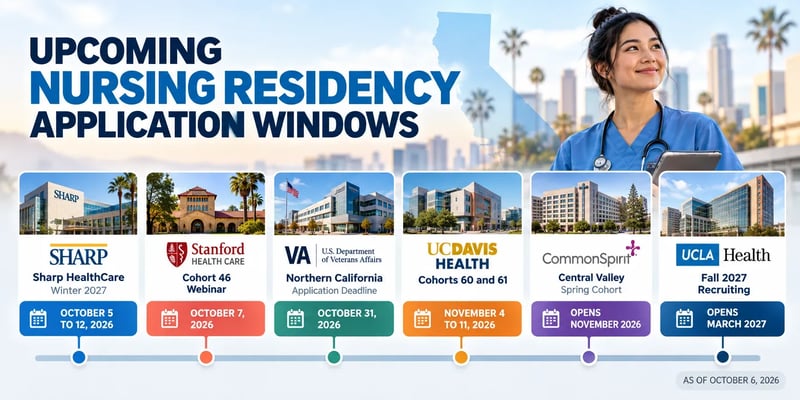
UCLA Health (Los Angeles) | BSN or MSN | California RN license by the start date | Under 6 months of inpatient RN experience | Two cohorts a year, Fall 2027 recruiting opens March 2027 |
UC San Diego Health (San Diego) | Not specified | Not specified | Under 6 months of nursing experience | March and September cohorts, postings go live about 5 months ahead |
UC Davis Health (Sacramento) | BSN or MSN strongly preferred | California RN license by the start date | Must be your first paid RN job | Four cohorts a year, next window November 4 to 11, 2026, 3 to 5 months to an offer |
Stanford Health Care (Bay Area) | ADN/ASN, BSN, or MSN | California RN license by a posted date, no interim permits | Graduated within 19 months of the cohort start, no more than 6 months (1,040 hours) of paid RN work | Cohort 46 application webinar October 7, 2026, 2027 dates not yet posted |
CommonSpirit / Dignity Health (five California regions) | Not listed | Not listed | Not listed | Central Coast and Southern California spring cohorts open October 1, Central Valley in November, North State in March, Sacramento's fall cohort opened July 8, 2026 |
Providence (California) | Accredited nursing program | Current RN license in the state where you apply | Under 12 months of RN experience | 2026 California cohort started August 24, 2027 dates not yet posted |
Sharp HealthCare (San Diego) | In the program FAQ | In the program FAQ | In the program FAQ | One-year program, Winter 2027 applications October 5 to 12, 2026, Spring 2027 applications around October 2026 |
Scripps Health (San Diego) | Accredited nursing program | California RN license by the start date | Program completed within 12 months of applying, 6 months or less of RN work | 40-week program, five 2026 cohorts with three-day external windows, 2027 calendar not yet posted |
VA Northern California (Sacramento area) | BSN or master's entry (MEPN), GPA 3.3 or higher | RN license from any U.S. state by the start date | Graduated less than a year before the start, no prior paid RN work, U.S. citizens only | 12 months with a $67,133 stipend, March 2027 cohort deadline October 31, 2026 |
Two notes. UCSF Health's residency, which accepts ASN, BSN, and MSN graduates with a degree earned within 18 months and a California license four weeks before the start, posted in April 2026 that it will not run in 2026. On accreditation, UC San Diego Health, UC Davis Health, Stanford Health Care, and Sharp HealthCare hold ANCC Practice Transition accreditation with distinction, Providence and several CommonSpirit sites hold ANCC accreditation, and the VA program is CCNE accredited.
How to Apply Without Missing a Window
How long are you considered a new grad nurse? Each employer sets its own clock: 12 months after finishing your program at Cedars-Sinai and Scripps Health, 18 months at UCSF, and 19 months at Stanford Health Care. At UC Davis Health, the residency has to be your first paid RN job. With that settled, the process is mostly logistics:
- Build a calendar from each program page, since some windows last three days (Kaiser Permanente and Scripps Health) or about a week (UC Davis Health and Sharp HealthCare).
- Line up documents early: resume, cover letter, two letters of recommendation for UCLA Health, transcripts, and an American Heart Association BLS card, which UC Davis Health, Providence, and Scripps Health require.
- Apply to several systems and regions in the same cycle.
- For Sutter Health, apply to new grad RN openings directly, because placement in the residency is automatic.
- For Kaiser Permanente, check the residency page by market, since Northern and Southern California post separate three-day windows.
Step 4: Search the Regions and Channels Where Hiring Happens
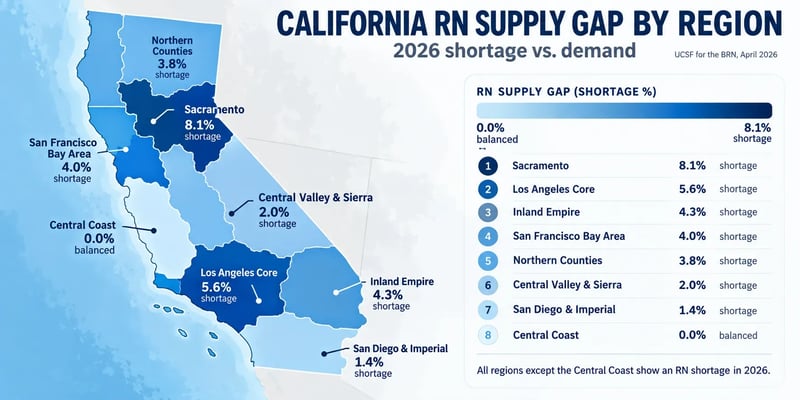
New grad RN jobs in Southern California and Northern California do not open on the same calendar, so a search across two regions widens your odds. The UCSF forecast prepared for the BRN in April 2026 shows where the gaps are widest, and which Step 3 programs sit in each region.
Region | 2026 RN supply gap vs. demand | Programs from Step 3 in the region |
|---|---|---|
Sacramento | 8.1% shortage | UC Davis Health, Sutter Health, Kaiser Permanente (Northern California), VA Northern California, CommonSpirit |
Los Angeles (the report's Los Angeles Core region) | 5.6% shortage | Cedars-Sinai, UCLA Health, Kaiser Permanente (Southern California), Providence, CommonSpirit (Los Angeles) |
Inland Empire | 4.3% shortage | Kaiser Permanente (Southern California), CommonSpirit (San Bernardino) |
San Francisco Bay Area, including San Jose and San Francisco | 4.0% shortage | Stanford Health Care, Kaiser Permanente (Northern California), Sutter Health, UCSF Health (paused in 2026) |
Northern Counties | 3.8% shortage | CommonSpirit (North State) |
Central Valley and Sierra | 2.0% shortage | CommonSpirit (Bakersfield, Merced, Stockton, San Andreas) |
San Diego and Imperial | 1.4% shortage | UC San Diego Health, Sharp HealthCare, Scripps Health, Kaiser Permanente (Southern California) |
Central Coast | 0.0% (balanced) | CommonSpirit (Arroyo Grande, Santa Cruz, San Luis Obispo, Santa Maria, Oxnard) |
The gap compares each region's RN workforce with vacancy- and age-adjusted demand. It is not a new grad hiring rate. As the report puts it, "In 2026, all regions of California, except the Central Coast, have a shortage of RNs."
Where to Search
- Health system career sites and the residency pages from Step 3, with job alerts turned on where offered. City of Hope (Duarte and Irvine) also runs an ANCC-accredited residency and posts new grad roles on its own careers site.
- CalCareers for state jobs: search, pass an online assessment, then apply. The Certified Nursing Assistant, Licensed Vocational Nurse (CDCR), and Registered Nurse, Correctional Facility exams accept applications continuously and require only the California credential.
- CalJOBS, EDD's job site, to search openings, build resumes and cover letters, and set alerts.
- County health systems, which post LA County nursing jobs and their equivalents on county sites, plus skilled nursing and home health employers, the usual first stops for CNA and LVN hires.
- Job boards for alerts, with applications sent through the employer's own site when possible. Indeed listed about 3,500 entry-level RN jobs in California in early October 2026, many of them new grad residency postings from the systems above.
Step 5: Stand Out as a New Grad With No Experience
Why can't I find a job as a new grad nurse? The usual reasons are a missed application window, a license that has not been issued yet, a one-region search, and generic applications. A lack of experience is rarely the reason, because every program in Step 3 is built for graduates with little or no RN experience. Getting a nursing job with no experience is mostly a matter of timing and proof, and the proof comes from a few habits:
- Treat clinical rotations and your preceptorship as a working interview, and ask your preceptor or charge nurse for a reference.
- Take a student nurse extern or nursing assistant job during school, which gives you a California employer on the resume before graduation.
- Hold an American Heart Association BLS card before you apply, and add unit certifications (ACLS, PALS, NRP) only when a posting asks for them.
- Rewrite the resume and cover letter for each unit, and prepare for behavioral interview questions, since programs interview inside a set window and UCLA Health adds a questionnaire on top.
- Look beyond the hospital. Long-term care (4.7% of 2024-25 graduates), other healthcare facilities (7.7%), and community or public health (3.2%) all hired new RNs (BRN). The state's Registered Nurse, Correctional Facility classification requires only a California RN license and pays $9,510 to $13,122 a month depending on the assignment.
- If you hold an ADN, target programs that do not require a BSN. Cedars-Sinai sets an ADN minimum, Stanford Health Care accepts ADN and ASN graduates, and Scripps Health and Providence ask only for an accredited nursing program. Plan a BSN later if you want systems that prefer or require one, since Kaiser Permanente prefers a BSN and UCLA Health requires one.
Entry-Level Nursing Pay in California
Entry-level RN salary in California has no official line in the BLS tables, because BLS does not publish a new-grad rate, so the lower percentiles are the best guide. In California the 10th percentile for RNs is $48.68 an hour ($101,260 a year), and the 25th is $58.87 ($122,440).
Role | 10th percentile | 25th percentile | Median |
|---|---|---|---|
Nursing assistant | $19.28 ($40,110) | $22.04 ($45,850) | $22.90 ($47,630) |
LVN | $30.96 ($64,390) | $35.98 ($74,840) | $38.34 ($79,750) |
RN | $48.68 ($101,260) | $58.87 ($122,440) | $67.44 ($140,270) |
Hourly, with annual in parentheses, from BLS 2025 wage data for California via O*NET OnLine, including the LVN wage data for California and the nursing assistant wages for California. For scale, the national RN median is $97,550 (BLS, May 2025).
Posted public pay gives a second reference point. CalCareers lists the state Certified Nursing Assistant classification at $3,370 to $4,699 a month across three levels. Licensed Vocational Nurse (CDCR) runs $3,983 to $7,500, and Registered Nurse, Correctional Facility runs $9,510 to $13,122 depending on the assignment. VA Northern California's residency pays a $67,133 stipend over 12 months.
One more thing to use: California employers with 15 or more employees must include a pay scale in every job posting (Labor Code 432.3), so compare posted ranges before you apply.
Frequently Asked Questions
Does California hire new grad nurses?
Yes. In 2024-25, 83.6% of California's new RN graduates were working in nursing in the state, and 61.0% were hired by hospitals. The catch is that 4.9% could not find a job, the highest share since 2015-16, when it was 5.5%, so timing and a multi-region search matter more than they did a few years ago (BRN).
How much does a new grad RN make in California?
There is no official new-grad rate. The best guide is the bottom of the California RN pay range: the 10th percentile is $48.68 an hour ($101,260 a year) and the 25th is $58.87 ($122,440), per BLS 2025 wage data. Posted pay scales, which larger California employers must include in job postings, show the real range for each unit.
Is an RN residency worth it?
For most new grads, yes. A residency is a paid, structured start with precepted hours, such as Stanford Health Care's 350-plus hours of clinical orientation or UC Davis Health's year of classes followed by a year of mentorship, and many California programs hold ANCC accreditation. The trade-off is competition and fixed application windows, which makes Step 3 a calendar exercise.
Is California a compact nursing state?
No. Forty-three jurisdictions belong to the Nurse Licensure Compact, and California has not enacted it, so a multistate license from another state does not let you work here. Out-of-state RNs apply to the BRN by endorsement, which takes 10 to 12 weeks, and can request a temporary license that is valid for six months while the application processes.
Do California hospitals hire nurses with an associate degree?
Yes. Cedars-Sinai sets an ADN as its minimum and Stanford Health Care accepts ADN and ASN graduates, while Kaiser Permanente prefers a BSN and UCLA Health requires one. In 2024-25, 58.9% of ADN graduates were hired by hospitals compared with 66.3% of BSN graduates, and fewer ADN graduates were unable to find work, 4.3% versus 5.3% (BRN).
Is there an RN shortage in California?
Yes, in every region except the Central Coast. The UCSF forecast for the BRN (April 2026) puts the gap at 8.1% in Sacramento, 5.6% in Los Angeles, 4.3% in the Inland Empire, and 4.0% in the Bay Area. A shortage of experienced RNs does not guarantee new grad hiring, though, and 4.9% of 2024-25 graduates could not find work.
Starting Your Nursing Career in California
Pick the entry point that fits your timeline and credentials, then treat California's residency calendar and license rules as part of the job search itself. A CNA certificate takes a few weeks to a few months of training, an LVN license about a year, and a new grad RN cohort opens on a schedule you can plan around.
Widen the search by region and by setting. Every region except the Central Coast was short of RNs in 2026, and long-term care, clinics, public health, and state facilities hire new nurses that the hospital cohorts pass over.