How to Manage Commercial Property: A Complete Guide
See if you qualify for Property Management programs
Answer a few questions in 2 minutes. Free, no commitment.
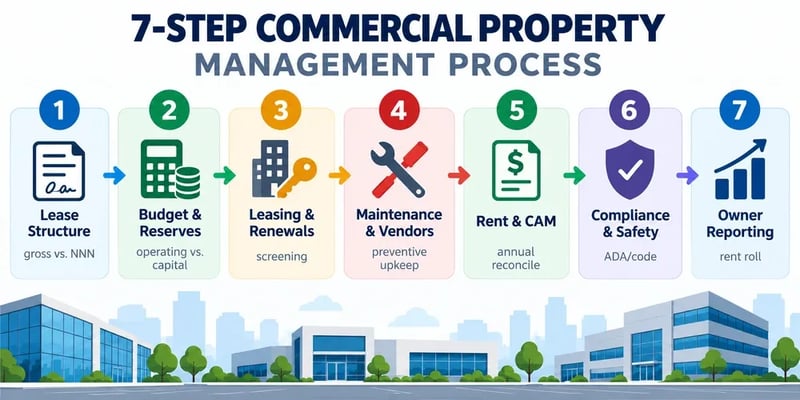
To manage commercial property, you work through seven jobs in order: learn the lease structure, set a budget with capital reserves, lease and renew space, coordinate maintenance and vendors, collect rent and common area maintenance (CAM) charges, keep the building in compliance, and report to ownership. The work resembles residential management only on the surface: commercial leases run for years, pass operating costs through to tenants, and often fund a tenant's build-out, so the stakes sit in the agreements and the insurance.
IREM's 2024 operating data puts office management fees at $0.68 per square foot against $10.33 in total operating expenses, so the fee is roughly one-fifteenth of the operating budget the manager administers. Getting the agreement and the coverage right at the start is what protects that budget.
Key Points
- A commercial property manager oversees leasing, maintenance, budgeting, and tenant relations for office, retail, industrial, or mixed-use properties.
- Management fees are typically structured as a percentage of collected rent, though flat fee and hybrid structures exist; IREM's 2024 data works out to about 3% of gross rents for office buildings and about 2% for industrial.
- A written management agreement should clearly define scope, fees, and liability before work begins, and states such as Arizona and Oregon set the minimum contents in law.
- Risk management and insurance coverage are a bigger part of commercial management than residential, given higher property values and liability exposure.

What Is a Commercial Property Manager?
A commercial property manager oversees the operation of income-producing property built for business use, office buildings, retail centers, warehouses, and mixed-use developments among them, so that the real estate produces the revenue its owner expects.
BLS groups the role with residential managers under property, real estate, and community association managers and reports 2025 median pay of $69,990 a year, 460,400 jobs, and 4% growth from 2025 to 2035, with about 36,900 openings a year. In most states the job requires a property management license or a real estate broker's license.
The residential version of the job ends at rent, repairs, and turnover. The commercial version adds three layers: multi-year leases that pass taxes, insurance, and maintenance costs through to tenants; common area maintenance charges that have to be estimated, billed, and reconciled; and tenant improvement (TI) work, the build-out a landlord funds or oversees so a space fits the tenant's business.
Training for the role exists at the certificate level. Penn Foster's online Property Management certificate, listed on Dreambound, is self-paced and covers tenant relations, real estate law, and risk management and fair housing.
How to Manage Commercial Property: The Core Process
The seven steps below run in order in the first year and in parallel after that, because every lease renewal restarts the cycle.
Step 1: Understand the Property and Its Lease Structure
Under a gross lease the tenant pays a set rent and the landlord covers operating expenses; under a triple net lease the tenant pays rent plus its share of taxes, insurance, and maintenance. Read every lease for its term, escalations, renewal options, and expense caps before you budget.
Step 2: Set and Manage a Property Budget, Including Capital Reserves
Separate operating expenses (utilities, janitorial, repairs) from capital expenses, the improvements that extend an asset's useful life, and fund a monthly reserve for the second category so a roof replacement never becomes an emergency capital call to the owner.
Step 3: Handle Leasing, Tenant Screening, and Lease Renewals
Vet a business tenant the way a lender would, with financial statements, a credit history, and a personal guaranty where the entity is thin, and open renewal talks well before expiration, since a vacant commercial space carries broker commissions and build-out costs a residential vacancy does not.
Step 4: Coordinate Maintenance, Vendors, and Preventive Upkeep
O*NET lists preparing and administering contracts for cleaning, maintenance, and security services among the occupation's tasks. Put HVAC, roofing, elevators, and fire protection on a written inspection calendar rather than waiting for a tenant call.
Step 5: Manage Rent Collection and Common Area Maintenance (CAM) Charges
CAM charges recover the cost of shared areas, from lobbies to parking lots, in proportion to each tenant's share of rentable area, which is what BOMA's floor measurement standards exist to define. Estimate CAM monthly, reconcile it annually against invoices, and refund or bill the difference.
Step 6: Maintain Compliance With Local Codes and Safety Requirements
Fire, elevator, and health inspections run on your jurisdiction's schedule; accessibility is federal. Office buildings and warehouses must meet the ADA Standards for Accessible Design, and where a tenant's space is open to the public, a store or a restaurant, both landlord and tenant are public accommodations under Title III. A lease can divide that work between them, but the ADA Title III Technical Assistance Manual states that both remain fully liable.
Step 7: Report Regularly to Ownership on Financial and Operational Performance
BLS describes managers reporting to owners on occupancy rates and lease expiration dates; a monthly package with the rent roll, budget variance, delinquencies, and work-order log keeps the owner from hearing about a problem from a tenant first.
If you are hiring for these seven jobs rather than doing them, ask about a state license and a property management certificate; Dreambound lists property management and construction management programs you can compare before you post the role.
Commercial Property Management Best Practices
Commercial property management best practices come down to five habits: scheduled maintenance, early tenant communication, complete records, annual benchmarking, and software that holds the whole picture. The process keeps a building running; these keep it from losing value between lease cycles.
- Schedule maintenance instead of reacting to it. A rooftop HVAC unit serviced on a calendar costs less than one replaced after it fails in July, and a failed unit is a tenant complaint at best and a lease dispute at worst.
- Communicate with tenants before there is a problem. A quarterly check-in surfaces parking, security, and access complaints while they are still fixable and long before a renewal decision.
- Keep records at the level a lender or auditor would expect: every vendor invoice behind a CAM reconciliation, every inspection report, every lease amendment. CAM disputes are won and lost on paper.
- Benchmark rents and expenses against the market at least once a year. IREM's Income/Expense IQ, built from 2024 operating data supplied by IREM, BOMA, and NAA members and other practitioners, put total operating expenses at $10.33 per square foot for office buildings and $3.83 for industrial; a building far above those lines has a problem worth finding.
- Run the property on property management software rather than spreadsheets alone. O*NET flags Yardi as an In Demand Hot Technology for property managers, the only property management platform with that mark; AppFolio and RealPage compete for the same work of tracking leases, work orders, and budgets in one place.
Commercial Property Management Fees and Fee Structures
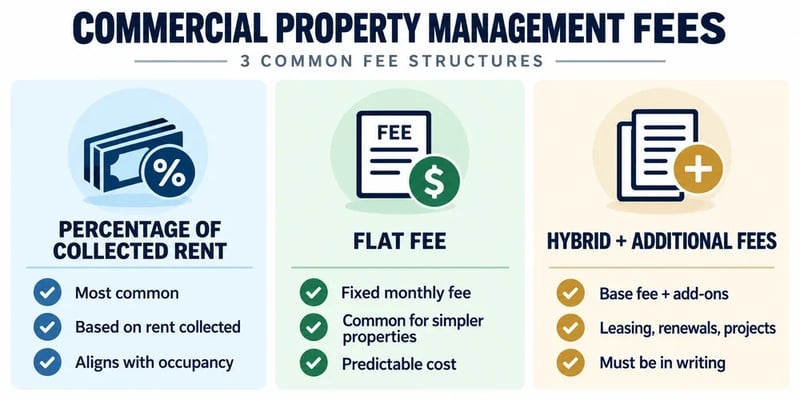
Commercial property management is priced three ways, and the structure matters as much as the rate.
Percentage of Collected Rent
The most common structure is a percentage of the gross rent collected each month. IREM's Income/Expense IQ National Summary for 2024 operating data reports management fees of $0.68 per square foot on office buildings, against total gross rents of $22.22 per square foot, and $0.36 per square foot on industrial properties, against $15.57.
That works out to about 3% of gross rents for office and about 2% for industrial. Insist on a percentage of rent collected, not rent due; a fee on rent due pays the manager for vacancies and delinquencies.
Flat Fee
A flat monthly fee is more common for smaller or simpler properties, a single-tenant industrial building on a triple net lease, for example, where the manager's work is a fixed set of tasks whatever the rent. The risk runs the other way: a flat fee gives the manager no stake in filling a vacancy or raising rents at renewal.
Hybrid and Additional Fees
Most agreements layer add-ons over a base fee: a leasing commission when a new tenant signs, a renewal fee when an existing one stays, a construction management fee for overseeing tenant improvements or capital projects, and sometimes a markup on vendor invoices. Each is negotiable, and each should appear in the agreement with its trigger and rate, because an add-on that is not in writing tends to appear on the first invoice.
What Should Be in a Commercial Property Management Agreement?
A commercial property management agreement should define six things before the manager collects a dollar:
- Scope of services, listing what the manager does and what stays with the owner.
- Fee structure and payment terms, including every add-on fee and its trigger.
- Term length and termination conditions, with a notice period.
- Insurance and liability responsibilities for owner, manager, and tenants.
- Reporting requirements, down to what the monthly package contains and when it arrives.
- Authority limits, the dollar threshold above which the manager needs owner approval before spending.
Several states write the minimum into law. Arizona's statute (ARS 32-2173) requires a signed agreement with a beginning and ending date, the terms of compensation, the disposition of all money collected, the amount held as an operating reserve, and cancellation provisions agreeable to both parties.
Oregon's rule, OAR 863-025-0020, adds the duties of both parties, when fees are earned and paid, a description of the monthly accounting statements, how records transfer after termination, and disclosure of any vendor the manager has a financial interest in.
Two clauses deserve the most attention. The authority limit lets the manager fix a leak without a phone call while keeping a roof contract in the owner's hands. The insurance clause states who carries what: the owner's property and liability policies, the manager's own liability and errors-and-omissions coverage, and the manager's duty to collect and track tenant certificates of insurance.
The termination clause closes the loop with a records-handover schedule, since the owner will need the leases, the CAM files, and the deposits on the day the manager leaves.
Commercial Property Risk Management and Insurance
Common Risks in Commercial Property Management
The risks scale with the building. Liability exposure comes from tenant and visitor injuries in the common areas the manager controls: parking lots, sidewalks, stairwells, elevators. Property damage comes from fire, water, wind, and mechanical systems that fail without warning. Business interruption follows both, because a building that cannot be occupied stops collecting rent while the mortgage, taxes, and payroll continue.
Environmental risk depends on the property type and its history; an industrial site or a former dry cleaner carries contamination exposure that an office building does not, which is what a Phase I environmental site assessment is meant to surface before a purchase.
Insurance Coverage to Have in Place
Four policies form the base:
- Property insurance compensates the owner when the building is damaged by a covered peril such as fire.
- General liability pays damages the owner or manager is found liable for, plus legal defense.
- Business interruption insurance, according to Triple-I, covers lost net income and continuing expenses such as mortgage and loan payments, taxes, and payroll after a covered loss, with a typical 48 to 72 hour waiting period and a 30-day restoration period that an endorsement can extend to 360 days.
- An umbrella policy sits above the liability limits for unusually large losses.
The lease then shifts part of the exposure to the tenant: require every tenant to carry its own liability insurance naming the owner and the manager as additional insureds, and do not hand over keys or approve a build-out until the certificate of insurance is on file.
Commercial Property Claims Management
Claims are won on documentation and speed. Triple-I's guidance for business claims is to contact the insurer as soon as possible, inventory the damaged property with receipts, take reasonable steps to prevent further damage once the area is safe, and prepare for the adjuster to inspect the property and examine books and records.
A business income claim requires showing net income and continuing operating expenses both before and after the event, so the monthly reporting package from step 7 doubles as the claim file. The manager coordinates three parties at once: ownership, the insurer, and the affected tenants, whose own policies cover their inventory and lost income.
Commercial Property Project and Construction Management
Commercial property project management is the layer above daily operations: tenant improvement build-outs, capital improvement projects such as a roof or a parking lot, and larger renovations. Each carries a budget, a schedule, and a contractor, and each can shut down a tenant's business if it slips. BLS reports that construction managers, who plan, coordinate, budget, and supervise projects from start to finish, earned 2025 median pay of $114,990 a year with 9% projected growth from 2025 to 2035, a signal of how specialized the work is.
An owner has two ways to cover it. A property manager with construction management experience can run smaller TI projects inside the management agreement, usually for the construction management fee described above. Larger capital work calls for a dedicated construction manager or general contractor, with the property manager coordinating access, tenant notices, and the building systems the project touches.
Either way the owner's controls are the same: three comparable bids on an identical scope of work, a schedule tied to the tenant's lease commencement date, a contingency in the budget, and lien waivers before final payment. For a property manager who wants to take on this work, the training path runs through online construction management classes.
Should You Hire a Commercial Property Management Consultant?
A commercial property management consultant makes sense in three situations, and each has an end date:
- A new owner unfamiliar with commercial leasing who needs the first lease abstracts, budget, and vendor contracts set up correctly.
- A portfolio in transition, such as a sale, a refinancing, or a change of management company, where an outside review of the CAM reconciliations and lease files protects the owner.
- A one-time job such as restructuring management fees or renegotiating a portfolio's service contracts.
A standing property is better served by an in-house manager or a third-party management firm under a written agreement, because the value is in continuity: the same person tracking lease expirations, vendor performance, and the reserve account year after year.
When you evaluate either a consultant or a manager, look for IREM's designations. The Certified Property Manager (CPM) requires 36 months of experience and a commercial portfolio of at least 120,000 square feet at one site or 80,000 square feet across two or more, and the Accredited Commercial Manager (ACoM) requires 12 months and 20,000 square feet of non-residential property.
Largest Commercial Property Management Companies
The commercial property management industry is concentrated at the top. Commercial Property Executive's 2026 ranking, published July 29, 2026 from self-reported data, counts nearly 13.5 billion square feet of income-producing property under management across its 30 listed firms in 2025. CBRE leads with 8.4 billion square feet, followed by Colliers at close to 1.9 billion, Cushman & Wakefield at more than 1.1 billion, Lincoln Property Co. at nearly 637 million, and Newmark at 322 million.
The ranking weights occupancy, growth, and sector presence alongside square footage, and several large firms, JLL among them, did not participate this year, so it is a snapshot rather than a census. Below the national firms sit regional and boutique managers that specialize in a single market or property type, the tier an owner of one or two buildings is usually choosing from.
Frequently Asked Questions
What does a commercial property manager do differently than a residential property manager?
A commercial property manager administers multi-year leases that pass taxes, insurance, and maintenance to tenants, reconciles common area maintenance charges every year, and oversees tenant improvement build-outs. A residential manager handles shorter leases, individual renters, and repairs. The financial work and the legal exposure, not the buildings, are the difference.
What is a typical commercial property management fee?
A typical commercial property management fee is a percentage of the rent collected each month. IREM's 2024 operating data works out to about 3% of gross rents for office buildings and about 2% for industrial properties. Leasing commissions, renewal fees, and construction management fees are charged on top of the base percentage.
What should be included in a commercial property management agreement?
A commercial property management agreement should include the scope of services, the fee structure and payment terms, the term and termination conditions, insurance and liability responsibilities, reporting requirements, and a spending limit above which the manager needs owner approval. Arizona and Oregon require most of these elements by statute or rule.
Who is responsible for insurance on a commercial property, the owner or the tenant?
Both. The owner carries property, general liability, business interruption, and umbrella coverage on the building, and under a triple net lease the tenant reimburses its share of the property insurance premium. The tenant also carries its own liability and contents coverage, and a well-drafted lease requires a certificate of insurance naming the owner and manager as additional insureds.
When should you hire a commercial property management consultant instead of a full time manager?
Hire a consultant for a defined project with an end date: setting up a newly purchased property, reviewing CAM files during a sale or refinancing, or restructuring fees and vendor contracts. Hire a manager, in-house or through a firm, for the standing work of leasing, maintenance, and reporting. Dreambound lists property management training if you want to build that capacity in-house.
Does a commercial property manager handle construction projects?
Often, within limits. Many property managers oversee tenant improvement build-outs and smaller capital projects under a construction management fee written into the agreement. Larger renovations usually need a dedicated construction manager or general contractor, with the property manager coordinating tenant notices, access, and the building systems the project affects.
Getting the Agreement and Insurance Right First
Commercial property management is daily operations with much higher stakes attached: fees measured in cents per square foot against budgets measured in dollars, agreements that states regulate by statute, and liability that a lease cannot sign away. Most of the expensive problems trace back to something that should have been settled before the first rent check, the spending limit in the management agreement or a tenant's missing certificate of insurance.
Settle those two first and the rest of the work is a calendar. If you plan to do the work yourself, or to hire someone who will, you can compare property management and construction management programs on Dreambound before you commit to either path.