Is CNA a Good Job? Pros and Cons
See if you qualify for Certified Nursing Assistant programs
Answer a few questions in 2 minutes. Free, no commitment.
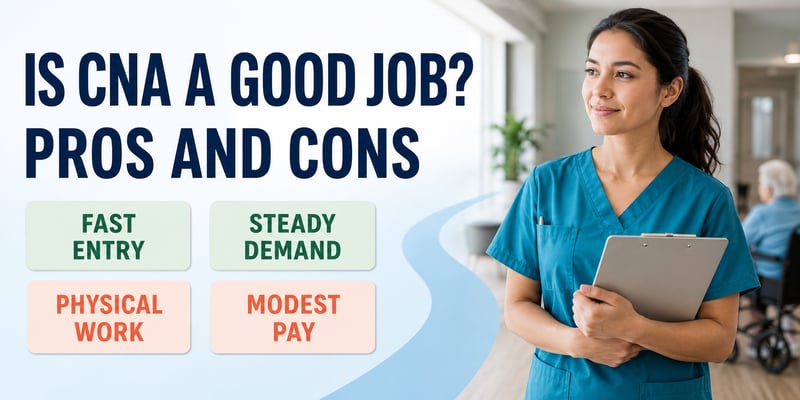
CNA is a good job if you want a fast, affordable way into healthcare and you go in clear-eyed about the trade-offs. You can train in a few weeks to a few months, the work is steady, and it is the most common first step toward becoming an LPN or RN. The honest catch is the pay and the wear: nursing assistants earn a median of $42,260 a year, below the $49,500 median for all jobs, and the work is physically and emotionally heavy, which is part of why turnover runs high. Whether it is a good job for you comes down to what you want from it, a starting point or a long-term career, and how well the day-to-day fits your life.
Key Points
- CNA is widely seen as a strong entry-level job and an on-ramp into nursing, not a high-paying long-term career.
- Training is fast and cheap, a few weeks to a few months and often under $1,500, with some free employer-sponsored routes.
- Nursing assistants earn a median of $42,260 a year, below the $49,500 median for all occupations.
- The work is steady, with about 211,800 openings a year, but most of those come from high turnover rather than growth.
- It fits people who want hands-on patient care and a way into the field, and frustrates those seeking high pay or a physically light job.
What the Work Actually Looks Like
A certified nursing assistant provides hands-on daily care under a nurse's supervision, in nursing homes, hospitals, assisted living, and home health. The work is bathing, dressing, feeding, and moving patients, taking vital signs, and reporting changes to the nursing staff. For the full role breakdown, see what a CNA is. The thing to hold onto before weighing the pros and cons is that this is close-contact, physical, people-facing work for an entire shift. That single fact is the source of both the biggest rewards and the biggest strains of the job.
Pros of Being a CNA
The upsides are real, and they are why CNA is one of the most common ways into healthcare.
- Fast, affordable entry. You finish a state-approved program in a few weeks to a few months, often for under $1,500, and some employers cover the cost in exchange for working with them.
- Steady demand. Even though net growth is only 2% through 2034, about 211,800 openings come up each year, so jobs are consistently available across the country.
- A clear path upward. CNA experience is the standard first rung toward LPN (median $62,340) and RN (median $93,600), and many employers help pay for staff who go back to school. More reasons to become a CNA covers the upside in depth.
- Hands-on patient care. If you want close contact with patients and immediate impact instead of a desk, the work gives you that every shift.
Cons of Being a CNA
The downsides are just as real, and they are why so many people leave the role.
- Physically demanding. Lifting and repositioning patients and staying on your feet for a full shift is hard on the body, and back strain is common.
- Emotionally heavy. You care for people who are sick, frightened, or near the end of life, and that weight adds up, especially when a facility offers little mental health support.
- Pay below the all-occupation median. The $42,260 median, about $20.32 an hour (May 2025 data), sits under the $49,500 figure for all jobs, and more than a third of CNAs report relying on some public assistance. See how much a CNA makes for the state-by-state picture.
- Hard hours and heavy loads. Nights, weekends, and holidays are normal, and short staffing can leave one aide responsible for 15 to 20 residents at once.
Why Do So Many CNAs Quit?
Turnover in CNA roles is strikingly high. Industry data puts annual CNA turnover around 42%, and in hospitals it climbed from about 34% in 2022 to nearly 42% in 2024. That churn, not job growth, is what creates most of the openings each year, and it comes down to a few clear causes.
- The physical and mental toll of the work, often without much mental health support from the employer.
- Short staffing, with surveys finding many CNAs responsible for 15 to 20 residents on a single shift.
- Pay that does not match the workload, a frequent reason people move on.
- Limited recognition and few ways to advance without going back to school.
None of this makes CNA a bad choice. It means the people who do well go in with clear eyes, and many treat it as a step toward [LPN] or RN rather than a place to stay for decades.
Who Is a CNA Job Right For?
CNA tends to be a good job if:
- You want the fastest, lowest-cost way to start working in healthcare.
- You see it as a step toward LPN, RN, or a specialty role, not a 30-year career.
- You are comfortable with physical, close-contact work and can handle emotionally hard days.
- You value steady demand and the flexibility to work in different settings.
CNA may not be the right fit if:
- You need pay above the all-occupation median from day one.
- A physically light or desk-based job matters to you.
- You want low turnover and a long built-in ladder without more schooling.
If the first list sounds like you, the qualities of a successful CNA are worth a look before you commit.
CNA Programs on Dreambound
If a CNA program is your next step, Dreambound lets you compare options side by side on cost, length, and format so you can pick one that fits. Here are three that show the range, and you can compare CNA classes near you for programs in your state.
Nurse Aide - Diamond Career Institute
- Format: Hybrid
- Length: 5 weeks
- Tuition: $274 to start, $920 total
- Covers first aid, CPR, vital signs, and infection prevention
Certified Nursing Assistant - Williams Career School of Excellence
- Format: Hybrid
- Tuition: $725 to start, $1,450 total
- No high school diploma or GED required, and you can start at age 16
Frequently Asked Questions
Is being a CNA worth it?
For most people, yes, as a starting point. It is the fastest, cheapest way into healthcare and a proven route toward nursing, which is why so many begin here. Whether it stays worth it long term depends on the modest pay and physical demands fitting your life, since both matter.
What is the hardest part of being a CNA?
Most CNAs point to the physical and emotional load, made worse by short staffing. Lifting and moving patients all shift wears on the body, and caring for people who are suffering wears on the mind, especially when one aide is covering 15 to 20 residents.
What CNA job pays the most?
Government settings such as VA hospitals and regular hospitals tend to pay CNAs the most, and travel CNA contracts often pay more than staff roles. Over time, adding a specialty or moving up to LPN or RN raises pay the most.
Is CNA a good long-term career?
It can be. Some people build long, steady careers as CNAs, especially in long-term care or home health where the patient relationships matter most, while others use it as a step toward nursing. The pay sits below the all-occupation median and the work is physically taxing, so those who stay longest tend to either love the bedside work or move into specialties, charge, or training roles.
Deciding If CNA Is Right for You
The honest verdict is that CNA is a good job for what it is: a fast, low-cost entry into healthcare with steady demand and a clear path upward, paired with modest pay and physically demanding work. The people happiest in it tend to treat it as a strong first step rather than the final one, and they go in knowing the trade-offs instead of being surprised by them.
If that sounds like the right move for you, Dreambound can help you compare CNA programs by cost, length, and format and start where it makes sense. Weigh these pros and cons against your own goals, and you will know whether this is your way into healthcare.