Is EKG Technician a Good Job? Pros and Cons (2026)
See if you qualify for Electrocardiogram (ECG/EKG) programs
Answer a few questions in 2 minutes. Free, no commitment.
Is EKG technician a good job? For the right person, yes. It is one of the shortest, cheapest routes into clinical healthcare: you run electrocardiogram tests that record a patient's heart activity, then hand the results to a physician to read. But the honest picture is more layered than most career pages admit. Entry pay is modest, the standalone role has a real ceiling, and the Bureau of Labor Statistics projects only 3% job growth through 2034, even as student interest in the training climbs fast. Whether it is a good job for you comes down to what you want from a healthcare career, and the honest pros and cons below should make the call clearer.
Key Points
- EKG technicians run electrocardiogram tests and prepare the heart-activity data physicians use to diagnose cardiac problems, mostly in hospitals, clinics, and outpatient diagnostic centers.
- The broader BLS category had a median wage of $74,310 in May 2025, but standalone EKG techs usually start lower, in roughly the $39,000 to $48,000 range.
- No state license is required in most places, though most employers expect a national certification such as the NHA Certified EKG Technician (CET) or the NCCT National Certified ECG Technician (NCET).
- Training is short and inexpensive: most standalone programs run 4 to 12 weeks and cost about $995 to $2,200.
- BLS projects 3% growth for the broader occupation through 2034, which is modest, while EKG was the fastest-growing program category on Dreambound in 2025.
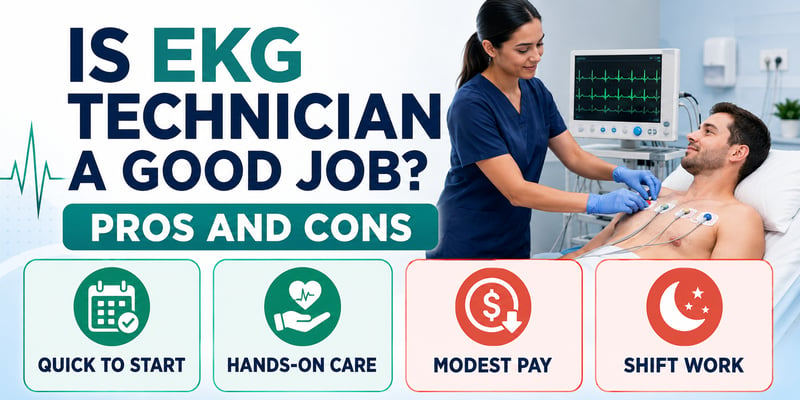
Pros of Working as an EKG Technician
A few things about EKG work hold up well under honest scrutiny.
- Short, affordable entry path. Most standalone EKG programs finish in 4 to 12 weeks for under $2,500 total, so you can test a healthcare career without years of school or long-term debt. If speed and cost are your priority, the cheapest and fastest EKG programs lay out the quickest routes in.
- Defined, visible clinical work. Each test you run produces a result a physician acts on, often the same day. People who want a clear, repeatable scope rather than the sprawling duties of a medical assistant tend to like that focus.
- A way into cardiology without a degree. EKG technician is one of the few cardiology-adjacent roles you can enter without an associate or bachelor's degree, and it works as a first step toward telemetry, cardiovascular technology, or echocardiography later.
- Multiple work settings. Hospitals, outpatient diagnostic centers, cardiology practices, and emergency departments all hire EKG techs. Large systems like HCA Healthcare, Ascension, AdventHealth, and Cleveland Clinic run dedicated cardiac testing units.
- Predictable hours in many roles. Outpatient and clinic positions usually follow standard business hours. Hospital roles involve shift work, but the testing schedule itself is steadier than the continuous demands of nursing or aide work.
Cons of Working as an EKG Technician
The trade-offs are worth understanding before you commit.
- Modest pay to start. The headline $74,310 median covers a broad group; standalone EKG roles cluster nearer the bottom, around $39,000 to $48,000 early on. Pay grows, but gradually.
- A real ceiling without more training. Most EKG-only jobs sit in the lower half of the salary range. Reaching the higher numbers usually means adding echocardiography or cardiovascular technology, which takes another one to two years of training.
- Physical and emotional weight. You are on your feet most of the shift, and the patient mix includes people in cardiac distress or serious decline. Bring comfortable shoes, and expect some emotionally heavy days.
- Shift work in hospitals. Hospital cardiac testing runs around the clock, so evenings, overnights, weekends, and holidays are common for new hires. Clinic and outpatient roles are more predictable but tend to pay and grow slower.
- Ongoing certification upkeep. The NHA CET renews every two years and the NCCT NCET renews annually, each with continuing-education hours and a fee. Letting a credential lapse can interrupt your employment.
What EKG Technicians Earn, and Where They Earn Most
The BLS files EKG techs under "Cardiovascular Technologists and Technicians" (code 29-2031), a group whose median wage was $74,310 a year, or $35.73 an hour, in May 2025. Read that number carefully before you bank on it. The same group includes invasive cardiovascular technologists and echocardiographers, who train longer and earn much more, which pulls the median up. Standalone EKG techs sit toward the bottom of the range: in that data, the lowest 25% earn under about $47,890 and the lowest 10% under about $39,000, which is the more realistic starting band.
Pay rises with three things: experience, the setting you work in, and the credentials you add. Hospitals and academic medical centers generally pay more than physician offices, and the top of the range (the 75th and 90th percentiles, roughly $98,000 to $121,000) reflects experienced specialists with invasive or echocardiography credentials, not entry-level EKG work. Geography matters too, with wages running higher in high-cost states and major metros. The BLS wage tool breaks pay down by state and metro area if you want to check your own market.
Is EKG Technician Work in Demand?
This is where the picture splits in two. On the employer side, demand is modest: BLS projects 3% job growth for the occupation from 2024 to 2034, below the average for all jobs, partly because standalone diagnostic-tech roles grow slower than fields like medical assisting or nursing support. Steady openings still come from turnover and an aging population that needs more cardiac testing.
On the candidate side, interest is surging. EKG technician was the fastest-growing program category on Dreambound in 2025, up 83% year over year, according to the 2025 Dreambound Student Choice and Interest Report. The draw is easy to see: a short timeline, named certifications, and tuition most people can manage without heavy debt. So "in demand" depends on which side you mean. Hiring growth is steady but unspectacular, while the training itself is one of the most sought-after entry points right now.
Is EKG Technician Work the Right Fit for You?
It tends to be a good fit if:
- You want hands-on patient contact but prefer a defined, repeatable scope over the broad duties of a medical assistant or CNA.
- You want a short, low-cost way into a healthcare credential, with the option to stack more certifications later.
- You are comfortable with detail-oriented technical work and with shift work, including some evenings and weekends early on.
- You see EKG as a stepping stone toward cardiovascular technology, echocardiography, or telemetry, not a final destination.
It may not be the right fit if:
- You want above-median pay right away; here the wage path is gradual and depends on adding credentials.
- You want broad clinical responsibilities like giving medication, assessing patients, or building care plans, which belong to nursing and medical assistant roles.
- You need a strict Monday-to-Friday daytime schedule and cannot find a clinic-based opening near you.
- You find the emotional weight of working closely with seriously ill cardiac patients hard to carry.
EKG Technician Programs on Dreambound
Dreambound lets you line up EKG technician programs from schools across the country at no cost, so you can compare what each one runs, how long it takes, and the certification it preps you for before committing. If you have decided EKG fits, these three span the main formats, and you can also browse EKG classes near you for local options.
Hybrid
EKG Technician - TSC Career Institute
A hybrid program, $200 to start and $1,200 total, covering 12-lead placement, EKG grid-paper reading, and normal-versus-abnormal rhythm recognition.
In Person
ECG - Intelvio
A $995 in-person program with hands-on lead placement and live ECG practice, offered at Riverside and also at Manteca, National City, and Mission Viejo.
If you would rather build broader lab skills at once, Dreambound also lists combined Laboratory Assistant, EKG, and Phlebotomist certificates that bundle EKG with lab work and phlebotomy and run about nine months.
Frequently Asked Questions
Is being an EKG technician a good job?
For people who want fast, affordable entry into clinical healthcare and like defined, hands-on work, yes. The trade-offs are honest ones: entry pay is modest, often $39,000 to $48,000, advancement usually means adding credentials, and hospital roles can include nights and weekends. If those fit your goals, it is a solid starting career.
Is being an EKG technician a stressful job?
It varies sharply by setting. Outpatient and clinic roles are calmer because tests are scheduled and patient flow is predictable. Hospital and emergency positions run higher, especially when stat EKGs are ordered on critically ill patients. Over time, the emotional weight of working with cardiac patients tends to matter more than minute-to-minute pressure.
Can you work as an EKG technician without a college degree?
Yes. The role does not require an associate or bachelor's degree. Most employers ask for a high school diploma or equivalent, completion of a short EKG training program, and a recognized certification such as the NHA CET or NCCT NCET. The credential is the gating step, not a college education.
Who makes more money, a CNA or an EKG technician?
EKG technicians usually earn more than certified nursing assistants, though the gap depends on the role and local market. The broader cardiovascular group had a $74,310 median in May 2025, with standalone EKG roles lower in that range. The CNA versus EKG comparison weighs schedules, renewal, and advancement, not just pay.
Is EKG technician or phlebotomy a better starting point in healthcare?
It depends on the path you want. Phlebotomy training is often shorter and cheaper, with broad entry-level demand across labs and clinics. EKG takes about the same time but opens a cardiology-adjacent route with a higher ceiling if you keep going. The EKG versus phlebotomy comparison covers the day-to-day differences and pay paths.
Choosing EKG Technician Training
EKG technician work suits a specific kind of person: someone who wants a quick, low-cost start in clinical care, is comfortable with a defined scope and some shift work, and treats the credential as a first rung rather than the whole ladder. If that is you, the modest starting pay and slow employer-side growth are fair trade-offs for how quickly you can be working and earning.
The next move is to compare your real options and choose deliberately, weighing each program against your budget, your schedule, and the certification you want to earn.