Is Pharmacy Tech a Good Job? Pros and Cons
See if you qualify for Pharmacy Technician programs
Answer a few questions in 2 minutes. Free, no commitment.
Is pharmacy tech a good job? For many people, yes. It offers a fast, steady way into healthcare, and in PTCB's 2025 survey of 17,112 technicians, 85% reported job satisfaction and more than 63% said they see the work as a long-term career.
Pharmacy technicians help pharmacists dispense prescription medication, and much of the job happens at the counter with customers. The trade-off is that starting pay is modest and busy retail pharmacies run at a demanding pace. Weighing the pros and cons of pharmacy technician work against the setting you have in mind is the clearest way to decide whether it fits you.
Key Points
Is pharmacy technician a good job for you? These five facts frame the answer.
- BLS reports a median annual wage of $45,750, or $22.00 an hour, for pharmacy technicians as of May 2025.
- Many pharmacy technician certificate programs take a year or less to finish, according to BLS.
- Employment is projected to grow 6% from 2025 to 2035, faster than the average for all occupations.
- A major con is the pace and accuracy pressure of retail pharmacy work, where errors can affect a patient's health.
- Hospitals pay pharmacy techs a higher median wage ($50,760) than pharmacies and drug retailers ($39,240).

Pros of Being a Pharmacy Technician
The strongest arguments for this career are how quickly you can start and how many places you can work once you do.
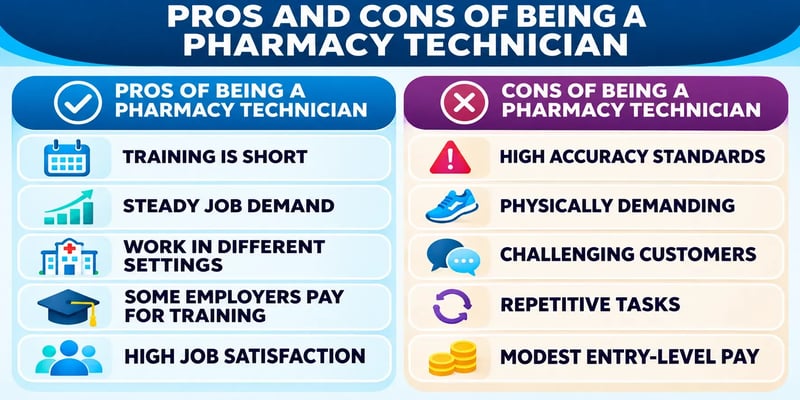
- Training is short. Many certificate programs take a year or less, and on-the-job training typically lasts less than a year, according to BLS.
- BLS projects 6% employment growth from 2025 to 2035, with about 44,700 openings a year, so steady demand is on your side.
- You aren't locked into one kind of workplace. Pharmacies and drug retailers employ 51% of pharmacy techs, hospitals 18%, general merchandise retailers 9%, grocery stores 8%, and ambulatory healthcare services 5%.
- Some employers pay for your training. Walgreens says its pharmacy technician apprenticeship pays for trainees to complete PTCB training and covers the cost of the Pharmacy Technician Certification Exam (PTCE), with paid, earn-while-you-learn training in store or at home.
- Satisfaction is high, with 85% of technicians reporting job satisfaction in PTCB's 2025 workforce survey.
Cons of Being a Pharmacy Technician
The disadvantages of being a pharmacy technician mostly come down to pressure and pay, with a physical side that's easy to underestimate. How much each one matters depends a lot on where you work.
- The accuracy stakes are high. Serious health problems can result from mistakes in filling prescriptions, BLS notes, so every count and label has to be right.
- It's physically demanding, and hours vary. Pharmacy technicians spend most of the workday standing or walking, and because pharmacies may be open at all hours, techs may have to work nights or weekends, based on BLS work environment data.
- Dealing with customers takes patience, since techs process insurance claims and serve patients who may be sick or in pain.
- Much of the work is repetitive. On O*NET, 57% of working pharmacy techs rate repeating the same tasks as extremely important to their job.
- Entry-level pay is modest. The lowest-paid 10% of pharmacy technicians earned less than $36,020 a year, according to BLS pay data for May 2025.
- Pay growth is a common frustration: "lack of pay and incentives" was the top reason PTCB's survey respondents gave for considering leaving the field.
- Certification needs regular renewal. Both PTCB and NHA require renewal every two years, and NHA's CPhT renewal calls for at least 20 hours of continuing education and a $55 fee.
Is Being a Pharmacy Technician Hard?
Is pharmacy tech hard? The day-to-day work can be, mostly because of the pace and the precision it demands. O*NET, the Department of Labor's occupational database, surveys people working in the role, and their answers show what a typical shift asks of you.
What pharmacy techs report | Share |
|---|---|
Being exact or accurate is extremely important | 98% |
Face time pressure every day | 69% |
Stand continually or almost continually | 74% |
Deal with conflict situations every day | 37% |
Source: O*NET work context data for pharmacy technicians, updated 2026.
Being a pharmacy tech can be stressful on those days. Prescriptions keep coming while you answer phones and sort out insurance problems, often with a customer at the counter waiting on medication they need.
Is pharmacy technician a hard job in every setting? Not in the same way. In retail, techs spend much of their time interacting with customers, while hospital techs prepare a greater variety of medications, such as intravenous medications, according to BLS. Hospitals also pay a higher median wage, $50,760, compared with $39,240 at pharmacies and drug retailers.
If your question is really about the certification exam rather than the job, our guide on how the pharmacy technician certification exam works covers eligibility, testing, and state requirements.
Is Pharmacy Tech a Good Career Long Term?
It can be, especially if you plan to earn certification and keep adding credentials. BLS reports a median wage of $45,750 for pharmacy technicians in May 2025, with the lowest 10% earning less than $36,020 and the highest 10% earning more than $61,040. Pay also varies by location, and our pharmacy technician salary guide highlights the top-paying states.
Demand should hold up over time. BLS projects 6% growth from 2025 to 2035 and about 44,700 openings a year, and our full look at the pharmacy technician job outlook explains where those openings are concentrated.
Certification also pays off. PTCB's workforce report found that Certified Pharmacy Technicians (CPhTs) earn approximately 20% more on average than their uncertified counterparts. From there, you can add the Certified Compounded Sterile Preparation Technician (CSPT) credential and, with enough experience, the Advanced Certified Pharmacy Technician (CPhT-Adv).
The role has also grown since 2020. BLS notes that in many states, trained technicians can administer vaccines under pharmacist supervision, and as of January 2025, 47 states plus Washington, DC, allowed pharmacy technicians to vaccinate, compared with only 6 in 2020, according to Drug Topics. PTCB's Immunization Administration Certificate is open to active CPhTs who complete a PTCB-recognized immunization training program.
If that long-term picture appeals to you, Dreambound shows which programs prepare you for national certification, so you can compare them before you choose one.
Should You Become a Pharmacy Technician?
The case for why become a pharmacy tech usually comes down to a short, practical path into healthcare, which matters most if you need to start working soon. Whether the job suits you depends on your temperament as much as your goals.
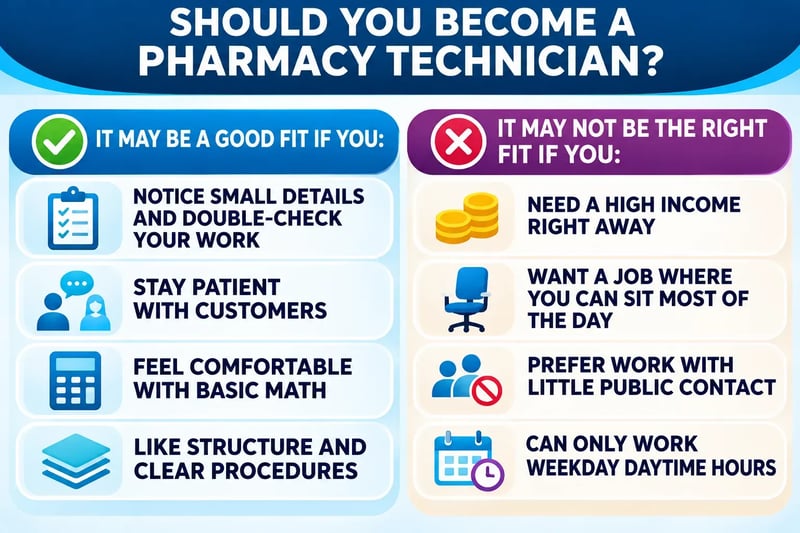
This career may fit you well if you:
- Notice small details and don't mind double-checking your own work
- Stay patient with customers, including people who are sick or frustrated
- Feel comfortable with the math used to measure and calculate medication amounts
- Like structure and a workday built around clear procedures
It may not be the right fit if you:
- Need a high income right away, since the median wage is $45,750
- Want a job where you can sit for most of the day
- Prefer work with little contact with the public
- Can only work weekday daytime hours
Some techs also use the job as a stepping stone, gaining pharmacy experience before they apply to pharmacy school.
Where to Start
Dreambound gathers pharmacy technician programs from different schools in one place, so you can see how each one is structured before you decide where to train.
A.S. Health Sciences, Pharmacy Technician - Ultimate Medical Academy
An online associate degree that prepares you for the PTCE if you meet the eligibility requirements. The program takes 18 months or more, and Ultimate Medical Academy is institutionally accredited by the Accrediting Bureau of Health Education Schools (ABHES).
Pharmacy Technician Certification - CCI Training Center
A 100% online program with an accelerated format, where individual courses average about three weeks each. CCI Training Center is accredited by the Accrediting Council for Continuing Education and Training (ACCET).
Comparing a longer degree with a faster certificate side by side is a practical way to match your training to how soon you want to start working.
Frequently Asked Questions
Is being a pharmacy tech worth it?
For many people, it is. In PTCB's 2025 workforce survey, 85% of technicians reported job satisfaction, and more than 63% saw their role as a long-term career, up from 59% in 2022. It's most worth it if you plan to get certified, since 77% of pharmacy technician employers in NHA's 2026 Industry Outlook said they require certification.
What is the hardest part of being a pharmacy technician?
For most techs, it's staying accurate under time pressure, which 69% face every day according to O*NET data. PTCB's 2025 report also names competitive compensation and workplace stress as ongoing pharmacy technician challenges.
Which pharmacy tech job pays the most?
Hospital jobs pay the highest median wage among the top employers of pharmacy technicians, at $50,760 as of May 2025. Ambulatory healthcare services ($48,860) and general merchandise retailers ($48,150) follow, while pharmacies and drug retailers pay a median of $39,240, according to BLS.
So, Is Pharmacy Tech a Good Job for You?
Whether pharmacy tech is a good job for you comes down to the setting you choose and how far you plan to take certification. High satisfaction and steady demand make a strong case, and the training is short. Retail pace and modest starting pay are the real costs to weigh before you commit.
If you're leaning toward yes, compare pharmacy technician programs on Dreambound and favor ones that prepare you for the PTCE. The CPhT it leads to is the credential that tends to open better pay and more specialized work over time.