Logistics Coordinator Duties and Responsibilities
See if you qualify for Supply Chain Logistics programs
Answer a few questions in 2 minutes. Free, no commitment.
A logistics coordinator manages the movement of goods from origin to destination, scheduling shipments, booking carriers, preparing shipping documents, and tracking inventory so orders arrive on time. The title sits between two neighbors. A warehouse coordinator handles what happens inside the facility, a transport coordinator handles the trucks and drivers on the road, and the logistics coordinator owns everything that moves between locations and across carriers, vendors, and customers. Job postings for the role, the resume bullets that answer them, and the line between the three titles all come back to the same six duty groups.
Key Points
- Core duties include coordinating shipments, communicating with carriers and vendors, managing documentation, and tracking inventory.
- The role sits at the coordination layer between warehouse operations, transportation, and customer or vendor communication.
- Logistics coordinator, transport coordinator, and warehouse coordinator titles overlap but focus on different parts of the supply chain.
- Strong organizational, communication, and problem solving skills are central to the role.

What Is a Logistics Coordinator?
A logistics coordinator is the person who keeps a company's shipments moving on schedule. Indeed's logistics coordinator job description, updated in May 2026, defines the role as one that "oversees the movement and distribution of goods" and fills the day with carrier communication, inventory tracking, shipping documentation, and logistics reporting.
Inside a company, the role reports into logistics or supply chain management, usually a logistics manager or supply chain manager. The coordinator works daily with three groups: the warehouse team that receives, stores, and picks orders; the transportation side, whether an in-house fleet or outside carriers; and the customer service or sales staff who need shipment status.
Employers include manufacturers, distributors, retailers, freight forwarders, and third-party logistics (3PL) providers. The desk can be in an office or on the warehouse floor.
Core Duties and Responsibilities of a Logistics Coordinator
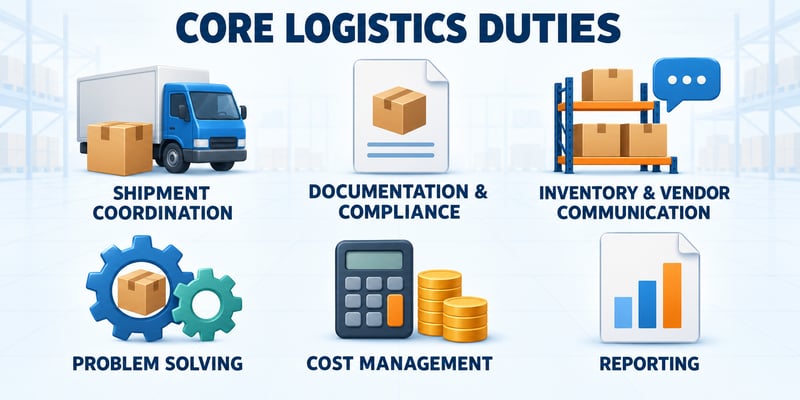
The work falls into six areas, and each one maps to a task statement in O*NET's cargo and freight agents profile, the federal occupation that lists Logistics Coordinator among its reported job titles.
- Shipment coordination: scheduling pickups and deliveries, booking freight with carriers, freight forwarders, and parcel services, and choosing the mode and service level (truckload, LTL, parcel, air, or ocean) that meets the delivery date at a workable cost. Once a load is moving, the coordinator tracks it and sends status updates to customers and account managers.
- Documentation and compliance: preparing bills of lading, packing lists, commercial invoices, and customs entry documents. Federal rules for for-hire motor carriers spell out what a bill of lading must contain: consignor and consignee, origin and destination, number of packages, a description of the freight, and its weight, volume, or measurement. For imports, U.S. Customs and Border Protection relies on the entry summary, CBP Form 7501, to determine appraisement, classification, and origin.
- Inventory and vendor communication: tracking inventory levels, reconciling counts against open orders and receipts, and updating the inventory or ERP system as goods ship and arrive. Vendors and suppliers get order status and confirmed ship dates from the same desk, and shortages are flagged before they reach the customer.
- Problem solving: resolving shipping delays, damaged goods, or scheduling conflicts as they come up. A missed pickup or a breakdown means rebooking or rerouting the load, damaged or short goods become freight claims the coordinator opens and documents, and conflicts between dock capacity, carrier availability, and customer deadlines get settled before they turn into late deliveries.
- Cost management: requesting and comparing carrier rate quotes, negotiating rates on recurring lanes, and auditing freight invoices against the quoted rate and any accessorial charges. Consolidating shipments or shifting modes can bring cost per shipment down without missing delivery dates.
- Reporting: tracking KPIs like on-time delivery rate, freight cost per shipment, and claims frequency, maintaining shipment logs and carrier scorecards for management review, and preparing daily, weekly, or monthly logistics reports, including the on-time delivery report Indeed names in its job description.
A Typical Day for a Logistics Coordinator
The six duty groups do not arrive in order. A typical day cycles through status checks, communication, exceptions, and reporting, and the exceptions decide how the day actually goes.
The morning starts with the day's shipment status: confirming today's carrier pickups and checking overnight arrivals against receiving reports, with a carrier call for any load flagged late before the customer asks. Midday is the inbox and the phone, booking next-day freight with carriers, answering delivery ETAs for account managers, and confirming purchase order ship dates with vendors.
Afternoons belong to exceptions as they surface, a missed pickup, a short shipment, a damaged pallet, each handled by rebooking, filing a claim, or resetting the customer's expectation, followed by tomorrow's outbound paperwork. The day closes with updates to tracking logs and the ERP or TMS, notes on open issues for the next shift, and the daily on-time delivery report.
Peak seasons, plant shutdowns, and weather compress this cycle, so the work favors people who can hold several open issues at once.
Skills Needed to Handle Logistics Coordinator Responsibilities
The duties above ask for five skills.
- Organization: a coordinator may hold many open shipments at once, each with its own pickup window, paperwork, and customer, so a system for tracking all of them is the job.
- Attention to detail: a wrong weight on a bill of lading or a transposed purchase order number leads to rebilling, a rejected delivery, or a customs hold.
- Written and verbal communication: status moves between carriers, vendors, warehouse staff, and account managers all day, and each group needs a different level of detail.
- Software comfort: O*NET's technology list for the occupation includes SAP for ERP, transportation management system (TMS) software, inventory management software, and Microsoft Excel.
- Problem solving under pressure: the calm to reroute a late truck while the customer is still on the phone.
Education requirements vary by employer. In O*NET's survey of the occupation, 31% of respondents said a new hire needs a bachelor's degree, 19% said some college without a degree, and 18% said a postsecondary certificate. Postings run the same range, from a high school diploma plus experience to a supply chain or business degree.
The APICS CLTD credential from ASCM covers logistics, transportation, and distribution in nine modules, including order management, inventory management, warehouse management, transportation, and global logistics, and it is the certification Indeed's job description names for the role. For structured training before applying, you can compare logistics classes near you on Dreambound by format and length.
Logistics Coordinator vs. Transport Coordinator: What's the Difference?
A transport coordinator manages the movement leg itself: which truck, which driver, which route, and when. A logistics coordinator manages the whole shipment, from the order behind it to the customer waiting for it.
Transport Coordinator Job Responsibilities
The work is planning delivery routes, scheduling carriers and drivers, and reviewing driver logs against federal hours-of-service limits, which cap property-carrying drivers at 11 hours of driving after 10 consecutive hours off duty. The transport coordinator's day is measured in trucks, drivers, and miles.
Logistics Coordinator Responsibilities on the Same Shipment
The logistics coordinator owns the order, the inventory it draws from, the documents that travel with it, the vendor waiting on it, and the carrier chosen to move it. Carrier selection and rates, paperwork, inventory, and vendor and customer updates before, during, and after the move all sit on the logistics side.
Where the Two Titles Overlap
At a carrier, a freight broker, or a company with its own fleet, the two titles can sit side by side and hand work back and forth all day. At a shipper that outsources every load, the logistics coordinator may handle carrier scheduling too, which is why some postings for the title read like transport coordinator jobs.
Logistics Coordinator vs. Warehouse Coordinator: What's the Difference?
A warehouse coordinator's duties stay inside the four walls. A logistics coordinator's duties start at the dock door and run outward, to carriers, vendors, customs, and customers.
Warehouse Coordinator Duties and Responsibilities
Inside the facility, the warehouse coordinator receives inbound freight, puts it away, picks and packs orders, keeps inventory counts accurate, assigns daily orders to warehouse staff, and enforces floor safety. OSHA allows only trained and evaluated forklift operators on the floor, re-evaluated at least once every three years, a rule the warehouse coordinator enforces and the logistics coordinator rarely touches. O*NET files shipping and receiving coordinators under shipping, receiving, and inventory clerks, whose tasks include checking shipment contents against manifests and packing, sealing, and labeling materials.
Logistics Coordinator Responsibilities at the Dock Door
The logistics coordinator books the carrier for what the warehouse packed, produces the bill of lading, tracks the load, and answers the customer. What the warehouse counts, the logistics coordinator promises to vendors and customers, so the two desks reconcile against each other every day.
Where the Roles Blend
The two roles work closely together, and at smaller companies the responsibilities blend: the person who books the carrier may also count the pallets. A posting that lists forklift certification or cycle counts alongside carrier scheduling describes that blended job.
How to List Logistics Coordinator Responsibilities on a Resume
Three moves turn the duty list into resume bullets that match the posting in front of you.
- Lead each bullet with an action verb and attach a number. Yale's Office of Career Strategy recommends the Action + Project + Result format and quantifying the result as a % improvement or increase. That suits logistics work because most of it is already measured: shipments per week, on-time delivery rate, freight cost, and claims.
- Tailor the order to the posting. A documentation-heavy role, such as international freight or regulated goods, wants bills of lading, customs entries, and audit accuracy near the top. A vendor and carrier relationship role wants rate negotiation, carrier scorecards, and account communication first.
- Translate adjacent experience into the same six duty groups. Shipping clerk, dispatcher, and customer service work all map onto them. For the education section, online logistics classes and certificates on Dreambound are compared by length, format, and the credential they lead to.
Four bullets written in that format:
- Coordinated 120+ outbound LTL and truckload shipments per week across 14 carriers, holding on-time delivery at 97%.
- Prepared bills of lading, packing lists, and customs entry documents for 40 international shipments per month with zero customs holds in 12 months.
- Renegotiated rates on six recurring lanes, cutting freight cost per shipment 11% year over year.
- Reconciled inventory counts against open orders daily and reduced short shipments 30% in one quarter.
Frequently Asked Questions
What is the most important responsibility of a logistics coordinator?
Keeping shipments on schedule. Every other duty, carrier booking, paperwork, inventory checks, and cost control, exists so goods leave when promised and arrive when promised, which is why Indeed's job description names on-time delivery reports among the coordinator's regular reports. When a shipment is at risk, resolving that exception comes before any routine task.
What is another name for a logistics coordinator?
Logistics specialist is the alternate title Indeed uses for the same role. O*NET files the job under cargo and freight agents, the federal occupation name, alongside titles such as logistics service representative, load planner, international coordinator, and traffic and documentation clerk. Postings under any of these titles describe the same shipment, carrier, and documentation work.
Does a logistics coordinator work with warehouse staff?
Yes, daily. The coordinator tells the warehouse what ships today and when the carrier arrives, and the warehouse tells the coordinator what is packed, what is short, and what arrived damaged. Dock scheduling, pick-and-pack readiness, and receiving discrepancies are the usual handoffs between the two.
What software do logistics coordinators typically use?
An ERP system such as SAP, a transportation management system (TMS), inventory management software, and Microsoft Excel, according to O*NET's technology list for the occupation. In O*NET's 2025 analysis of job postings for the role, Microsoft Office and Excel were the most requested tools, with Outlook next. Coordinators inside a distribution center also work in a warehouse management system (WMS).
How do you describe logistics coordinator experience on a resume?
Use one line per duty group with an action verb, the scope, and a measured result. An example: "Coordinated 80 shipments per week across 10 carriers, holding on-time delivery at 96%." Cover shipment coordination, documentation, inventory and vendor communication, problem solving, cost, and reporting, then reorder the lines to match the posting you are answering.
What does a senior logistics coordinator do?
The same six duty groups with added ownership: overseeing logistics operations, managing or training other coordinators, and taking part in planning such as carrier selection. ZipRecruiter's comparison of the two titles describes the senior logistics role as carrying more strategic and leadership duties, and lists a bachelor's degree and a CLTD or CSCP certification among its typical credentials.
Matching These Duties to a Job Posting
A logistics coordinator's value is keeping carriers, documents, inventory, and vendors synchronized so shipments arrive on time, and a job posting is a list of which of those pieces the employer needs covered most. Read the duties against the three titles: inside the building points to warehouse work, trucks and drivers point to transport work, and everything in between is the logistics coordinator's ground. Dreambound lists logistics classes and certificate programs by city and online, so you can compare formats and lengths before you apply.