Medical Billing Audit Services: What They Are and Why Your Practice Needs One

See if you qualify for Medical Billing and Coding programs
Answer a few questions in 2 minutes. Free, no commitment.
A medical billing audit systematically reviews a practice's claims, coding, and documentation for accuracy and compliance, so that lost revenue and compliance risk surface before a payer or regulator finds them first. CMS put the Medicare fee-for-service improper payment rate at 6.55%, or $28.83 billion, for fiscal year 2025. Most of it traced back to documentation that could not support the claim rather than to fraud. An outside audit service applies that same review to your own claims, on your own schedule. Choosing one comes down to the type of audit you need, what it should include, what it costs, and how to tell an auditing specialist from a general coding shop.
Key Points
- A billing audit reviews claims for coding accuracy, documentation support, and compliance with payer and CMS rules, usually on a sample of records rather than every claim.
- Audits can be internal or conducted by an outside service, and comprehensive or focused on a specific provider, code set, or known problem area.
- Regular audits catch revenue leakage from undercoding as often as they catch compliance risk from overcoding, and the OIG recommends a periodic audit at least once a year.
- Look for auditors holding the CPMA or an equivalent auditing-specific certification, not just a general coding credential.

What Is a Medical Billing Audit?
A medical billing audit is a structured review of a sample of claims, or occasionally the full set, that checks three things. The codes submitted must match what the documentation says was done, the documentation must support medical necessity, and the billing must follow the payer's and the regulators' current rules. It tests the whole chain from visit note to payment.
Documentation sits at the center of that review, and CMS's own numbers show why. In its 2025 Medicare fee-for-service improper payment data, insufficient documentation accounted for 53.0% of improper payment dollars and missing documentation another 12.0%, while medical necessity accounted for 15.3% and incorrect coding 11.1%. Most claims that fail a federal review fail because the record could not back them up, so a good audit reads the chart, not just the claim. If the vocabulary is new, the guide to what medical billing and coding is covers how codes become claims.
Types of Medical Billing Audits
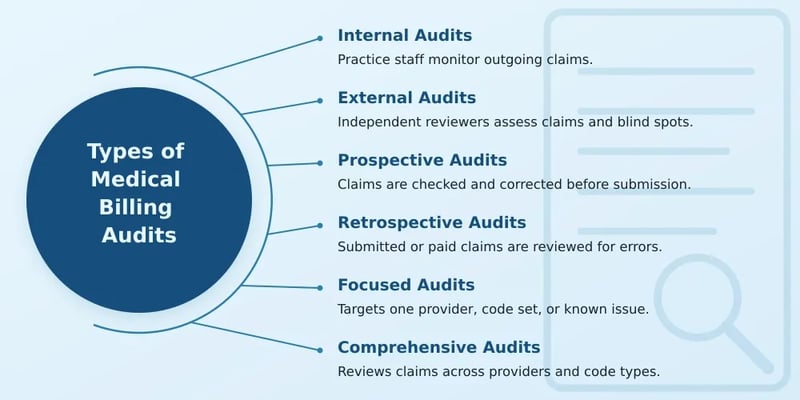
Audits differ along three lines: who performs the review, when it happens relative to claim submission, and how wide the sample is. Most practices combine them, with an external, retrospective baseline first and internal, prospective spot checks on the problem areas it found.
Internal vs. External Audits
Internal audits are conducted by the practice's own staff and are the least expensive way to keep a steady eye on outgoing claims. External audits are conducted by an independent third-party service, and independence is the point: an outside review carries more credibility with payers and regulators, removes the bias of people grading their own work, and brings specialty benchmarks the practice cannot see from inside.
The OIG's compliance guidance for physician practices lists auditing and monitoring among the seven components of a compliance program and describes a baseline audit when the program starts and periodic audits afterward.
Prospective vs. Retrospective Audits
Prospective audits review claims before they are submitted, so errors are corrected before a payer sees them, which prevents denials and avoids the refund process. Retrospective audits review claims that have already been submitted and paid, which is the only way to measure the real error rate, quantify overpayments that may need to be returned, and find undercoding the practice has been absorbing.
Focused vs. Comprehensive Audits
Focused audits target one provider, one code set such as evaluation and management levels, or one known problem such as a spike in denials for a single procedure. Comprehensive audits review billing practice-wide across every provider and code type, which is what a baseline should be. The OIG guidance sets the sample floor at five or more records per federal payer, or five to ten records per physician. One audit and consulting firm, DoctorsManagement, publishes a typical range of 10 to 30 records per provider.
What Medical Billing Audit Services Typically Include
A full-service audit delivers five things, and a proposal missing any of them is worth questioning.
- A claim sampling methodology: how many records per provider, which date range, random or targeted selection, and whether the sample supports extrapolation.
- A coding accuracy review against documentation: every sampled claim is re-coded from the chart by a certified auditor and compared line by line to what was billed.
- A denial pattern analysis: denied claims grouped by payer, code, and reason, to separate one-off mistakes from a workflow problem.
- A compliance review against current payer and CMS guidelines, including medical necessity, modifier use, and the professional versus institutional claim rules covered in types of medical billing.
- A final report with specific findings and corrective recommendations, usually an error rate per provider, the dollar impact of overcoding and undercoding, and a training plan, rather than a pass/fail summary.
Some services add underpayment recovery, risk-adjustment validation, or provider education on top, but the five above are the floor.
Why Practices Use Medical Billing Audit Services
Practices audit for two reasons that pull in opposite directions, and a good audit serves both.
The first is revenue. Undercoding, missed charges, and unbilled services are invisible in a normal month because nobody complains about a claim that was never sent, and a retrospective audit is usually the first time a practice sees that money as one number.
The second is exposure. Overcoding and documentation gaps create risk under the False Claims Act, where the per-claim penalty was adjusted to $14,308 to $28,619 in July 2025 on top of treble damages. The Department of Justice reported more than $5.7 billion in health care recoveries under the Act in fiscal year 2025. Not every improper payment is fraud, and CMS says so directly, but a pattern a practice never looked for is harder to explain than one it found and fixed.
The third reason is timing. A practice that audits itself regularly is in a stronger position if a payer or CMS starts a review, because it already knows its error rate and can show corrective action. Under Medicare's Targeted Probe and Educate program, a contractor reviews 20 to 40 claims per round for up to three rounds, and providers whose results do not improve can be referred for 100% prepayment review, extrapolation, or a Recovery Auditor. A practice that has run the same exercise on itself walks into round one knowing what the contractor will find.
How Often Should a Practice Get a Billing Audit?
At least once a year, and that floor comes from the regulator rather than from the vendors. The OIG's guidance for physician practices recommends a baseline audit of claims from the first three months after the practice's compliance training takes effect. After that, it recommends that "periodic audits be conducted at least once each year," and its 2023 General Compliance Program Guidance adds an annual risk assessment as a standing duty of the compliance function.
Quarterly audits are common for larger groups, high-risk specialties, and any practice that has just onboarded new providers or coding staff, added a service line, or changed billing software. A focused audit is also worth running whenever denials jump for a single code or payer, since that is usually a process problem rather than a coincidence.
How to Choose a Medical Billing Audit Service
The screening question is not whether the firm employs certified coders. It is whether the people reading your charts are trained as auditors. Screen for:
- Auditing-specific credentials: the Certified Professional Medical Auditor (CPMA) from AAPC, whose exam runs 100 multiple-choice questions in a single four-hour sitting, held alongside a coding credential such as the CPC or AHIMA's CCS rather than in place of one.
- A sampling methodology the firm can explain in one paragraph: sample size per provider, how records are selected, and whether the design supports extrapolation.
- Experience in your specialty, because coding risk areas vary sharply by specialty, and an auditor who works mostly in orthopedics will miss what matters in behavioral health.
- A report format built for action: findings by provider and code with the dollar impact, the rule each finding violates, and a corrective plan, rather than a summary score.
Ask for a sample report with the names removed, since the findings on someone else's audit are the best preview of yours.
How Much Do Medical Billing Audit Services Cost?
Audit services are priced three ways, and most audit firms do not publish a rate card, so expect a custom quote. A flat project fee covers a defined scope, such as a baseline audit of 10 charts for each of six providers. Per-chart or per-claim pricing scales with the sample, which makes it the usual model for focused audits and large groups. An ongoing retainer covers recurring quarterly or monthly reviews in larger practices and higher-risk specialties.
The sample size and the amount of education and follow-up bundled in move the quote more than anything else. Weigh the price against both sides of the ledger. A retrospective audit puts a number on the undercoding the practice has been absorbing, and the per-claim False Claims Act penalty alone runs $14,308 to $28,619 before damages. A review that surfaces a systematic error is not a cost line in the same sense as software or supplies. When a firm quotes, ask about the sample size, provider-level error rates in the report, and the price of a follow-up audit.
Frequently Asked Questions
What's the difference between an internal and external billing audit?
An internal audit is performed by the practice's own staff, usually a coding lead or compliance officer, and works well for ongoing spot checks. An external audit is performed by an independent third-party service, which brings specialty benchmarks and carries more weight with payers and regulators because the reviewers have no stake in the results.
How long does a medical billing audit typically take?
A few weeks for most practices. DoctorsManagement, one audit and consulting firm, publishes a typical timeline of four to six weeks from kickoff to final report for a review of 10 to 30 records per provider. The calendar stretches with the sample size and the number of providers, and a focused audit of a single code set can run faster.
What certification should a medical billing auditor have?
An auditing-specific credential, not only a coding one. The Certified Professional Medical Auditor (CPMA) from AAPC is the standard, with an exam of 100 multiple-choice questions taken in a single four-hour sitting, usually held alongside a coding credential such as the CPC or AHIMA's CCS. Ask who will read your charts, not just who signs the proposal.
Can a billing audit help before a payer initiates one?
Yes, and that is the timing the OIG built its guidance around: a baseline audit when the compliance program starts and periodic audits at least once a year. A practice that already knows its error rate and has corrected it walks into a Targeted Probe and Educate review, which samples 20 to 40 claims per round, with its documentation ready.
How often should a small practice get audited?
At least once a year, per the OIG's guidance for individual and small group practices, with a baseline sample of five to ten records per physician. Add a focused audit when a new provider joins, when billing staff or software change, or when denials spike for a single code or payer.
Auditing Before Someone Else Does
A billing audit is a proactive tool for both revenue and compliance, not just a defensive one. The review that turns up undercoding also turns up the documentation gaps CMS found behind 65% of Medicare's improper payment dollars, and finding them on your own schedule costs far less than having a contractor find them.
Weigh the auditor's credentials, the sampling method, and the clarity of the report above the price. A cheap audit that returns a pass/fail score leaves you where you started, and one that hands you provider-level findings and a corrective plan is the audit the OIG had in mind.