Medical Billing Companies in Texas: How to Choose the Right Service

See if you qualify for Medical Billing and Coding programs
Answer a few questions in 2 minutes. Free, no commitment.
Choosing a medical billing company in Texas is a higher-stakes decision than it looks, because the company you hire sets your cash flow, your denial rate, and your compliance exposure in one contract. Texas adds rules of its own on top of the federal ones. State-regulated insurers must act on a clean electronic claim within 30 days, Texas Medicaid gives you 95 days to file, and since September 2023 any patient balance has to be preceded by an itemized bill. A vendor that does not work those clocks every day will cost you money without ever sending an invoice for it. The right choice comes down to specialty fit, city, fee structure, and whether the company can show you its Texas record.
Key Points
- Medical billing companies in Texas handle claims submission, coding accuracy, denial management, and patient billing on a practice's behalf, and report the results back to you.
- Specialty matters: mental health, home health, and emergency medicine billing each have distinct payer rules and documentation needs.
- Fee structures typically run as a percentage of collections, though flat-fee options exist for lower-volume practices.
- Local presence in hubs like Houston and Dallas can matter for payer relationships and in-person support.

What Do Medical Billing Services in Texas Actually Do?
A full-service billing company takes over the revenue cycle from the moment a visit is documented to the moment the account is closed. It submits claims to Medicare, Texas Medicaid, and commercial payers, follows up on anything unpaid, and reviews coding before claims go out. It also posts payments and remittances, appeals denials, sends patient statements, and reports collections, denial reasons, and days in accounts receivable back to the practice each month. Many Texas companies add credentialing and payer enrollment, which is where new providers can lose their first months of revenue.
Coding-only support is narrower. Certified coders assign ICD-10-CM, CPT, and HCPCS codes from your documentation and hand the claim back, while your own staff submit and work it, which suits a practice with a strong office team that needs accuracy rather than capacity. Full-service billing suits a practice that wants the whole function off its desk. The people doing either job are the billers and coders described in medical billing and coding careers in Texas, which is why the credentials in a vendor proposal are worth reading closely.
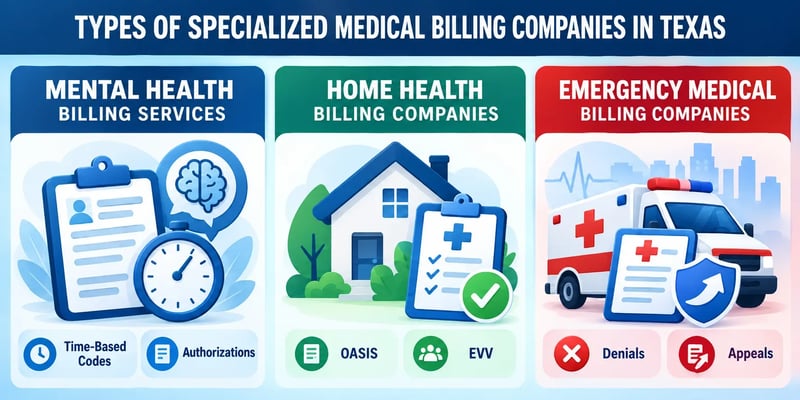
Types of Specialized Medical Billing Companies in Texas
Specialty billing is less about the codes themselves than about the rules wrapped around them, and three specialties in Texas carry rules strict enough to justify a specialist.
Mental Health Billing Services
Behavioral health claims live and die on time. Psychotherapy codes are chosen by minutes, with 90832 covering 16 to 37 minutes, 90834 covering 38 to 52, and 90837 covering 53 or more. McGovern Medical School's billing compliance office in Houston warns that psychotherapy is on Medicare's radar and that the record has to show start and stop times, or total time, plus the diagnosis and symptoms that support medical necessity. Payers add prior authorization on many services and review medical necessity closely, so a mental health billing company earns its fee by catching session-length mismatches and authorization gaps before the claim goes out.
Home Health Billing Companies
Home health billing runs on Medicare's Patient-Driven Groupings Model, which since January 2020 has paid agencies a standardized rate per 30-day period of care, with the case mix set by OASIS assessment items and claim data. That means an OASIS error changes the payment, not just the chart. Texas adds a Medicaid layer. Since January 1, 2024, Medicaid home health care services have required electronic visit verification, and a claim that does not match an EVV record does not pay. A home health billing company in Texas has to manage both systems at once.
Emergency Medical Billing Companies
Emergency billing carries the highest volume, the highest denial exposure, and the tightest balance-billing rules. The federal No Surprises Act bars balance billing for most emergency care, and Texas's own law covers state-regulated plans and the Employees and Teacher Retirement Systems. Providers can request arbitration through the Texas IDR portal between 20 and 90 days after the first claim payment.
Denial volume is the other half of the job. KFF found that HealthCare.gov insurers denied 19% of in-network claims in 2024 and that fewer than 1% of those denials were appealed, which is why an emergency billing company is judged on appeal turnaround more than anything else.
How to Choose a Medical Billing Company in Texas
Six checks, taken in order, separate a billing partner from a billing problem.
- Confirm experience with your specific specialty and payer mix. Ask how many clients the company bills in your specialty and which Texas Medicaid managed care plans, Blue Cross and Blue Shield of Texas, and Medicare through Novitas it works with every week, since those payers decide your cash flow.
- Check compatibility with your existing EHR and practice management system. The company should work inside your system or integrate with it, so charges flow out and payments post back without anyone retyping them. If you are replacing software at the same time, the guide to medical invoice software covers what that integration should look like.
- Ask about denial rates and average days in accounts receivable. Request the first-pass acceptance rate, denial rate, and days in A/R for clients like you, and ask how each is calculated, because the rates on vendor websites are often undefined.
- Review the fee structure and get it in writing before committing. Percentage of collections, per-claim, flat monthly, and hybrid models all exist in Texas, and the contract should define what counts as a collection, what is excluded, and what happens to claims in process when the contract ends.
- Verify the compliance track record. Ask for the business associate agreement, the written compliance program, and the date of the last coding audit, and look for HBMA compliance accreditation, which checks a billing company against HIPAA and the OIG's compliance program elements. An outside medical billing audit of your current claims before you sign gives you a baseline to hold the new vendor to.
- Request references from similarly sized Texas practices. Ask for two or three current clients in your specialty and size, and ask each one what happened the last time a payer changed a rule.

Medical Billing Companies by City: Houston and Dallas
Billing is remote work, but payer relationships and in-person support are local, and the two largest Texas metros are where many billing companies keep an office.
Medical Billing Companies in Houston, Texas
Houston's hospital and specialty-practice base, anchored by the Texas Medical Center, is one reason billing companies keep offices there. Companies with a Houston presence include MediBill RCM, headquartered on South Dairy Ashford Road, and Right Medical Billing, which appears in Google's local results for the city. The question to ask a Houston company is specific: which hospital systems and specialty groups it bills for now. Ask too how it handles accounts that cross between a hospital's facility billing and the physician's professional billing, since Houston practices generate both.
Medical Billing Companies in Dallas, Texas
Dallas-Fort Worth is home to many multi-location practice groups, which makes consolidated reporting across sites the first thing to ask a Dallas company about. BillingParadise keeps its corporate office in Dallas, MediCommerce is on Alpha Road in Dallas, Vigilant Medical Group is in Mesquite, and Transcure is in Farmers Branch. Ask how a company reports by location and by provider, and how it handles credentialing when a group adds a site. Then ask whether its denial work is done in Texas or routed elsewhere, which affects turnaround on the 120-day Medicaid appeal clock.
What Makes a Medical Billing Expert in Texas?
Credentials come first. Look for AAPC's Certified Professional Coder (CPC), whose exam runs 100 questions in four hours, and its Certified Professional Biller (CPB) for the billing side, and ask how many certified staff will touch your account. Tenure with Texas-specific rules comes second, and it is testable. A company that bills in Texas every day should be able to explain all six of these without looking them up:
- Prompt pay: under Texas Insurance Code Chapters 843 and 1301, a state-regulated carrier must pay, deny in writing, or pay the undisputed part of a clean claim within 30 days if filed electronically and 45 days on paper, and late payment carries penalties that scale with the delay.
- The 95-day clock: Texas Medicaid claims must be received within 95 days of the date of service, and appeals within 120 days of the last denial or adjustment.
- Itemized bills: since September 1, 2023, a provider must send the patient an itemized bill within 30 days of the final insurance payment before collecting a balance.
- Surprise billing: state-regulated plans fall under Texas law and its arbitration window, while self-funded employer plans fall under the federal No Surprises Act, and the company has to tell them apart from the ID card.
- EVV: Medicaid home health claims have to match an electronic visit verification record.
- The Medicare contractor: Texas Part A and Part B claims go through Novitas Solutions, which was awarded the Jurisdiction H contract again in June 2026.
Red flags are the mirror image: a vague answer on denial rates, no clients in your specialty, no written compliance program, and a fee quoted without a definition of collections. The OIG's compliance guidance for billing companies adds one more, warning that percentage billing arrangements may implicate the anti-kickback statute and may raise the risk of upcoding, so ask how the company pays its coders.
Frequently Asked Questions
How much do medical billing companies in Texas typically charge?
Most Texas companies charge a percentage of collections. One Texas vendor that publishes its rate, HPC Billing, lists 5% to 9% of net monthly collections as of September 2026. Per-claim, flat monthly, and hybrid fees are the usual alternatives for low-volume practices. Whatever the model, get the definition of a collection in writing, since that clause decides what you pay.
Do I need a billing company that specializes in my specialty?
Yes if your specialty has its own rulebook, and mental health, home health, and emergency medicine all do: time-based psychotherapy codes, 30-day periods with EVV matching, and balance-billing arbitration respectively. A family medicine or general practice can use a strong generalist, but ask any company how many clients it bills in your specialty and its denial rate for them.
Are there medical billing companies that handle multiple Texas locations?
Yes. Several Dallas-Fort Worth companies serve multi-site groups, and larger firms statewide will bill multiple locations under one contract. Ask for reporting by location and by provider, a credentialing process for new sites, and a single point of contact, since multi-location billing fails on coordination more often than on coding.
How do I switch medical billing companies without disrupting cash flow?
Run the two companies in parallel for one filing cycle. The old company keeps working its submitted claims, plus any appeals inside Texas Medicaid's 120-day window, while the new company takes every date of service from the cutover forward and files inside the 95-day limit. Put the handoff date, open-claim list, and return of your data in the exit terms.
How much do medical billers make in TX?
Texas Career Check, the Texas Workforce Commission's career information site, lists a 2024 statewide average wage of $24.53 an hour for medical records specialists, the federal job category that covers billers and coders. Pay rises with certification and with hospital work, and the fuller salary picture, including entry-level and certified ranges, is in the Texas careers guide linked above.
Choosing a Texas Billing Company for the Long Run
The right billing partner is a specialty and city fit as much as a price decision, and the six Texas rules above are the fastest way to tell the two apart. A company that can walk you through the prompt-pay clock, the 95-day Medicaid limit, and the itemized-bill rule without notes has done this work in Texas before. One that cannot will learn on your claims.
Vet denial rates, the fee definition, and the compliance program before you sign, because switching later costs a filing cycle of cash flow that the first contract could have protected.