How to Increase Your Operating Room Nurse Salary: Certifications, Skills and Career Moves

See if you qualify for training programs
Answer a few questions in 2 minutes. Free, no commitment.
Raising an operating room nurse salary comes down to three moves: earning a credential such as the CNOR, adding the skills surgical teams pay extra for, and changing roles or employers when the numbers justify it. OR nurses, also called perioperative or surgical nurses, start from the registered nurse pay scale, which had a median of $97,550 a year in May 2025, according to the Bureau of Labor Statistics (BLS). BLS doesn't track OR nurses separately, so that figure covers all RNs.
What you add from there is where the gaps open up. AORN's 2024 salary survey found staff perioperative nurses averaged $89,200 while nurses in director and vice president-level roles averaged $135,600, and registered nurse first assistants (RNFAs) average $113,214 on ZipRecruiter. The CNOR that unlocks the RNFA path and shortens the route to leadership credentials requires two years and 2,400 hours in the OR, so the timeline starts the day you're hired.
Key Points
- OR nurses earn RN-level pay, a $97,550 median in May 2025 according to BLS, while AORN's 2024 survey put the average staff perioperative nurse at $89,200 and leaders at $135,600.
- CNOR certification requires two years and 2,400 hours of perioperative experience and costs $475, and Payscale reports a $110,000 average base salary for CNOR holders.
- RNFAs average $113,214 on ZipRecruiter, about $18,600 more than its operating room nurse average, and the role requires CNOR, a bachelor's degree and an AORN-standard program.
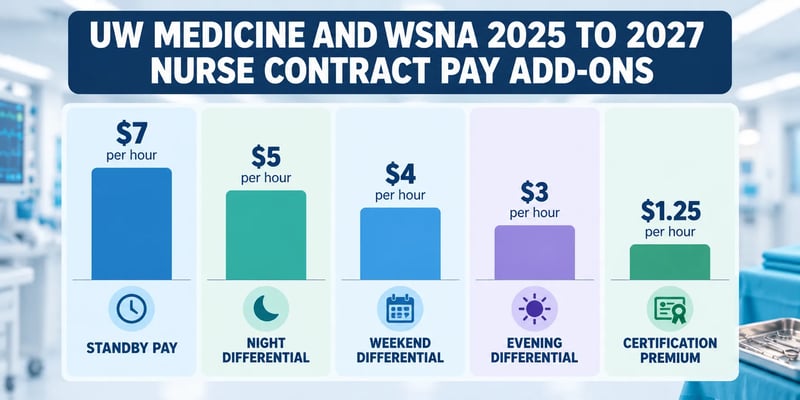
- Call pay, differentials and callback minimums stack on base pay: one 2025 to 2027 hospital contract pays $7 an hour on standby, $5 an hour for nights and a three-hour callback minimum at time and a half.
- Pay transparency laws in California, Washington, New York and Colorado require posted pay ranges, which gives you a benchmark before you negotiate.

How Much Does an Operating Room Nurse Make?
An operating room nurse makes about what other registered nurses make at the median: $97,550 a year, or $46.90 an hour, in May 2025, according to the BLS Occupational Outlook Handbook, which groups OR nurses with all RNs. The lowest 10% of RNs earn less than $68,940 and the highest 10% earn more than $137,470.
Specialty surveys land close to that baseline. AORN's 2024 Salary and Compensation Survey put the average staff perioperative nurse's income at $89,200, up $4,300 from 2023, according to its survey takeaways, while NCSBN's 2024 workforce survey found an $88,000 median for RNs overall. Job sites that track the OR nurse title add their own figures:
Source | Figure | What it measures |
|---|---|---|
BLS | $97,550 a year | Median wage for all registered nurses, May 2025 |
AORN | $89,200 a year | Average income of staff perioperative nurses, 2024 survey |
ZipRecruiter | $94,573 a year | Average for "operating room nurse" from job postings and third-party data, August 2026 |
Indeed | $2,298 a week | Average base pay for "registered nurse - operating room" from 91,800 salaries, September 2026 |
Salary.com | $88,800 a year | Median base salary for operating room nurses, October 2026 |
Vivian | $57.01 an hour | Average for staff OR circulating nurse postings, October 2026 |
Where OR pay pulls ahead of the median is in the extras. In AORN's 2025 survey, 77% of perioperative nurses received overtime pay, up from 70% a year earlier, according to its 2025 survey editorial, and Indeed's postings average $9,863 a year in overtime on top of base pay. AORN also notes that periop salaries have stayed at or below the inflation rate, which is why the levers below tend to matter more than annual raises.
Operating Room Nurse Hourly Wage
The median operating room nurse hourly wage is best read from the RN figure of $46.90, with the lowest 10% of RNs earning under $33.14 an hour and the top 10% earning more than $66.09. Job sites show the same spread: ZipRecruiter lists $45.47 an hour for OR nurses, and Payscale's self-reported profiles average $40.02.
Most of AORN's 2025 survey respondents were hourly employees, and for hourly nurses, call pay adds to the base rate directly. AORN's 2022 survey found a median on-call rate of $4.50 an hour, up from $3.50 in earlier surveys, and more than half of respondents earned time and a half when they were called in.
Operating Room Nurse Salary by State
BLS publishes state pay for RNs as a group, and the Pacific states lead:
State | Median RN salary | Median hourly wage |
|---|---|---|
California | $140,270 | $67.44 |
Hawaii | $136,320 | $65.54 |
Oregon | $129,010 | $62.02 |
Washington | $124,200 | $59.71 |
Alaska | $109,480 | $52.64 |
Source: BLS Occupational Employment and Wage Statistics, May 2025, all registered nurses.
AORN's surveys show the same pattern for OR nurses: in 2022, perioperative nurses in the Pacific region earned $21,000 more than the national average, and the 2025 survey again found higher salaries in the Pacific region. For every state's RN median, see our registered nurse salary guide.
Certifications That Pay Off
Certification is the first lever because the RNFA path requires it and the faster route to the CSSL runs through it. BLS puts it plainly: "Although certification is usually voluntary, it demonstrates adherence to a specific level of competency, and some employers require it." In Nurse.com's 2024 salary report, 40% of nurses who earned a certification said it resulted in a raise.
CNOR Salary and Requirements
The CNOR, from the Competency and Credentialing Institute (CCI), is the specialty's main credential, held by more than 40,000 nurses. To sit for the exam you need an RN license plus at least two years and 2,400 hours of perioperative experience, including 1,200 hours in the intraoperative setting, according to CCI's CNOR requirements. The application fee is $475 and includes the first exam attempt, retakes cost $175, and the credential lasts five years before recertification, which costs $400 in 2026.
CNOR holders report higher pay. On Payscale, nurses with the CNOR average $110,000 in base salary across 287 profiles, compared with $40.02 an hour, or about $83,200 a year at full time, on its general operating room nurse page, though the certification page spans every title CNOR nurses hold, managers included.
BetterComp, which builds pay ranges for employers, lists CNOR premiums of about 8% to 14% across the tables in its San Francisco OR nurse data, and some union contracts add a flat premium, such as the $1.25 an hour for certification in the UW Medicine and Washington State Nurses Association contract described below.
CFPN, CNAMB and CSSL
CCI offers three other credentials that match different career stages:
Credential | Who qualifies | Exam fee |
|---|---|---|
CFPN (Certified Foundational Perioperative Nurse) | RNs within their first 23 months in the OR who completed a perioperative orientation program | $250 |
CNAMB (Certified Ambulatory Surgery Nurse) | RNs with two years and 2,400 hours, including 500 intraoperative hours, working in ambulatory surgery | $400 |
CSSL (Certified Surgical Services Leader) | RNs with a bachelor's degree or higher and two years and 2,400 hours in surgical services management if they hold the CNOR, or four years and 4,800 hours without it | $425 |
The CSSL was called the CSSM until February 2026, when CCI renamed it, and it's the credential to target for the leadership roles that averaged $135,600 in AORN's 2024 survey. The CFPN matters for a different reason: AORN's 2025 survey analysis found that perioperative nurses see larger pay increases early in their careers than later, and the CFPN falls in exactly those years.
In-Demand Skills for Operating Room Nurses
These skills show up in higher pay ranges and contract premiums:
- Cardiovascular and other high-acuity service lines. Salary.com lists a $95,044 median for cardiovascular operating room (CVOR) nurses, compared with $88,800 for OR nurses overall, and BetterComp's San Francisco ranges put cardiothoracic OR nurses at $192,000 and neurosurgery OR nurses at $188,000, against $165,000 in ambulatory surgery centers.
- Scrubbing, circulating and robotics. Nurses trained in both roles can cover either assignment, and BetterComp's San Francisco ranges add premiums of 7% to 11% for robotic surgery certification.
- Charge and preceptor duties. Contracts pay for both: the UW Medicine and WSNA agreement adds $3 an hour for charge duty and $2 an hour for precepting.
- Call and overtime availability. In AORN's 2025 survey, 39% of perioperative nurses worked on call, and only 34% of those were required to, so volunteering for call is a direct way to add hours at premium rates.
Career Moves That Raise Income
The biggest raises in perioperative nursing come from changing roles rather than waiting on merit increases.
RN First Assistant (RNFA) Salary
An RNFA assists the surgeon directly, handling tissue, controlling bleeding and suturing, and the role pays accordingly. On ZipRecruiter, the average RNFA salary is $113,214 a year as of October 2026, with the 75th percentile at $127,000, compared with $94,573 for its operating room nurse title.
Getting there takes three things, according to AORN's position statement on RN first assistants: CNOR certification, a bachelor's degree and completion of an RNFA program that meets AORN's standards, which require at least 120 intraoperative first-assisting hours. North Carolina A&T State University's RNFA program, for example, lists tuition of $3,672 and up to a year to finish. After 2,000 practice hours, RNFAs can earn the CRNFA credential through the National Assistant at Surgery Certification.
Check your state before you invest, though. Medicare doesn't treat RNFAs as qualified providers for assistant-at-surgery billing, and AORN's list of state laws addressing RNFA reimbursement, last updated in 2017, covers 17 states, so look up your state's rules before you pay for a program.
Charge Nurse and OR Manager Roles
Charge duty is the first step on the ladder, and it often pays a flat premium such as the $3 an hour in the UW Medicine contract. Management is the bigger jump: Salary.com lists a $105,654 median for operating room nurse managers and $114,549 for senior managers as of October 2026, while AORN's 2024 survey put director- and vice president-level roles at $135,600.
BLS notes that management-level nursing positions increasingly require a graduate degree, which is where the CSSL and a master's degree come in, and our guide to the nursing career ladder maps each step. Graduate school opens an advanced practice path too: nurse practitioners earned a median of $132,300 in May 2025, according to BLS, as our nurse practitioner salary guide breaks down.
Travel Operating Room Nurse Salary
Travel contracts pay the most per week. The average travel operating room nurse earns $2,442 a week as of October 2026, and $2,954 a week in California, according to Vivian. AORN's 2023 survey found travel nurses earned $18,100 more a year than staff nurses.
Those weekly figures usually include tax-free stipends rather than taxable wages alone, so the trade-off is stability and a more complicated paycheck. Our guide to travel nurse pay explains how the packages are built.
Changing Employers and Settings
The same OR job pays differently depending on who runs the building. Hospitals pay RNs a $100,220 median, compared with $91,230 in ambulatory health care, according to BLS, though AORN's 2022 survey found that pay at freestanding surgery centers roughly matched hospital pay for perioperative nurses.
Public employers publish their differentials, which makes them easy to compare:
- The Department of Veterans Affairs pays nurses 10% extra for night shifts, 25% for weekends and double time on holidays, with on-call pay set at 10% of the overtime rate, under federal law. A VA operating room nurse posting in Hampton, Virginia, listed $83,487 to $153,496 a year in September 2026.
- The UW Medicine and WSNA contract for 2025 to 2027 pays $7 an hour on standby, a three-hour minimum at time and a half when called back, $3 for evenings, $5 for nights and $4 for weekends.
- San Mateo County, California, pays on-call nurses half their base hourly rate while on standby, with a three-hour overtime minimum per callback, under its 2022 to 2025 nurses' labor agreement.
The RNFA and the CSSL both require a bachelor's degree. Dreambound brings nursing programs from different schools together in one place, so if you hold an associate degree, you can compare BSN programs, including RN-to-BSN options, by format and length before you commit.
Negotiation Tips for Operating Room Nurses
Perioperative nurses have more to negotiate than base pay, and the data above gives you a starting point for each item:
- Get the range before the conversation. California requires every employer to give applicants the pay scale on request, and employers with 15 or more employees must include it in job postings. Washington's law covers employers with 15 or more employees, according to the state's Department of Labor and Industries, New York's covers employers with four or more, according to the New York Department of Labor, and Colorado's applies to any employer with a Colorado employee. In other states, ask for the range anyway.
- Negotiate the extras. Call pay, callback minimums, shift differentials, certification premiums and preceptor pay are all line items. AORN's 2025 analysis found that call pay was a source of dissatisfaction and that benefits such as 401(k) matches and tuition reimbursement had eroded since 2024, which makes them fair targets.
- Ask about a hiring bonus when you switch. In AORN's 2024 survey, 22% of perioperative nurses received a hiring bonus, and 63% of those bonuses were $10,000 or more. The share fell to 16% in 2025, so bonuses are available but no longer automatic.
- Time your ask to a credential. The two-year CNOR mark and RNFA completion are natural moments to renegotiate, and AORN's 2025 analysis found pay rises faster early in a perioperative career than later.
- Read the contract if you're in a union. Union members in health care practitioner and technical occupations earned median weekly pay of $1,605 in 2025, compared with $1,521 for nonunion workers, according to the BLS union membership release. Contract pay schedules, like the UW Medicine example above, spell out every differential in writing.
- Know how your overtime is calculated. Under federal rules, hospitals can use a 14-day "8 and 80" schedule that pays overtime after eight hours in a day or 80 in two weeks, but only with a prior agreement, so ask which system your employer uses before you take extra shifts.
Frequently Asked Questions
Is it hard to become an operating room nurse?
There's no separate license for the OR, but the specialty has its own training path. You first need an RN license through an associate or bachelor's degree program and the NCLEX-RN exam, then a perioperative orientation program, which CCI requires for its CFPN credential. The CFPN is available within your first 23 months, and the CNOR follows at the two-year, 2,400-hour mark. Our guide on how to become a registered nurse covers the licensing steps.
Where do operating room nurses make the most money?
California, where RNs earned a $140,270 median in May 2025 and the San Jose metro area reached $216,740, according to BLS data. AORN's 2022 and 2025 surveys both found the Pacific region paying above the national average for perioperative nurses, and Nurse.com's 2026 report found a $100,000 median RN salary in the West compared with $80,000 in the Midwest and South.
What does an operating room nurse do?
Operating room nurses care for patients before, during and after surgery. Broadly, circulating nurses manage the room, verify consent and counts, monitor the patient and document the case, while scrub nurses maintain the sterile field and pass instruments, and RNFAs assist the surgeon directly. Our comparison of registered nurses and surgical technicians explains how the nurse's role differs from the surgical technologist who works beside them.
Can you make $200,000 as a nurse?
Yes, in a few places and roles. The top 10% of California RNs earned more than $213,320 in May 2025, and the San Jose metro median was $216,740, according to BLS. Outside the Bay Area, the surest path is advanced practice: nurse anesthetists earned a median of $236,590 in May 2025, and perioperative leaders averaged $135,600 in AORN's 2024 survey.
Building Your Operating Room Nurse Pay Plan
The order of the moves matters more than any single one. The CNOR comes first because the RNFA requires it and it halves the experience the CSSL asks for, and its two-year clock starts on your first day in the OR. From there, pick the path that fits: first assisting for the biggest bedside raise, leadership for the highest ceiling, travel for the fastest weekly pay, or a public employer whose differentials are written into law.
Whichever you choose, walk into the negotiation with the posted range, the contract schedule and your credentials in hand.
If a bachelor's degree is the step between you and those roles, Dreambound lets you compare RN-to-BSN programs by format and length in one place.