Pediatric Nurse Job Outlook and Salary: Will Pay Keep Growing?

See if you qualify for training programs
Answer a few questions in 2 minutes. Free, no commitment.
The Bureau of Labor Statistics (BLS) projects about 180,800 openings for registered nurses each year through 2035, and pediatric nurses compete for those jobs with the same RN license as every other specialty. BLS doesn't count pediatric nurses as a separate group, so the clearest baseline for a pediatric nurse salary is the median RN wage: $97,550 a year, or $46.90 an hour, in May 2025.
Whether that pay keeps rising depends on more than the nursing shortage. Pediatric demand also follows how many children are born and how many hospitals keep pediatric units open, and both have fallen since the late 2000s. To work in the specialty, you need an RN license first, and you can add the Certified Pediatric Nurse (CPN) credential once you meet its experience requirement, such as 1,800 hours of pediatric RN work within two years.
Key Points
- BLS doesn't publish a separate pediatric nurse salary, so its $97,550 median for all RNs in May 2025 is the baseline, while salary sites estimate $34.95 to $52.64 an hour.
- The standard route to the CPN credential takes 1,800 hours of pediatric RN experience within 24 months, plus a $309 exam fee.
- RN employment is projected to grow 6% from 2025 to 2035, faster than the 3.5% average for all occupations.
- Utah, Nevada, and Idaho lead projected RN job growth through 2034, while California and Texas have the most openings each year.
- After adjusting for inflation, the median RN salary rose about 5% from May 2021 to May 2025, a much smaller gain than the 25.7% raise on paper.

How Much Does a Pediatric Nurse Make?
The closest benchmark for pediatric nurse pay is the median RN salary, because pediatric nursing is an RN specialty rather than a separate occupation. BLS reports a median RN salary of $97,550 in May 2025, with the lowest 10% earning less than $68,940 and the highest 10% earning more than $137,470, according to the BLS Occupational Outlook Handbook.
Salary sites that track pediatric job titles land on both sides of that figure, so the average pediatric nurse salary you see online depends on which site you check:
Source | Pediatric pay estimate | What it measures |
|---|---|---|
ZipRecruiter, "pediatric registered nurse" | $109,492 a year ($52.64 an hour) | Average from job postings and third-party data, October 2026 |
Salary.com | $85,400 a year ($41.00 an hour) | Average base salary, October 2026 |
Indeed, "registered nurse - pediatrics" | $39.53 an hour | Average base pay from reported salaries, October 2026 |
ZipRecruiter, "pediatric nurse" | $76,348 a year ($36.71 an hour) | Average from job postings and third-party data, October 2026 |
Payscale | $34.95 an hour | Average self-reported pay from 232 profiles, June 2026 |
The job title changes the answer more than you might expect. ZipRecruiter's pediatric registered nurse estimate runs $33,144 a year higher than its estimate for the "pediatric nurse" title. Since the two titles can describe different job postings, the RN-specific title and the BLS median make the better comparison points if you hold or plan to earn an RN license.
Pediatric Nurse Hourly Wage
The median RN hourly wage is $46.90, which works out to about $1,876 a week or $8,129 a month before taxes for a full-time nurse. Pediatric-title estimates range from $34.95 an hour on Payscale to $52.64 on ZipRecruiter.
Those hourly rates reflect base pay. BLS wage data leaves out overtime, shift differentials, and nonproduction bonuses, so a pediatric nurse who works nights, weekends, or extra shifts can take home more than the median suggests.
Pediatric Nurse Pay by Work Setting
Children's hospitals fall under the hospital category in BLS data, pediatricians' offices count as ambulatory health care, and school nurses fall under educational services. Here are the May 2025 RN medians by setting, along with each setting's share of RN jobs:
- Government, not counting public schools and hospitals: $110,780 (5% of RN jobs)
- Hospitals: $100,220 (59%)
- Ambulatory health care, including physicians' offices: $91,230 (19%)
- Nursing and residential care facilities: $84,300 (6%)
- Educational services, including schools: $78,620 (3%)
The gap between hospitals and schools comes to $21,600 a year, which is worth weighing if you're choosing between a children's hospital unit and a school nursing job.
Pediatric Nurse Job Outlook Through 2035
The job outlook for pediatric nurses follows the RN outlook, because BLS projects nursing jobs as a whole rather than by specialty. RN employment is projected to grow 6% from 2025 to 2035, from 3,465,400 jobs to 3,660,100, an increase of 194,700. That's faster than the 3.5% growth BLS projects for all occupations combined, according to its 2025 to 2035 employment projections.
Openings will far outnumber new jobs. BLS expects about 180,800 RN openings each year, on average, and it expects many of them to come from replacing nurses who retire or move into other occupations.
BLS cites an aging population and more patients with chronic conditions among the reasons for that growth. Those trends point mainly to adult care, so pediatric demand rests on a different set of factors, including birth rates and hospital decisions about pediatric beds.
Federal workforce projections also show a tight market that gradually loosens. The Health Resources and Services Administration (HRSA) projects a national RN shortage of 8% in 2028, easing to 3% by 2038, in its nurse workforce projections.
Every pediatric nursing career starts with an RN license. Dreambound is a marketplace that lists nursing programs from schools around the country, so you can compare RN programs in your area by format, length, and location before you apply.
Where Pediatric Nurses Are Most in Demand
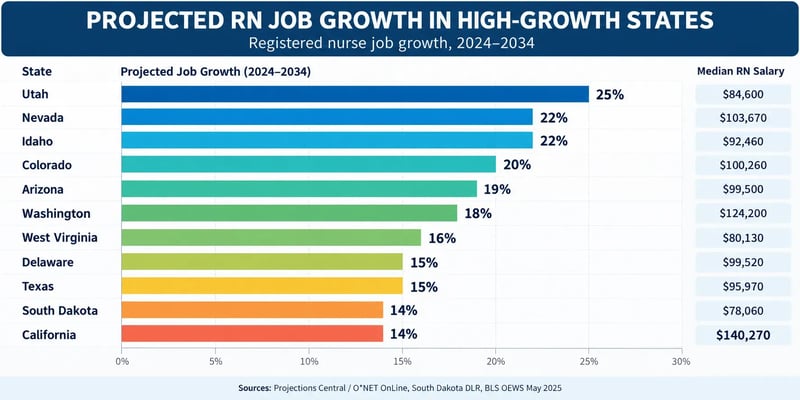
Nursing jobs are projected to grow fastest in the Mountain West and Southwest. State labor agencies project RN employment in Utah to grow 25% from 2024 to 2034, followed by Nevada and Idaho at 22% and Colorado at 20%, based on long-term projections published through O*NET OnLine. These figures cover all RNs, pediatric roles included.
Pediatric Nurse Salary by State in High-Growth Markets
Fast growth and high pay don't always go together. The 11 states with projected RN growth of 14% or more range from the highest median salary in the country to the third-lowest:
State | Projected RN growth, 2024-2034 | Median RN salary, May 2025 |
|---|---|---|
Utah | 25% | $84,600 |
Nevada | 22% | $103,670 |
Idaho | 22% | $92,460 |
Colorado | 20% | $100,260 |
Arizona | 19% | $99,500 |
Washington | 18% | $124,200 |
West Virginia | 16% | $80,130 |
Delaware | 15% | $99,520 |
Texas | 15% | $95,970 |
South Dakota | 14% | $78,060 |
California | 14% | $140,270 |
Sources: State long-term occupational projections, 2024-2034, via Projections Central and O*NET OnLine, with South Dakota's figure from the South Dakota Department of Labor and Regulation; BLS Occupational Employment and Wage Statistics, May 2025.
Utah has the fastest projected growth but ranks 31st among the 50 states for RN pay. California sits at the other end, pairing 14% growth with the highest RN median in the country and the most openings, about 22,890 a year. Texas follows with 17,710 openings a year, and our guide to becoming a pediatric nurse in Texas covers the state's training and certification steps.
Growth is slowest in Ohio and Louisiana, at 2% each, followed by Massachusetts and Rhode Island at 3%. For median pay in every state, see our RN salary guide.
Rural vs. Metro Demand
The nursing shortage looks very different outside cities. HRSA projects a 24% RN shortage in nonmetro areas in 2028, compared with 5% in metro areas, and the gap is still 11% versus 2% in 2038.
Rural areas have also lost pediatric capacity faster. Rural pediatric inpatient beds fell 26.1% from 2008 to 2018, more than twice the 11.8% national decline in pediatric inpatient unit beds over the same years, according to a 2021 study in Pediatrics. So while rural areas face the steepest nurse shortages, they have fewer pediatric beds to staff than they did in 2008.
How Pediatric Nurse Pay Has Changed Over Time
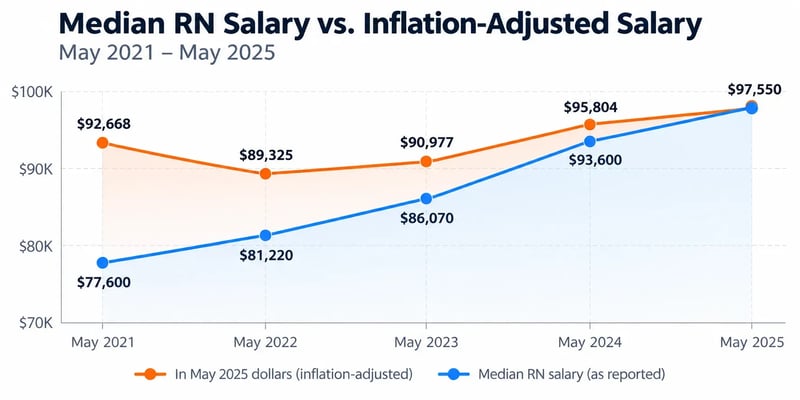
The median RN salary grew every year from May 2021 to May 2025, rising from $77,600 to $97,550, or 25.7%, in BLS data. Inflation took a large share of that raise. Consumer prices rose 19.4% over the same period, based on the BLS Consumer Price Index for All Urban Consumers (CPI-U), so the median RN's buying power grew about 5.3%.
Year (May) | Median RN salary | In May 2025 dollars |
|---|---|---|
2021 | $77,600 | $92,668 |
2022 | $81,220 | $89,325 |
2023 | $86,070 | $90,977 |
2024 | $93,600 | $95,804 |
2025 | $97,550 | $97,550 |
Sources: BLS Occupational Employment and Wage Statistics national estimates for RNs; inflation adjustment uses the May CPI-U for each year.
The numbers show two phases. In 2022, RN pay rose 4.7% while prices jumped 8.6%, so nurses lost ground in real terms. From 2023 to 2025, raises outpaced inflation every year, including a 4.2% increase in 2025 when prices rose 2.4%. BLS doesn't encourage using its wage survey for time-series analysis, so treat these figures as a trend line rather than exact annual raises.
Will Pediatric Nurse Pay Keep Growing?
BLS projects jobs, not wages, so the answer depends on which pressures win out. Several signals point to continued raises: about 180,800 RN openings a year, a national shortage that HRSA projects will last through 2038, and much steeper shortages in rural areas.
Other trends could weigh on pediatric pay, including fewer births and the closure of pediatric hospital units. HRSA's projected shortage also shrinks from 8% in 2028 to 3% in 2038, which could ease some of the pressure on wages. If the pattern from 2023 to 2025 holds, RN pay would keep edging ahead of prices.
What Could Change the Outlook for Pediatric Nurses
Pediatric nursing depends on factors that adult specialties don't share, and three of them are worth watching.
Births and the Child Population
U.S. births totaled 3,606,400 in 2025, down 1% from 2024, based on provisional CDC data. The general fertility rate dropped to 53.1 births per 1,000 women ages 15 to 44, and it has fallen 23% since 2007.
The child population is shrinking, too. The U.S. Census Bureau estimated 72.0 million people under 18 in July 2025, 2.4% fewer than in April 2020, while the population ages 65 and older grew 16.2%. A smaller child population doesn't erase pediatric jobs, but it does mean pediatric demand isn't growing with an aging population the way adult nursing demand is.
Pediatric Unit Closures
Hospitals have been consolidating children's inpatient care. The number of pediatric inpatient units in U.S. hospitals fell 29.9% from 2008 to 2022, from 1,749 to 1,226, and pediatric beds dropped 19.5%, according to a research letter in JAMA Pediatrics. Adult units declined just 4.4% over the same period.
Not every part of pediatrics shrank. The 2021 Pediatrics study found that PICU beds grew 16.0% from 2008 to 2018, even as beds on general pediatric inpatient units declined. That means a larger share of the remaining pediatric beds are intensive care beds, where nurses care for the sickest children.
Medicaid and Children's Hospital Finances
Medicaid and the Children's Health Insurance Program (CHIP) covered 35.0 million children and other CHIP members in June 2026, according to Medicaid.gov. The Children's Hospital Association reports that Medicaid covers about half of children's hospitals' patients, which ties those hospitals' budgets closely to Medicaid payment policy.
The 2025 budget reconciliation law changed several Medicaid rules, and the Congressional Budget Office estimated it would increase the number of uninsured people by 10 million in 2034, as summarized by KFF.
Children aren't subject to the law's new work requirement, which applies to adults ages 19 to 64 in the Medicaid expansion group, and parents or caretakers of children 13 and younger are exempt. Hospital finances could still shift as states put the changes in place.
How Pediatric Nurses Can Earn More
Pediatric nurses can raise their pay through credentials, specialty units, location, and advanced practice:
- Earn the CPN. The Pediatric Nursing Certification Board requires 1,800 hours of pediatric RN experience in the past 24 months, or at least five years as a pediatric RN with 3,000 pediatric hours in the past five years, including 1,000 in the past 24 months. The exam costs $309, and recertification is annual.
- Ask how employers reward certification. Pay bumps vary by employer, and in Nurse.com's 2024 salary report, 40% of nurses who earned a certification said it led to a raise.
- Move into a specialty unit. The PICU and pediatric emergency department are where Pediatric Advanced Life Support (PALS) training comes in, so check local job postings to see whether employers require it, and compare PALS classes near you.
- Follow the pay map. California's RN median of $140,270 is the highest in the country, and Washington ranks among the top five at $124,200 while being projected to add RN jobs quickly.
- Become a pediatric nurse practitioner. NPs earned a median of $132,300 in May 2025, and BLS projects NP jobs to grow 41% from 2025 to 2035. About 3% of NPs hold their main certification in pediatrics, according to the American Association of Nurse Practitioners, and our breakdown of NP pay by experience shows how that salary grows over a career.
Frequently Asked Questions
How long does it take to become a pediatric RN?
You first need an RN license, which means finishing an approved nursing diploma, associate degree, or bachelor's degree program and passing the NCLEX-RN exam. After that, the standard CPN route requires 1,800 hours of pediatric RN work within 24 months, which is a little less than a year of full-time hours. Our guide on how long it takes to become a pediatric nurse lays out each stage.
Can you make $200,000 as a nurse?
Yes, in the highest-paying markets. In the San Jose metro area, the median RN salary was $216,740 in May 2025, and the San Francisco-Oakland-Fremont median was $186,610, according to BLS data published through O*NET. Nationally, the top 10% of RNs earned more than $137,470, so a $200,000 salary usually takes a high-wage metro, an advanced practice role, or extra shifts.
What kind of pediatric nurse makes the most money?
Advanced practice nurses earn the most. Nurse anesthetists earned a median of $236,590 in May 2025, and some specialize in pediatric anesthesia, while NPs as a group, including pediatric nurse practitioners, earned $132,300. Among bedside roles, BLS data shows government and hospital jobs paying the highest RN medians, at $110,780 and $100,220.
Is it hard being a pediatric nurse?
It can be. Pediatric nurses adjust medication doses and care plans for patients ranging from newborns to teenagers, explain treatment to worried parents, and care for seriously ill children. Our look at the pros and cons of pediatric nursing covers the daily demands in more detail.
Planning a Pediatric Nursing Career for the Long Run
Pediatric nurse salary growth rides on the broader RN market, which BLS expects to keep adding jobs through 2035, but the specialty has its own pressure points in birth rates, unit closures, and Medicaid funding. The pay levers you control are the ones that stay scarce: a CPN credential, experience in higher-acuity units, an advanced practice degree, and a willingness to work where states are projected to add nursing jobs fastest.
If you're still working toward your RN license, Dreambound lets you compare nursing programs by format, length, and location before you choose one.