Pharmacy Technician Requirements: What You Need to Get Started
See if you qualify for Pharmacy Technician programs
Answer a few questions in 2 minutes. Free, no commitment.
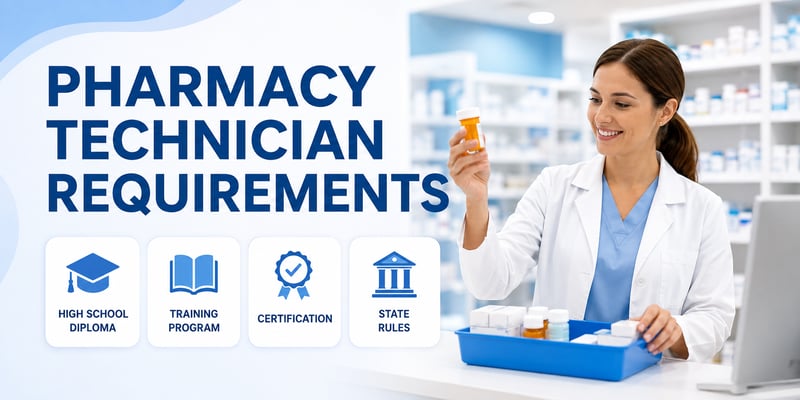
What does it take to be a pharmacy technician? Pharmacy technician requirements usually include a high school diploma or equivalent, on-the-job training or a short postsecondary program, and registration or a license with your state board of pharmacy, which can involve a criminal background check, according to BLS. Some states and employers also require national certification.
The details depend heavily on where you work. Illinois registers technicians from age 16, while New York requires you to be 18 and already certified.
Key Points
These pharmacy tech requirements apply in most of the country, with state rules layered on top:
- Pharmacy technicians typically need a high school diploma or equivalent, according to BLS.
- Most states regulate pharmacy technicians in some way, usually through registration or a license with the state board of pharmacy.
- Eighteen states require CPhT certification, according to PTCB.
- PTCB's exam is open to anyone who completes a PTCB-recognized training program or logs at least 500 hours of pharmacy technician work.
- In NHA's 2026 Industry Outlook, 77% of pharmacy technician employers said they require certification, and another 14% said they encourage it.

What Do You Need to Be a Pharmacy Technician?
At minimum, you need a high school diploma and some training. Most states also require registration or a license, and some require national certification. These are the main pharmacy tech qualifications, drawn from BLS licensing data and state board rules:
Requirement | What it means | Source |
|---|---|---|
Education | High school diploma or equivalent | BLS |
Training | On-the-job training or a certificate program; many take a year or less | BLS |
Background check | Listed among typical state requirements | BLS |
State registration or license | Issued by your state board of pharmacy | BLS, state boards |
National certification | PTCE or ExCPT, where your state or employer requires it | BLS, PTCB |
Minimum age | Varies by state, such as 16 in Illinois and 18 in New York | State boards |
Pharmacy Technician Education Requirements
The pharmacy technician schooling needed to get started is a high school diploma or equivalent, according to BLS. From there, some technicians learn on the job, while others complete a certificate program, and many programs award a certificate after a year or less. Some programs last longer and lead to an associate degree.
How much schooling to be a pharmacy technician is enough? That depends on your route and your state. Florida and Pennsylvania require a Board-approved training program, and Ohio accepts only certain types of training programs for registration.
Accredited programs are about to change, too. The ASHP/ACPE accreditation standard, effective Jan. 1, 2027, requires a minimum of 400 hours: 100 in the classroom, 50 in simulation, and 120 of hands-on experience, with the remaining 130 assigned by each program. It also replaces separate entry-level and advanced programs with a single level.
Program length shapes how soon you can start working, and our guide to how long pharmacy tech training takes compares the timelines for each route.
Do You Need a Degree to Be a Pharmacy Technician?
No. BLS lists a high school diploma or equivalent as the typical education for the job. You'll sometimes see programs marketed as a pharmaceutical technician degree, and an associate degree in pharmacy technology is one way to qualify in California, but it's one option among several rather than a requirement.
Pharmacy Technician Certification Requirements
The certified pharmacy technician requirements come from the two national certifying bodies, and both focus on training or work experience. Here's how their eligibility rules compare:
Requirement | PTCB (PTCE) | NHA (ExCPT) |
|---|---|---|
Training route | PTCB-recognized program, or finishing one within 60 days of applying | Training program completed within the last 5 years |
Work route | At least 500 hours as a pharmacy technician | 1 year and at least 1,200 supervised hours within 3 years |
Education | Not listed in PTCB's pathways | High school diploma or GED, or earning one within 12 months |
The table reflects PTCB's CPhT eligibility rules and NHA's ExCPT requirements as published in November 2026.
Exam formats, fees, and renewal rules are a separate topic, and our guide on how to get pharmacy technician certification or a license covers them step by step.
Do You Need a License to Be a Pharmacy Technician?
In most states, yes. According to BLS, most states regulate pharmacy technicians in some way, and typical pharmacy tech license requirements include some or all of the following:
- High school diploma or equivalent
- Formal education or training program
- Exam
- Fees
- Continuing education
- Criminal background check
- Minimum age requirement
These rules also change. Hawaii is a recent example: under Act 93, its technicians have needed a certificate of registration with the Board of Pharmacy since Jan. 1, 2026, according to a Hawaii Board of Pharmacy memo.
Can You Work as a Non-Certified Pharmacy Technician?
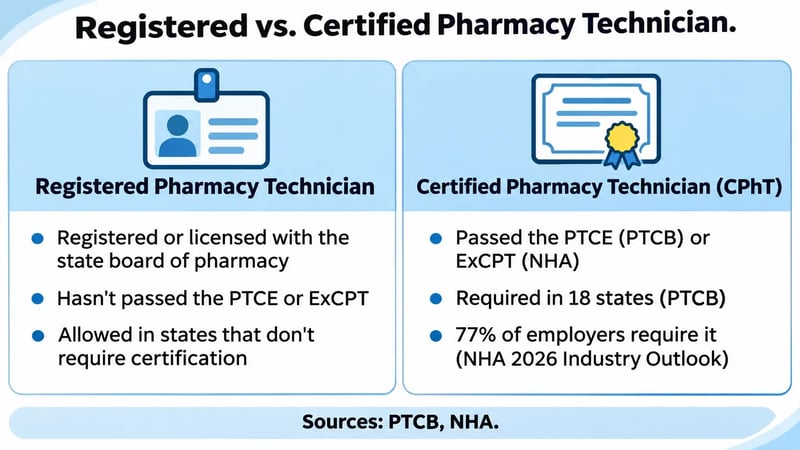
Can I be a pharmacy tech without certification? Yes, in states that don't require it, as long as an employer is willing to hire you. A non-certified pharmacy technician is a technician who is registered or licensed with the state but hasn't passed the PTCE or ExCPT.
North Carolina, Georgia, and Pennsylvania register technicians without a certification exam, while Texas and New York require it. Across the country, 18 states require CPhT certification, according to PTCB's credential statistics, and in NHA's 2026 Industry Outlook, 77% of pharmacy technician employers said they require it. Even where it isn't required, certification may make it easier to get a job, BLS adds.
Pharmacy Technician Requirements by State
Pharmacy technician state requirements differ most in whether certification is required and what it costs to apply. The 10 states below account for a little over half of all pharmacy technician jobs in the U.S., based on BLS OEWS employment data for May 2025.
State | Board issues | Certification required? | Fee |
|---|---|---|---|
Registration (technician or trainee) | Yes, for technicians | $88 ($55 trainee) | |
License | One way to qualify | $120 | |
Registration | No; approved training instead | $105 | |
License | Yes (PTCB or NHA) | $175 | |
Registration | Not for registered status | $40 | |
Registration | No; approved training instead | $30 | |
Registration (3 types) | Not for registered status | $65 ($45 trainee) | |
Registration | No | $30 | |
Registration | No | $100 | |
License | Exam required | $137.70 |
Fees are each board's application fee as listed in November 2026. Texas fees took effect Sept. 1, 2025, California's on Jan. 1, 2025, and Ohio's on Sept. 30, 2025. Michigan's fee covers a two-year license.
A few states add rules a table can't capture. Illinois technicians must add a Certified or Student designation by their second renewal. Michigan accepts a PTCB, NHA, or approved employer-program exam and offers a one-year temporary license for $15.30 while you prepare. In Texas, a trainee registration can be issued only once, can't be renewed, and expires two years after it's issued, under Texas Administrative Code Rule 297.3.
Our guides on becoming a pharmacy technician in California and pharmacy technician steps in Texas walk through two of the largest markets step by step.
Pharmacy Technician Job Requirements From Employers
Employers can set their own expectations beyond state rules, and screening can start before you're hired. City College of San Francisco, for example, requires a background check and drug test before placing pharmacy technician students in an externship.
Certification is the other big expectation. BLS notes that some employers require pharmacy technicians to be certified, and that employers may pay for employees to take the certification exam.
Two large retailers put this in writing. The Walgreens pharmacy tech apprenticeship covers PTCB training and the PTCE for trainees, and Walmart says it pays for associates to become certified pharmacy technicians, with more than 22,000 associates certified since 2016. PTCB's 2025 survey of pharmacy technicians also points to a 6.3% rise in employer-based training programs.
Frequently Asked Questions
What are the basic requirements to become a pharmacy technician?
Most pharmacy technicians need a high school diploma or equivalent, training on the job or through a program, and registration or a license with their state board of pharmacy. Some states and employers also require national certification through the PTCE or ExCPT.
Can you be a pharmacy tech at 17?
In some states, yes. Florida, Georgia, and Ohio set the minimum age at 17, and Illinois allows registered pharmacy technicians from age 16. New York requires you to be at least 18, so check your own board's age rule before you apply.
Do you need schooling to be a pharmacy tech?
You need a high school diploma or equivalent, but not a college degree. Some states, including Florida and Pennsylvania, require a Board-approved training program, while others let you train on the job.
What disqualifies you from being a pharmacy tech?
A criminal history can, since BLS lists a criminal background check among typical state requirements. Texas, for example, weighs felonies, drug-related offenses, theft or fraud involving drugs, and sex offender registration under the Texas board's criminal offense guidelines, with outcomes ranging from a reprimand to probation or denial. Each board applies its own rules, so ask yours if you have a record.
Do requirements differ by state?
Yes, quite a bit. Certification is required in Texas and New York, while Florida and Pennsylvania require approved training instead. Application fees in the 10 states with the most pharmacy technician jobs run from $30 in North Carolina and Pennsylvania to $175 in New York.
Matching a Pharmacy Technician Program to Your State
Because training rules vary, it helps to choose a program in the state where you plan to work. Dreambound lists programs in several of the states covered above:
- Texas: Southern Careers Institute's Pharmacy Technician program is taught in person at campuses in Brownsville, Corpus Christi, Pharr, and San Antonio and prepares you for the CPhT exam.
- California, Arizona, Idaho, New Mexico, and Washington: Carrington College's Pharmacy Technology program runs at campuses in each of these states, and the school is accredited by the Accrediting Commission for Community and Junior Colleges.
- Nevada, Texas, and California: Asher College's Pharmacy Technician program is taught in person at its Las Vegas campus, prepares you for the PTCE, and includes a 130-hour externship.
- Florida: Northbridge University's Pharmacy Technician diploma is offered in person in Tampa, Kissimmee, and Pembroke Pines.
- Online: CCI Training Center's pharmacy technician course and Ultimate Medical Academy's online A.S. program let you study from home.
Meeting the Requirements for Pharmacy Technician Work
The requirements for pharmacy technician work start the same almost everywhere, with a diploma and some form of training, and then split by state. Your board decides the rest, so look up its rules before you commit to a program.
Once you know what your state expects, compare pharmacy technician programs on Dreambound and choose one that fits those rules and your schedule.