Surgical Tech Certification: CST vs TS-C and How to Earn One
See if you qualify for Surgical Technician programs
Answer a few questions in 2 minutes. Free, no commitment.
Surgical tech certification comes from two national credentials: the Certified Surgical Technologist (CST) from the National Board of Surgical Technology and Surgical Assisting (NBSTSA), and the Tech in Surgery-Certified (TS-C) from the National Center for Competency Testing (NCCT). Both require passing an exam, and the one you can sit for depends on how you trained. Some states require a credential, and employers can ask for one even where the state does not.
Certification is separate from training. A program teaches the work, the exam tests it, and CST eligibility depends on finishing an accredited program first. For a look at the job itself, see what a surgical technician does day to day. Fees and eligibility below come from NBSTSA's 2026 candidate handbook and application, NCCT's current pages, and the statutes cited in each section.
Key Points
- The CST exam has 175 multiple-choice questions, 150 of them scored, with a 4-hour limit and a passing score of 98.
- The TS-C exam fee is $199, and the first-time CST exam costs $340 ($230 for members of the Association of Surgical Technologists).
- CST candidates generally need a CAAHEP- or ABHES-accredited program; NCCT accepts NCCT-authorized programs and an experience route.

Do You Need Surgical Technologist Certification?
Sometimes. Whether you need surgical technologist certification depends on the state and the employer, and the three state rules Dreambound has reviewed read very differently.
New York has the clearest credential rule. Its Public Health Law says a person may not work as a surgical technologist in a healthcare facility, and a facility may not employ one, unless the person finished a nationally accredited program and holds a certified surgical technologist credential from a nationally accredited credentialing organization. Healthcare facilities here means general hospitals and hospital-run diagnostic and treatment centers that offer ambulatory surgery. Military training, a one-year work-history exception tied to the law's start date, and federal service are listed as alternatives, and a graduate may work for 12 months before documenting the credential. The guide on what New York law requires of surgical technologists adds the local detail.
In Texas, Health and Safety Code Chapter 259 bars a licensed or state-owned health care facility from employing a person to practice surgical technology unless that person completed an accredited program and holds certification from NBSTSA, NCCT, or another certification program the state approves. Exceptions cover military training, people employed in the field before September 1, 2009, and federal service. A facility that documents a diligent search and cannot find enough qualified technologists has a further exception, and new graduates may work for 180 days before showing certification. The guide to how Texas handles surgical tech employment walks through the state's process.
Colorado works differently. The state's Division of Professions and Occupations runs an Office of Surgical Assistant and Surgical Technologist Registration, so working there involves state registration, which is separate from national certification. The guide to how Colorado registration works for surgical technologists covers that process.
This page does not state rules for other states. Check with the state health department or the facility that would hire you.
CST vs TS-C: How the Two Credentials Compare
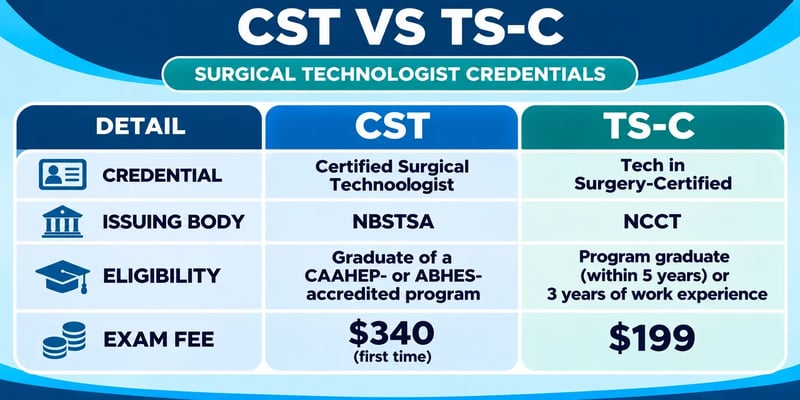
The CST and the TS-C both show that a surgical technologist passed a national exam. They differ in who issues them, who can sit for the exam, and what each costs.
Detail | CST (NBSTSA) | TS-C (NCCT) |
|---|---|---|
Full name | Certified Surgical Technologist | Tech in Surgery-Certified |
Exam format | 175 questions, 150 scored, 4 hours, computer-based, passing score 98 | Not published on the NCCT pages reviewed; confirm with NCCT |
Exam fee | $340 first time ($230 for AST members); $300 retake | $199 |
Education route | Graduate of a CAAHEP- or ABHES-accredited program, a military surgical technology program, or a current or previous CST | Current student or graduate (within 5 years) of an NCCT-authorized program, plus a skills competency form |
Experience route | None listed in the 2026 handbook | 3 years of full-time, verifiable work as a surgical technologist within the past 5 years |
Sources: NBSTSA CST page and 2026 candidate handbook; NCCT TS-C page and route sheet.
The program you attend settles most of the choice. CST eligibility is tied to CAAHEP or ABHES accreditation, while the TS-C graduate route is tied to NCCT-authorized programs. Texas names both NBSTSA and NCCT in its statute. New York names neither and refers to nationally accredited credentialing organizations.
What Is the TS-C (NCCT) Certification?
The TS-C is NCCT's surgical technologist credential, and its exam page lists a $199 exam fee. NCCT's route sheet names six ways to qualify: current student, graduate, experience, high school, military, and instructor. The graduate route requires finishing an NCCT-authorized program within the past five years. Four of the six routes require a skills competency form, and the student, graduate, and high school routes require case documentation within two years. NCCT does not publish exam length or passing score on the pages Dreambound reviewed.
Eligibility Requirements for Each Exam
NBSTSA accepts graduates of surgical technology programs accredited by CAAHEP or ABHES, graduates of a military surgical technology training program, and current or previous CSTs. Proof of graduation is a diploma, a transcript, or a notarized letter on official school letterhead; military applicants submit a DD214 or a Joint Services Transcript. NBSTSA makes the final eligibility decision and does not refund processing fees when an applicant is found ineligible.
Accreditation decides which exam you can sit for, so check it before choosing a program. CAAHEP's directory of accredited programs lists programs that are currently accredited or hold a Letter of Review.
How Do You Get Your Surgical Tech Certification?
To become a certified surgical technologist on the CST route, follow these six steps in order, because NBSTSA reviews eligibility before you can schedule a test. The national steps to become a surgical tech cover the whole path from program to job; these steps cover the certification part.
- Choose an accredited program. Look for a surgical technology program accredited by CAAHEP or ABHES.
- Graduate. Finish the program and keep a diploma, a transcript, or a notarized letter on official letterhead that shows your graduation date and degree.
- Apply to NBSTSA. Submit the application, proof of graduation, and the fee.
- Wait for the Authorization to Test (ATT) email. NBSTSA sends it after approving the application.
- Schedule the exam. Book with PSI, NBSTSA's testing agency, online through the link in the ATT email or by phone, within your six-month eligibility period.
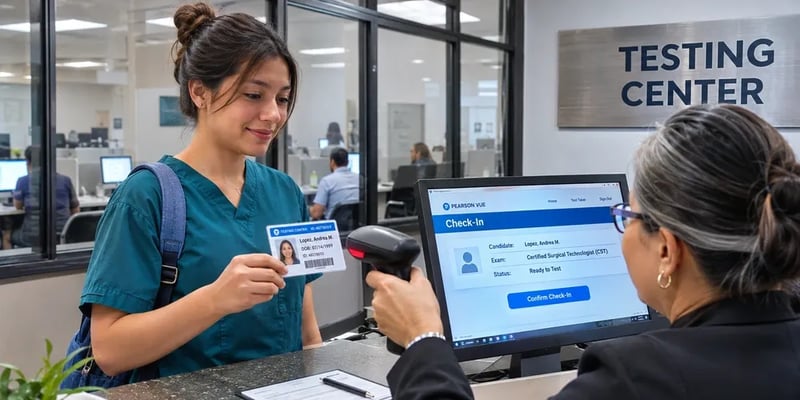
- Take the exam. Bring two current forms of identification, one with a photo, matching the name on the ATT email.
How Long Does It Take to Get Certified?
Getting certified takes as long as your program lasts, plus the time to apply, get approved, and test. Dreambound's guide to how long surgical tech training takes compares program lengths, so this page does not restate them. After approval, PSI offers exam appointments year-round, Monday through Saturday at 9 a.m. and 1:30 p.m. A candidate may reschedule once at no charge by calling PSI at least 48 hours ahead, and the new date must fall inside the six-month eligibility period.
Can You Get Surgical Tech Certification Online?
Not fully online. The coursework may be online, but the CST exam is not, because NBSTSA schedules it at PSI testing centers by appointment. CST eligibility also depends on graduating from a CAAHEP- or ABHES-accredited program, so an online course outside those accreditations does not meet the program route. If you are weighing how to get CST certification through an online program, confirm the accreditation first, and see what online surgical tech coursework includes.
CST Exam: Format, Passing Score, and What to Expect
The CST exam from NBSTSA has 175 multiple-choice questions and runs 4 hours on a computer. Of the 175 questions, 150 are scored and 25 are unscored pretest items mixed into the exam. The passing score is 98, the minimum number of scored questions answered correctly, according to the NBSTSA CST certification page.
Content area | Scored items | Share |
|---|---|---|
Perioperative Care | 97 | 65% |
Ancillary Duties | 23 | 15% |
Science content | 30 | 20% |
Source: NBSTSA 2026 CST candidate handbook, examination content outline.
On test day, candidates sign a roster and show two forms of identification that match the name on the ATT email. A candidate may take the exam up to three times in a calendar year, with a new application and the full fee each time.
What Does Certification Cost, and What Does Renewal Cost?
According to NBSTSA's 2026 candidate handbook, the first-time CST exam costs $340, or $230 for members of the Association of Surgical Technologists (AST). Of the total, $100 is a non-refundable application processing fee. A retake costs $300, and a rush option adds $85 for first-time candidates. The TS-C exam fee at NCCT is $199.
Renewing a CST costs $40, or $140 with the $100 late fee when the application arrives 1 to 90 days after expiration. Renewal by examination costs $540. NBSTSA moves its continuing education platform on January 5, 2027. Certifications expiring from January 5 through May 31, 2027 are pointed to transition options on the NBSTSA renewals page, and expiration dates do not change. NBSTSA sets the certification cycle and the continuing education credits required, so confirm both there. Check NCCT for TS-C renewal terms.
Frequently Asked Questions
Is certification required to work as a surgical tech?
Surgical tech certification is a legal requirement in some states, such as New York and Texas, and an employer can ask for it even where the law does not. Colorado uses state registration, which is separate from national certification. Dreambound's guides cover surgical technologist rules in New York, Texas surgical technologist requirements, and Colorado surgical technologist registration.
Can you take the CST exam without graduating from an accredited program?
Yes, but only through two routes: completing a military surgical technology training program, or being a current or previous CST. Work experience alone is not a listed CST route. The TS-C from NCCT is different, with an experience route of three years of full-time, verifiable surgical technologist work within the past five years.
Does surgical tech certification expire?
Yes, the CST expires and has to be renewed through NBSTSA. Renewal costs $40, or $140 when filed 1 to 90 days after expiration. Continuing education credits cannot be earned after expiration, so a candidate without them applies to recertify by examination at $540. NBSTSA sets the cycle length, so confirm it there.
How much do surgical techs get paid?
Surgical technologists earned a median of $64,650 a year in May 2025, according to the U.S. Bureau of Labor Statistics (Occupational Outlook Handbook, updated August 27, 2026). BLS does not publish pay by credential. For percentiles, hourly rates, and workplace differences, see what surgical techs earn by percentile, hourly rate, and workplace.
Your Next Step Toward a Surgical Tech Credential
Confirm accreditation before anything else, because it decides which exam you can sit for. Then compare programs by length, cost, and location, starting with Dreambound's guide to comparing surgical tech programs by type, state, and city. Dreambound is a marketplace, not a school, so eligibility and exam results rest with NBSTSA or NCCT, not with any program listing.