Types of Medical Billing Explained

See if you qualify for Medical Billing and Coding programs
Answer a few questions in 2 minutes. Free, no commitment.
Medical billing is not one single process. It splits into a few distinct types depending on who is being billed, what kind of care was provided, and how the provider gets paid. The two categories every biller learns first are professional billing, for an individual clinician's services, and institutional billing, for a facility's charges. Payment models, the inpatient versus outpatient line, and how a billing system shares records add three more layers. Which type applies is written on the claim itself, in the form, the transaction, and the type-of-bill code.
Key Points
- The two main categories are professional billing, an individual provider's services on the CMS-1500 or 837P, and institutional billing, facility charges on the UB-04 or 837I.
- Billing systems are also described as open or closed, based on whether patient records and billing data are shared across providers or kept within one practice.
- Payment models vary too: fee-for-service, capitation, bundled payments, and value-based care all bill differently, and fee-for-service still brings in about two-thirds of physician practice revenue.
- Inpatient and outpatient billing follow different rules, payment groups, and documentation, starting with whether a doctor formally admitted the patient.

Professional Billing vs. Institutional Billing
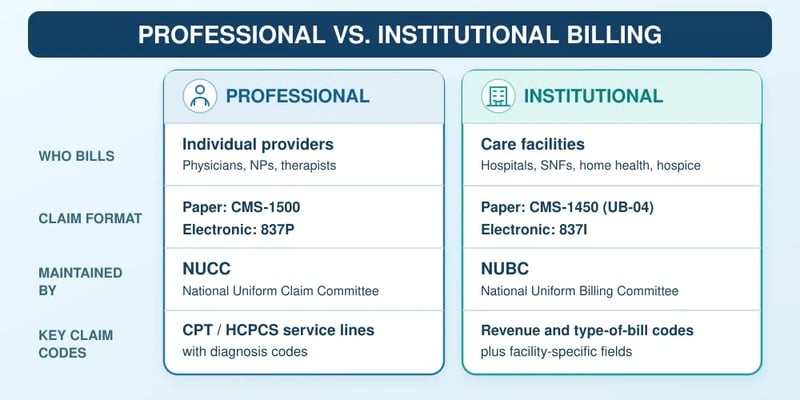
The first split in medical billing is between the person who provided the care and the place where it happened, and Medicare treats the two as separate claim types with different forms and different data.
Professional Billing
Professional billing is how physicians, nurse practitioners, therapists, and other individual providers bill for their services. The paper form is the CMS-1500, which the National Uniform Claim Committee (NUCC) designs and maintains, and the electronic version is the 837P, currently version 5010A1, according to the CMS guide Medicare Billing: 837P and Form CMS-1500 (December 2025). Medicare requires electronic filing unless the provider holds a waiver, so the paper form is now the exception. Each service goes on its own line as a CPT or HCPCS code, with the diagnosis codes that support it.
Institutional Billing
Institutional billing covers charges from the facility itself: hospitals, skilled nursing facilities, home health agencies, and hospice organizations. The paper form is the CMS-1450, better known as the UB-04, and the electronic version is the 837I. The National Uniform Billing Committee (NUBC) maintains the code sets. The CMS guide Medicare Billing: 837I and Form CMS-1450 (December 2025) lists the codes an institutional claim carries that a professional claim does not: revenue codes, type of bill, condition codes, occurrence codes, value codes, and discharge status.
This is where facility fees live. When a patient has surgery at a hospital, the surgeon's work goes out on a professional claim, and the operating room, nursing, supplies, and room charges go out on the institutional claim.
Feature | Professional billing | Institutional billing |
|---|---|---|
Who bills | Individual providers and suppliers: physicians, nurse practitioners, therapists | Facilities: hospitals, skilled nursing facilities, home health, hospice |
Claim form and transaction | CMS-1500 on paper, 837P electronically | UB-04 (CMS-1450) on paper, 837I electronically |
Maintained by | National Uniform Claim Committee (NUCC) | National Uniform Billing Committee (NUBC) |
What the claim carries | CPT and HCPCS service lines with diagnosis codes | Revenue codes, type of bill, condition, occurrence, and value codes, discharge status |
Open Medical Billing vs. Closed Medical Billing
A closed billing system keeps a patient's billing and records inside a single practice or facility, while an open system lets records and billing information move between the providers involved in that patient's care. The terms come from billing-software vendors rather than from CMS or HIPAA, so there is no regulatory definition, though regulators do measure the underlying idea as interoperability.
Closed systems are common in solo and small practices, with one record and one billing workflow. Open systems fit larger health systems, where an office visit, a referral, imaging, and a hospital stay all need to reconcile against the same record. The Office of the National Coordinator for Health IT describes interoperability as the secure exchange of electronic health information among authorized users. Its 2023 hospital survey found 70% of non-federal acute care hospitals sending, receiving, finding, and integrating outside records at least sometimes, though only 43% did so routinely.
Vendors often add a third label, the isolated system, but they do not agree on what it means. Some use it for a standalone system that connects to nothing else, others for a partially open system that shares records only within a defined network such as a hospital group. If the term comes up in a job posting, ask which one they mean.
Types of Medical Billing by Payment Model
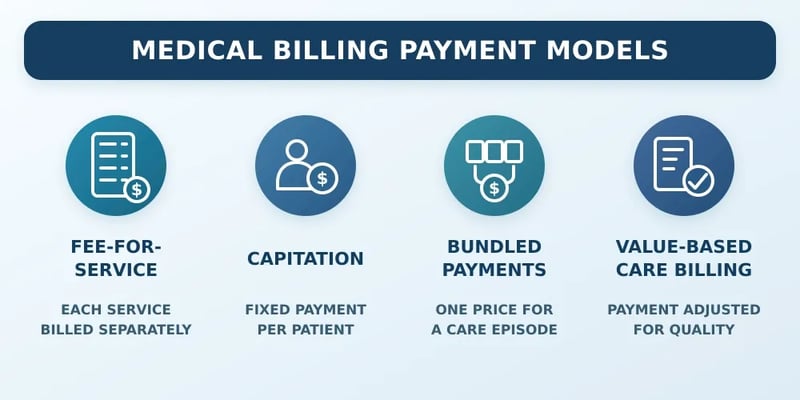
Payment models change what a claim asks for. Under fee-for-service, every service is billed and paid on its own, while the alternatives fix payment per patient, bundle it per episode, or adjust it by quality results.
Fee-for-Service
Fee-for-service is the traditional model and still the most common: the provider bills separately for each visit, test, and procedure, and the payer reimburses each line. The American Medical Association's 2024 Physician Practice Benchmark Survey found 82.8% of physicians in practices that received some fee-for-service payment, with two-thirds of total practice revenue coming from it.
Capitation
Capitation pays a fixed amount per patient for a set period, usually per member per month, regardless of how many services that patient uses. Billers still submit encounter data, but payment does not rise with volume. Medicare Advantage is the best-known example: MedPAC reports that Medicare pays plans a capitated rate for the beneficiaries in those plans, 54% of eligible beneficiaries in 2024.
Bundled Payments
A bundled payment covers everything tied to one episode of care, such as a joint replacement and the recovery that follows, under a single target price instead of unrelated payments for the surgeon, the hospital, and the follow-up. Medicare's BPCI Advanced model bundled the 90 days after a hospital discharge or outpatient procedure and ended on December 31, 2025.
The current Medicare model is the mandatory Transforming Episode Accountability Model (TEAM), which runs from January 1, 2026 through 2030. It gives hospitals in selected metro areas a target price for five surgical episodes, each ending 30 days after the patient leaves the hospital. Hospitals keep billing Medicare fee-for-service as usual, and CMS compares actual spending to the target price afterward.
Value-Based Care Billing
Value-based billing ties part of the payment to quality and outcome measures rather than volume. CMS says its value-based programs reward providers "with incentive payments for the quality of care they give to people with Medicare." The list includes:
- The Hospital Value-Based Purchasing Program
- The Hospital Readmissions Reduction Program
- The Hospital-Acquired Condition Reduction Program
- Value-based purchasing for skilled nursing facilities and home health agencies
Claims still go out line by line, but reimbursement is adjusted afterward based on reported measures, so documentation quality changes what the claim pays.
Inpatient Billing vs. Outpatient Billing
Inpatient billing applies once a doctor formally admits a patient, and outpatient billing covers everything else, including an overnight stay in observation. Medicare's rule draws the line: "You're an inpatient starting when you're formally admitted to the hospital with a doctor's order," according to Medicare.gov. Emergency department services, observation, outpatient surgery, lab tests, and X-rays stay outpatient until an admission order is written.
Under Medicare, inpatient stays are paid through the Inpatient Prospective Payment System, where CMS assigns each case to a diagnosis-related group and multiplies a base rate by that group's weight. The codes on the claim set the payment for the whole stay. Outpatient services are paid through ambulatory payment classifications, groups of clinically similar services that share one payment rate, as MedPAC describes them. Medicare Part A pays the inpatient claim, including related outpatient services from the 3 days before admission, while Part B pays outpatient hospital services and the doctor's professional claim in either setting.
On the institutional claim, the type-of-bill code tells the payer which setting it is looking at. Noridian, a Medicare Administrative Contractor, explains it as a four-digit code: a leading zero, a digit for the facility type, a digit for the type of care, and a frequency digit for where the claim falls in the episode. The three you will see most often:
- 0111: hospital inpatient, admit through discharge, the standard Part A inpatient claim.
- 0131: hospital outpatient, the claim behind an emergency visit, an observation stay, or a same-day procedure.
- 0211: skilled nursing facility inpatient, the Part A claim for a covered nursing facility stay.
How Medical Billing Relates to Medical Coding
Coding and billing are two steps in the same revenue cycle, not two names for one job. Coding translates the documentation from a visit into standardized codes: ICD-10-CM for diagnoses, CPT and HCPCS for procedures and supplies, and ICD-10-PCS for inpatient hospital procedures. Billing takes those codes and turns them into a claim, chooses the right form and type of bill, submits it, works the payer's response, and posts the payment.
Many people hold both roles in a small practice, but the claim is only as accurate as the codes it is built on. The guide to what medical billing and coding is walks through the code-to-claim workflow. If you are still deciding whether the career fits, the pros and cons of medical billing and coding cover training time, pay, and the daily work.
Frequently Asked Questions
What is the difference between professional and institutional billing?
Professional billing covers an individual provider's services and goes out on the CMS-1500 form or its electronic version, the 837P, while institutional billing covers a facility's charges and goes out on the UB-04 (CMS-1450) or the 837I. Institutional claims also carry fields professional claims do not, including revenue codes and a type-of-bill code.
What is a closed medical billing system?
A closed medical billing system keeps a patient's billing data and records within one practice or facility, with no sharing across outside providers, which suits solo and small practices. An open system shares records and billing across the providers involved in a patient's care, and vendors sometimes add a third label, isolated, though their definitions of it vary.
What is the most common medical billing payment model?
Fee-for-service, where each service is billed and paid separately. The AMA's 2024 Physician Practice Benchmark Survey found 82.8% of physicians in practices receiving fee-for-service payments, which supplied two-thirds of practice revenue, while 62.4% also reported some alternative-payment revenue.
Is inpatient billing more complex than outpatient billing?
Usually, yes. An inpatient claim covers an entire admission, is paid as one diagnosis-related group under Medicare Part A, and carries ICD-10-PCS codes for any procedures, a type-of-bill code, and a discharge status. One coding choice can change the payment for the whole stay. Outpatient claims are paid per service through ambulatory payment classifications under Part B.
Is medical billing the same as medical coding?
No. Coding converts a provider's documentation into ICD-10-CM, CPT, and HCPCS codes, and billing uses those codes to build, submit, and follow up on the claim. They are separate steps in the same revenue cycle, and while one person often does both in a small office, larger organizations split them into different teams with different certifications.
Knowing Which Type of Billing Applies to a Claim
Most real billing work touches more than one of these categories at once. A single hospital admission produces a professional claim for the surgeon and an institutional claim for the facility, is paid as an inpatient diagnosis-related group under Part A, and may sit inside a bundled episode or a value-based adjustment. Reading the claim tells you which rules apply: the form gives you professional or institutional, the type-of-bill code gives you the setting, and the contract behind it gives you the payment model.
If you are weighing the career rather than a claim, this vocabulary is what training programs teach first, and Dreambound lists medical billing and coding programs you can compare by length, format, and cost.