What Is an Orthodontic Assistant? Duties, Salary, and How to Become One
See if you qualify for training programs
Answer a few questions in 2 minutes. Free, no commitment.
An orthodontic assistant is a dental assistant who works specifically alongside an orthodontist, supporting patients through braces, clear aligners, and other treatment that straightens teeth and corrects the bite. It is a more specialized role than general dental assisting, built around the repeat adjustment visits that orthodontic treatment requires rather than the fillings, cleanings, and exams of a general practice.
Many orthodontic assistants start out as dental assistants and learn the wire and bracket work on the job, though a few states now issue their own orthodontic assistant permit. The sections below cover what the role involves day to day, how it differs from general dental assisting, certification, and pay.
Key Points
- Orthodontic assistants support orthodontists specifically, working on braces, aligners, and bite correction rather than general dental care.
- Many orthodontic assistants start as general dental assistants and specialize through on-the-job training or a dedicated orthodontic assisting course.
- Certification is not universally required but can improve job prospects, and DANB offers a Certified Orthodontic Assistant (COA) credential built on its Orthodontic Assisting (OA) exam.
- Pay is generally comparable to or slightly above general dental assisting, reflecting the added specialization.
What Is an Orthodontic Assistant?
An orthodontic assistant is a chairside dental assistant employed by an orthodontic practice rather than a general dental office. Orthodontists, as the Bureau of Labor Statistics puts it, straighten teeth by applying pressure to the teeth with braces or other appliances, and that work has its own visit pattern, tools, and patient education.
The federal government does not track the job as a separate occupation. BLS groups orthodontic assistants with dental assistants, and O*NET lists Orthodontic Assistant as a reported job title under that occupation, which is why the pay data and licensing rules for this job are mostly dental assistant data and rules.
What sets the role apart is continuity, since an orthodontic assistant follows the same patient from the first consultation through active treatment and into retention. The field is also smaller than most people expect: BLS counted 7,100 orthodontists in 2025 against 388,600 dental assistants, so orthodontic openings are a narrow slice of the dental assisting market.
What Does an Orthodontic Assistant Do?
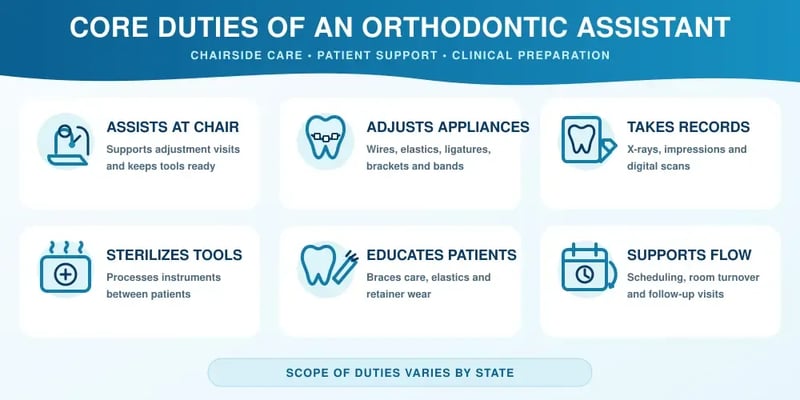
Most of the day is spent at the chair, and most of the chair time is spent on adjustments, because braces need periodic tightening and aligner patients come back for checks and new trays. The duties follow that rhythm:
- Placing and removing brackets and bands in states that allow assistants to do so.
- Changing archwires, elastics, and ligatures at adjustment visits, with the orthodontist checking the work.
- Taking impressions or digital scans for aligners and retainers.
- Preparing and sterilizing orthodontic instruments between patients.
- Educating patients on oral hygiene with braces or aligners and on wearing elastics and retainers.
- Taking x-rays where state regulations allow it.
- Supporting scheduling and patient flow, since orthodontic patients return for adjustments far more often than general dental patients do.
Which of those tasks an assistant may perform, and how closely the orthodontist must supervise them, is set by each state's dental practice act. California's permit, for example, covers sizing and securing bands, curing brackets once the dentist approves their position, and placing and ligating archwires.
Orthodontic Assistant vs. Dental Assistant: What's the Difference?
The difference is scope. A general dental assistant supports a wide range of procedures across a general practice, from cleanings and fillings to extractions and exams. An orthodontic assistant works on one kind of treatment, organized around the recurring, adjustment-focused visits that braces and aligners create.
The two roles share a foundation, though. Infection control, radiography, charting, and chairside habits are the same in both offices, which is why many orthodontic assistants begin their careers as general dental assistants before specializing. The dental assistant vs. dental hygienist comparison covers the other common fork in a dental office.
Area | Dental assistant | Orthodontic assistant |
|---|---|---|
Procedures | Cleanings, fillings, crowns, extractions, exams | Braces, aligners, retainers, bite correction |
Visit pattern | Occasional, varied appointments | Recurring adjustment visits over months or years |
Signature tasks | Passing instruments, suction, x-rays, sterilization | Brackets, bands, archwires, scans, aligner checks |
Credential | DANB's CDA | DANB's COA, plus a state permit in a few states |
How to Become an Orthodontic Assistant
There is no single required path, but the most common one runs through general dental assisting first and then into an orthodontic practice, where the specialized skills are learned on the job.
Step 1: Train or Work as a Dental Assistant
Complete a dental assisting program or gain general dental assisting experience. The American Dental Association counts about 240 CODA-accredited programs, most of them nine to eleven months long, and the accelerated certificates listed on Dreambound run about 12 weeks.
According to DANB, most states also let you start as an entry-level assistant with no formal education and learn on the job. Either way, this is where you pick up radiography, infection control, and chairside basics.
Step 2: Get Hired Into an Orthodontic Practice
Seek entry-level positions specifically at orthodontic practices. The path is open to general assistants, and in states that permit on-the-job training it can be open to people with no dental background. A dental assisting certificate, a radiography credential where your state requires one, and current CPR cover the parts of the job that every state regulates, so they are worth having before you apply.
Step 3: Build Orthodontic Skills on the Job
Learn the orthodontic-specific work in the orthodontic setting itself. Working with wires, brackets, and aligner systems is not part of a general dental assisting curriculum, so the practice teaches it, and bands and archwires come last. Where a state regulates the role, the board spells that out: Oregon, for example, requires a dentist to sign off on 10 supervised archwire placements.
Do You Need Certification to Be an Orthodontic Assistant?
Formal certification is not universally required. State requirements vary the same way they do for general dental assisting, and BLS notes that states typically do not require licenses for entry-level dental assistants. Two things change that picture.
DANB's Certified Orthodontic Assistant (COA)
The Dental Assisting National Board offers a Certified Orthodontic Assistant credential built for this job. It combines two component exams, Orthodontic Assisting (OA) and Infection Control (ICE), into a single 215-question, 165-minute test. DANB's 2026 application packet lists the fee at $450, or $320 for the OA exam alone, each including a $75 application fee, and the certification renews annually.
Two of the four eligibility pathways cover the typical routes. One is 3,500 hours of orthodontic assisting experience accrued over two to four years and verified by a licensed orthodontist or dentist, open to anyone with a high school diploma. The other is a current DANB CDA plus an orthodontic assisting course at a CODA-accredited program.
The credential can strengthen a candidate's qualifications and, in some practices, open the door to expanded duties.
States With Their Own Orthodontic Assistant Credential
A handful of states go further and name the role in their own rules. Four examples, three of which build on DANB's exams:
- California's Dental Board issues an Orthodontic Assistant Permit. The permit requirements in California include a board-approved orthodontic assistant course of at least 84 hours for non-RDAs, infection control and Dental Practice Act courses, current BLS, fingerprinting, a $120 fee, and a written exam. The permit statute, as updated in January 2025, covers aligner buttons and attachments as well as brackets and archwires. The California dental assistant guide covers the state's RDA license, which shortens the permit course to 55 hours.
- New Jersey offers a limited registration in orthodontics. Applicants pass DANB's COA exam plus its Topical Fluoride and Coronal Polish exams, and they need either a CODA-accredited program within the past 10 years or two years of work as a dental assistant under an orthodontist's supervision.
- Oregon certifies Expanded Function Orthodontic Dental Assistants through DANB, per the Oregon Board of Dentistry, and a dentist must certify that the applicant placed and ligated archwires on 10 patients and removed bands, brackets, and adhesive from four. The Oregon dental assistant guide shows where that track sits among the state's other certificates.
- Maryland recognizes dental assistants as qualified in orthodontics after a board-approved course of at least 35 hours and DANB's orthodontic exam, with a $20 certification fee.
Outside states like these, the orthodontic role sits under the general dental assistant rules, so the credential you may need is the one for x-rays or expanded functions rather than a separate orthodontic one.
How Long Does It Take to Become an Orthodontic Assistant?
Plan on a few months to about a year to become a dental assistant, then several more months of on-the-job specialization before you handle wires and brackets on your own. Programs run from about 12 weeks for an accelerated certificate to nine to eleven months for a CODA-accredited program, and the dental assistant timeline guide shows how radiography and CDA certification add to that.
The other route is faster to start and slower to finish. Entering an orthodontic practice directly as an entry-level assistant and training fully on site is common, and in many states it requires no separate program, but the specialized knowledge then arrives one procedure at a time. DANB's experience pathway sets the bar: 3,500 hours over at least two years before you can sit for the COA.
How Much Does an Orthodontic Assistant Make?
Because BLS does not separate orthodontic assistants from other dental assistants, the government figure for the job is the dental assistant median: $48,070 a year, or $23.11 an hour, as of May 2025. The lowest-paid 10% earned under $37,130 and the highest-paid 10% earned more than $62,250, and employment is projected to grow 7% from 2025 to 2035, with about 53,000 openings a year.
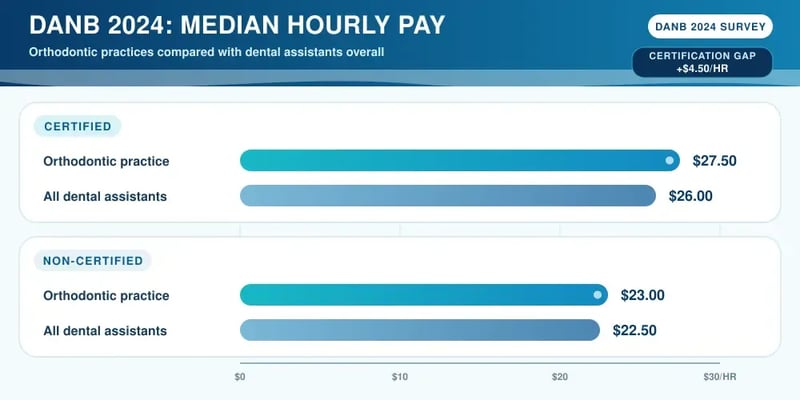
The one source that does separate the two roles is DANB's 2024 Dental Assistants Salary and Satisfaction Survey, and it shows a small premium for orthodontics. Certified assistants in orthodontic practices reported a median of $27.50 an hour, compared with $26.00 for certified dental assistants overall, and non-certified orthodontic assistants reported $23.00 against $22.50.
Both gaps are modest, so the fair description of orthodontic assistant pay is comparable to or slightly above general dental assisting.
Three things move an individual figure more than the specialty does. Experience shows up in the $25,000 spread between the 10th and 90th percentiles, and geographic market shows up in Florida, where the same dental assistant job pays a median of $57,260 in Naples and $46,480 in Orlando.
Certification matters most of all, because the DANB survey puts the certified-to-non-certified gap inside orthodontics at $4.50 an hour, three times the $1.50 orthodontic premium for certified assistants.
Skills Needed to Succeed as an Orthodontic Assistant
The technical bar is manual dexterity and attention to detail, because the hardware is small. Ligatures are tied one tooth at a time, brackets are positioned to the millimeter, and an archwire seated slightly wrong shows up as a sore spot a week later.
The second bar is communication. Many orthodontic patients are children and teens, and the American Association of Orthodontists reports that one in three is an adult, so an assistant may coach a nervous 12-year-old and a busy professional in the same afternoon. Treatment spans months to years, so the rapport built at the first visit has to last.
The third is comfort with repetitive, precision-focused chairside work. Adjustment days are a steady sequence of short, similar appointments, and the assistants who stay in orthodontics are the ones who find that pace satisfying rather than monotonous.
Frequently Asked Questions
Do you need to be a dental assistant before becoming an orthodontic assistant?
No state requires it, but it is the most common route because the infection control, radiography, and chairside basics carry over. DANB's COA experience pathway needs only a high school diploma plus 3,500 hours of orthodontic assisting, and New Jersey accepts two years under an orthodontist in place of a dental assisting program.
Do orthodontic assistants get paid more than dental assistants?
Slightly, according to DANB's 2024 salary survey. Certified assistants in orthodontic practices reported a median of $27.50 an hour against $26.00 for certified dental assistants overall, and non-certified orthodontic assistants reported $23.00 against $22.50. BLS does not separate the two roles, so its $48,070 median covers both.
How much does an orthodontic assistant make in Florida?
Florida does not report orthodontic assistant pay separately, so the closest figure is the state's dental assistant median of $47,620 a year, or $22.89 an hour, per BLS data for 2025. Pay runs higher in Naples-Marco Island at $57,260 and Jacksonville at $50,270, and near the state median in the Miami, Tampa, and Orlando metros.
How long does orthodontic-specific training take once hired?
Plan on months rather than weeks before you handle wires and brackets on your own, since the timeline depends on the practice and, in regulated states, on the board. DANB's COA experience pathway calls for 3,500 hours over at least two years, and Oregon requires sign-off on 10 archwire placements and four debonds.
Do you need a degree to be an orthodontic assistant?
No. A high school diploma or equivalent is the baseline, and the usual credential is a dental assisting certificate or diploma from a program of about a year, or on-the-job training in a state that allows it. An associate degree is optional, and the credentials tied to the role are DANB's COA and, in a few states, a permit.
Is Orthodontic Assisting Your Next Step?
Orthodontic assisting is a specialized branch of dental assisting, and most of the specialization is learned at the chair rather than in a classroom. That makes it a natural next step for a dental assistant who wants to focus on one kind of treatment.
Certification through DANB's COA is available to strengthen your qualifications, and in California, New Jersey, Oregon, and Maryland the state credential is part of the job rather than an extra.
If the role fits, the first decision is the dental assisting program that gets you into a practice, and Dreambound's dental assistant listings let you weigh a short certificate against a longer diploma before you commit.